While texture describes the percent of each sand, silt and clay, soil structure is the organization of these individual soil particles into a larger arrangement. The size and orientation of the particles affect acceptance and treatment of wastewater in the soil.
Soil structure develops over time, typically many hundreds to thousands of years, through physical and chemical weathering. Examples of forces forming soil structure include freeze and thaw cycles, wetting and drying, plant rooting and invertebrate activity. Some of these processes are physical or chemical such as the binding of materials to clay particles, freezing and thawing, wetting and drying, and root pressure. Other forces are biological such as the organic glues that are excreted by fungi and bacteria while decomposing organic material and by polymers and sugars excreted from roots. Larger organisms, such as insects and earthworms, enhance soil structure when they burrow through the soil and deposit waste which assists in structure formation. These forces are concentrated in the upper portion of the soil generally within three to five feet of the surface.
MAKING AN IMPACT
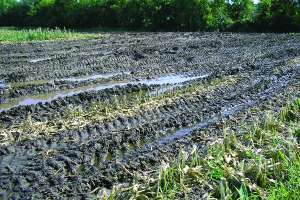
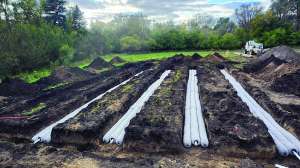
Areas where the soil has been disturbed commonly have impacted soil structure. This includes areas that have been cut, filled, compacted or disturbed in any way. When severe these sites will have difficulty in accepting effluent. These areas can sometimes be identified by wheel tracks, hummocks, stunted vegetative growth or incorporated debris. Normal agricultural and forestry uses do not constitute disturbed areas unless they are high-traffic areas or severely eroded areas.
Compacted soils have less space for air and water movement, which impacts microorganism presence, oxygen levels, pore space and moisture levels. The space for air and water to travel between the particles is referred to as the porosity of the soil. When the amount of pore space is reduced, or low-porosity, it becomes difficult for the soil to function properly. Low-porosity leads to improper water drainage and overall, less mobility for things like air, water and soil organisms underground.
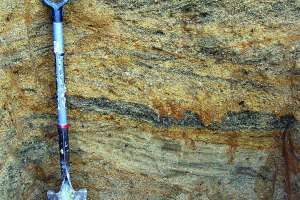
Fill soils are soils that have been moved by mechanical means and deposited in a new location. Fill soils commonly have stratified layers or different colored and textured materials. These layers have abrupt boundaries. If you are concerned you may have fill soils, be sure to check the soil survey report as they are often, but certainly not always, mapped as urban land.
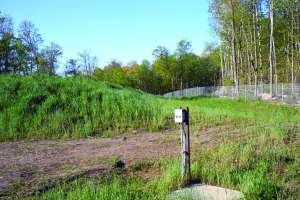
When soils with textures other than clean sand (like for a mound or combined treatment and dispersal) are moved to a new location, the soil structure is impacted, which allows the silts and clays to migrate when water is added. This loss of pore space and restricted water movement between the different layers ultimately results in water movement problems in the soil, which can be severe. This also creates challenges in determining water table depth. With fill soil, the soil color cannot be used as an indication of the water table depth. Fill soil colors are characteristic of where it was excavated from, not that of its present location. Carefully considering the natural soils, landscapes and vegetation is key to correctly identifying the limiting conditions on these sites.
MOVING FORWARD
What should you do if the soil treatment area structure was damaged prior to installation?
Determine if another area exists on the property with undamaged structure. Placing the new septic system in this location is typically the easiest and most cost-effective solution.
Determine the severity of the damage — Is it just at the surface or does the damage go deep into the soil profile? Several soil pits should be dug across the site to evaluate the extent and depth of the problem. Run percolation or other similar hydraulic tests to determine the impact of the structure damage.
Once the structure is negatively impacted, it can never be “natural.” There is little that can be done to artificially recreate good structure. There are techniques used in agriculture to rebuild soil structure that could potentially be utilized for septic systems. The challenge is these practices take time which is not something we often have with septic systems installation.
BRINGING IT BACK
Overcoming soil compaction starts with breaking up the compacted zone with shearing under dry soil conditions. If the problem is compaction in the upper 12 inches of the site breaking that layer up by subsoiling such as with a chisel plow (when the soil is dry) may alleviate some of the challenges particularly for above-grade systems but deeper depths may be needed depending on the depth of compaction or fill.
Mechanical processes work to physically aerate the soil and return it to its pre-impact porosity. Soil structure is enhanced with flocculation which brings the soil mineral particles together. Flocculation is enhanced by polyvalent cations on the exchange sites. So divalent cations like calcium and magnesium are good for this first stage and can be found in calcite, dolomite lime or gypsum.
Structural stability can be improved by adding a substance that serves as a binding agent. Commonly a source of organic material is added or naturally occurs from farming. The organic material assists with retaining more water and nutrients for plant uptake. Compost, the most common soil amendment, contains a mixture of organic matter that enhances soil structure, infiltration rate, plant root growth and water-holding capacity and reduces soil compaction. Iron and aluminum oxides can also be added as binding agents.
Structural stability can also be improved through biological (worms and other soil organisms) and mechanical aeration, mechanical loosening (tilling) and planting dense vegetation. Methods include aeration, mechanical loosening (tilling) and densely planting vegetation. Vegetation has been used to break up compaction and assist with structure formation primarily in farming applications. Examples of crops that can be used to break compacted soil layers include forage radish, annual ryegrass, canola, sunflower, sorghum-sudan and turnip. Similarly, rotations where crops with shallow rooting follow crops with deeper rooting systems or rotating annuals with perennials (for example, alfalfa after annual vegetables) is another tool for managing soil compaction and improving soil health.
Soil structure is easy to damage and hard to repair. Care should be taken to choose sights that have good soil structure and protect that during the installation process. When the only location to build a septic system has damaged soil structure, experimental methods can be tried to build back soil structure but they take a plan and time to achieve results.