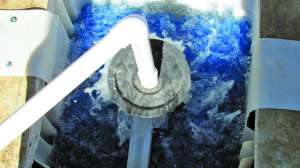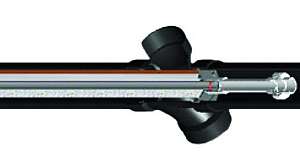
Everyone seems to know it: Effluent filters at septic tank outlets help extend drainfield life. And a water meter upstream in the house can provide information that helps the owner prevent hydraulic overload.
But does anyone care to guess what percentage of onsite treatment systems have effluent filters? Water meters? Both? My hunch is that the rough answers would be: A fairly high number, mighty few, and next to none.
Why should that be?
Proven benefits
This issue of Onsite Installer includes separate articles that make a compelling case for both these simple tools. Matt Byers and Randy Dyer argue that the industry needs to promote effluent filters to homeowners and regulators alike.
Albert Royster, meanwhile, looks beyond water meters that simply measure total mass flow into the home toward newer technologies that could measure actual flow down the house sewer lateral. That’s obviously a truer way to measure what actually flows to the septic tank and ultimately to the drainfield.
The technology Royster talks about is perhaps somewhat futuristic. The basic concept of water meters in homes with septic systems has been around for years. It just doesn’t seem to get applied very often in practice.
So one has to ask: Why would an installer who wants to serve customers well not install an effluent filter and a water meter? Two of the greatest dangers to an onsite system are drainfield plugging and hydraulic overload. A filter helps prevent one and a water meter helps prevent the other. Neither is costly. So why not include them?
Social resistance
Byers and Dyer argue that many homeowners consider effluent filters a nuisance — they can plug prematurely and they require maintenance. As for water meters, I can’t prove it, but I believe many homeowners want no part of anything that restricts their water usage. They never had such restrictions when they lived in the city (unless they lived in an arid, water-scarce region). So why should they have them in the country?
It therefore seems the resistance to effluent filters and water meters has to do not with science or technology but with social factors. That doesn’t make the resistance less real. In fact, it probably makes it tougher to overcome. We human beings are stubborn creatures, espe-cially when it comes to being asked to change our comfortable habits.
So what’s to be done? It’s hard to argue with what Byers and Dyer suggest, which is that the onsite industry has to take the lead. Why the industry? Because who else will? There is no possibility of anyone else taking up this challenge.
Who is the industry?
And what does taking up the challenge mean? It means industry members and associations working to move regulators in the direction of these simple accessories. But it also means individual installers showing leadership in their markets.
A dentist friend of mine decided some years go that he was going to care for patients on his terms. He would give them the preventive care his industry recommends, and if they didn’t want to accept that, they could find another dentist. So it’s two checkups and cleanings per year, X-rays when warranted, and so forth. His way or the highway. His practice does fine — better than before he took the hard line.
Where are the installers who will draw that sort of line? It’s in the customer’s interests to filter effluent and monitor water usage. So every system gets a filter and a meter. A tough sell? Maybe. Effective? In the hands of a good communicator, probably. If a dentist can do it, why not an onsite professional?
As it stands, many onsite professionals give in to their customers’ resistance, or don’t bring the issues up at all. Which is another way of saying that instead of taking care of customers’ systems as they know they should, they leave those customers to their own devices. That in turn leads too often to neglect.
Why should that be? Why indeed?
Continue reading for free