Imagine this scenario: You are meeting at the site with the local inspector, looking at tire tracks left by the cement truck that was pouring the floor and footings.
The area you had counted on as an uncompacted and natural site for the soil treatment system is now a mess. Even worse, this was the only place the system would fit. Now you face the expense of some type of alternative system, or with trying to rehabilitate the site.
So even though you both agree the mistake was made by the cement company, that is of little or no consolation. There are some things that you could have done to avoid this problem, and that you should implement for the future.
Marking it off
One of the big steps would have been to stake the site for the owner and other contractors. Ideally, you should do this in the presence of the owners or discuss it with them after the staking is complete.
The clear identification of the onsite system’s location helps all the other contractors or subcontractors involved in the home construction to avoid damaging the area. This includes keeping contractors from parking trucks and vans there, and preventing the stockpiling of heavier building materials and the spoil pile from the excavation.
All these events can create compaction in the soil. If a soil is compacted, 70 percent of the damage in the soil is caused by the first pass of the vehicle tires. So there is no free pass on the part of anyone to drive over the site “just once.”
Identifying the location to keep all the traffic off is critical for long-term system performance. If everyone understands the importance of staying off this area, many problems can be avoided.
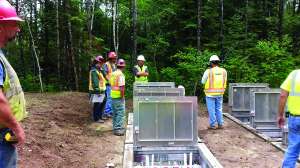
When the site is on a small lakeshore lot (as shown in the photo at right), this becomes all the more critical, because one of the excavator’s main problems will be what to do with the excess soil. It is only human nature to put it in the closest open spot available. It may cost more to move the material or even haul it away, but that expense will pay off down the road in improved system performance.
Lasting damage
We often hear statements from professionals, including engineers, to the effect that this type of compaction is not important as long as the system goes through a freeze-thaw cycle. That is not true — it takes many years for the soil to recover the ability for water and air to flow through and enable proper treatment of wastewater and effective operation of the system.
Some same the compacted soil can simply be removed. That is another idea, but leads to an expensive solution and requires a specific choice for the soil that is used as a replacement. Only clean sand — sand with less than 5 percent fine particles (silt and clay) — should be used. This is the only replacement soil that will maintain the ability to transmit water and air consistently.
Another benefit of staking is that it enables the owner to visualize the location and layout of the soil treatment system. It is a way to compare some different layout options, and it can allow the owner to have input to the system location. This may mean talking with the owner, and for some installers that may be a big change for the better. The owner now gains the ability to see where the system, including the tanks, will be located, and how that may affect traffic patterns on the property.
We recently visited a site where the location of a woodpile created the need for a path over the piping to the soil treatment area, raising the potential for freezing. This led to the owner considering a different route for firewood hauling to minimize the traffic over the piping and reduce the freezing concerns.
Checking elevations
Staking is also a great time to set or verify system elevations. If gravity will be used to distribute effluent between parts of the system, now is the time to make sure there is enough elevation difference to install the system where you intend — while still maintaining the required separation from the saturated soil to the bottom of the system.
Typically, for sewage to run freely from the house to the septic tank, you need an elevation drop of 1 inch per 8 feet of piping. An additional 2 to 3 inches is required for the fall through the tank. This, coupled with the required depth of rock in the trenches, gives a quick estimate of the necessary elevation drop in the system.
Consider a system where the septic tank is 10 feet from the home, the soil treatment area is another 20 feet from the tank, and there will be 12 inches of rock in the trenches. For gravity to work, the system needs:
• 2 inches of drop from the house to the tank
• 3 inches of drop in the tank
• 15 inches of drop to the bottom of the soil treatment area.
This is a total of 20 inches from the invert of the outlet of the house sewer to the proposed depth of the soil treatment area. By checking this before all the equipment is operating, you can avoid problems. It is better to know the right answer than to have to dig to make gravity work.
The staking of the system location has many advantages and can be a helpful step in proper installation. Planning and communication all make the system installation easier and long-term performance of the system more reliable.
Continue reading for free