
Across the U.S., state and local codes vary in how much separation is required below the infiltrative surface to the limiting condition for the soil treatment area. The variation is based on several factors, including the effluent quality, groundwater mounding and risk assessment. The two most common limiting conditions used in designs are a water table (either seasonal or standing) and bedrock, both of which will not adequately treat wastewater before returning it into the environment.
The water table is typically evaluated using the soil color, as it is an indicator of natural drainage conditions. A specific kind of mottle occurs in soils that are subject to saturation. These color changes are the result of chemical and biological reactions that typically occur in wetter soil horizons. The movement of iron with water in the soil will result in areas where iron has been removed, accumulated or reduced. These types of formations in the soil are known collectively as redoximorphic features. The presence of these features indicates there is a limiting condition present in the soil that the septic design must address. Bedrock on a site will severely limit the treatment and hydraulic acceptance of wastewater effluent. Bedrock typically includes solid or soft rock, as well as profiles consisting of greater than 50 percent rock fragments by volume.
Effluent quality
The quality of effluent delivered to the STA depends on the source and the amount of pretreatment. Many codes distinguish between septic tank effluent and secondary-treated effluent. Septic tank effluent still contains a large amount of organic material along with bacteria and viruses and needs the maximum amount of separation. With secondary-treated effluent, typically, 90-plus percent of the pathogens have been removed and a reduction in the separation may be allowed. In addition, due to the reduction in organics, a reduction in square footage is also often allowed.
Groundwater mounding
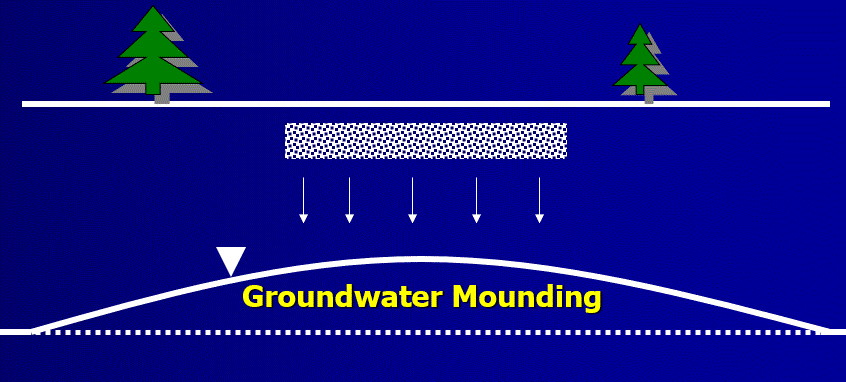
Research has indicated that sewage effluent discharged into the soil from a septic system may not disperse laterally at a fast enough rate to prevent an artificial rise in the water table beneath the STA. This phenomenon is termed “groundwater mounding” and causes increased concerns for larger systems that serve multiple-unit housing developments or large commercial establishments.
Groundwater mounding is a phenomenon that occurs in the soil when soil-loading rates are greater than the soil’s hydraulic acceptance rate. As this occurs, the excess water builds up or mounds in the soil. If loading rates are high enough, this groundwater mound may influence the functioning of the soil system by reducing vertical separation or the surfacing of effluent. Some reduction in the designed separation is factored into many state codes. In coarser-textured, sandy soils more separation is needed to remove the bacteria and viruses, and very little mounding will develop. On the other hand, in finer-textured soil, less unsaturated soil is needed to remove the pathogens, but the amount of mounding will be thicker. In addition, groundwater mounding is mitigated by restricting the contour loading rate.
You can attempt to quantify the amount of mounding that will occur beneath a system under various circumstances. All of the methods, even the most basic, require additional field testing and knowledge of the geometry of the proposed septic system. The appropriate method(s) will depend on your site/soil conditions, flow, local ordinance and additional factors. Generally, hand calculations or even complex computer model simulations may need to be conducted in order to analyze the potential for groundwater mounding.
Risk assessment
When asked how much risk a person is willing to accept for any adverse outcome (illness, injury, loss, death, etc.), many people will answer “zero.” In reality, complete zero risk is unattainable. In fact, even a very low risk, while possibly attainable, could sometimes require drastic measures or very large expense. Because zero risk, or even very low risk, of adverse outcome is often not possible, we are forced to choose among trade-offs of risk and benefit to determine an “acceptable” (or “currently tolerated”) risk level.
The U.S. EPA currently maintains a goal of 1/10,000 infections per year from drinking water. This standard was developed based on the probability of Giardia infection after ingesting water. Giardia is a protozoan that causes gastrointestinal symptoms. Giardia was chosen as the target pathogen because it has a cyst stage that is more difficult to inactivate with disinfection.
How clean do you want your groundwater to be? How many days can full treatment not be achieved? Days with heavy rainfall can result in inadequate treatment, particularly on sites with limited separation. These questions are the basis of risk assessment for wastewater treatment systems and the answers result in varying requirements in different jurisdictions.
About the author
Sara Heger, Ph.D., is an engineer, researcher and instructor in the Onsite Sewage Treatment Program in the Water Resources Center at the University of Minnesota. She presents at many local and national training events regarding the design, installation and management of septic systems and related research. Heger is education chair of the Minnesota Onsite Wastewater Association (MOWA) and the National Onsite Wastewater Recycling Association (NOWRA), and serves on the NSF International Committee on Wastewater Treatment Systems. Send her questions about septic system maintenance and operation by email to kim.peterson@colepublishing.com.
Continue reading for free