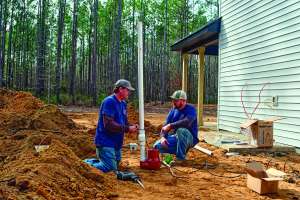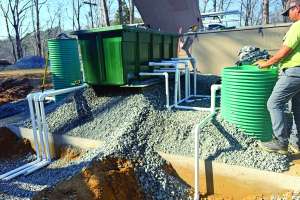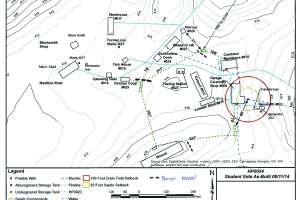

The good news is that installer Frank Schmitz deals with uniform soil conditions through most of his coastal Georgia territory. The bad news: Those conditions are uniformly challenging.
Schmitz and his wife, Cameron, operate Septic Works of the Lowcountry out of Savannah. From the coastline to about 75 miles inland, the soils are sand over a low water table. That rules out most conventional septic systems.
“Everywhere we deal with in this whole floodplain area, we have to do a lot of mound systems,” says Schmitz. “Those systems also use mostly alternative drainfield media and, in many cases, plastic septic tanks.”
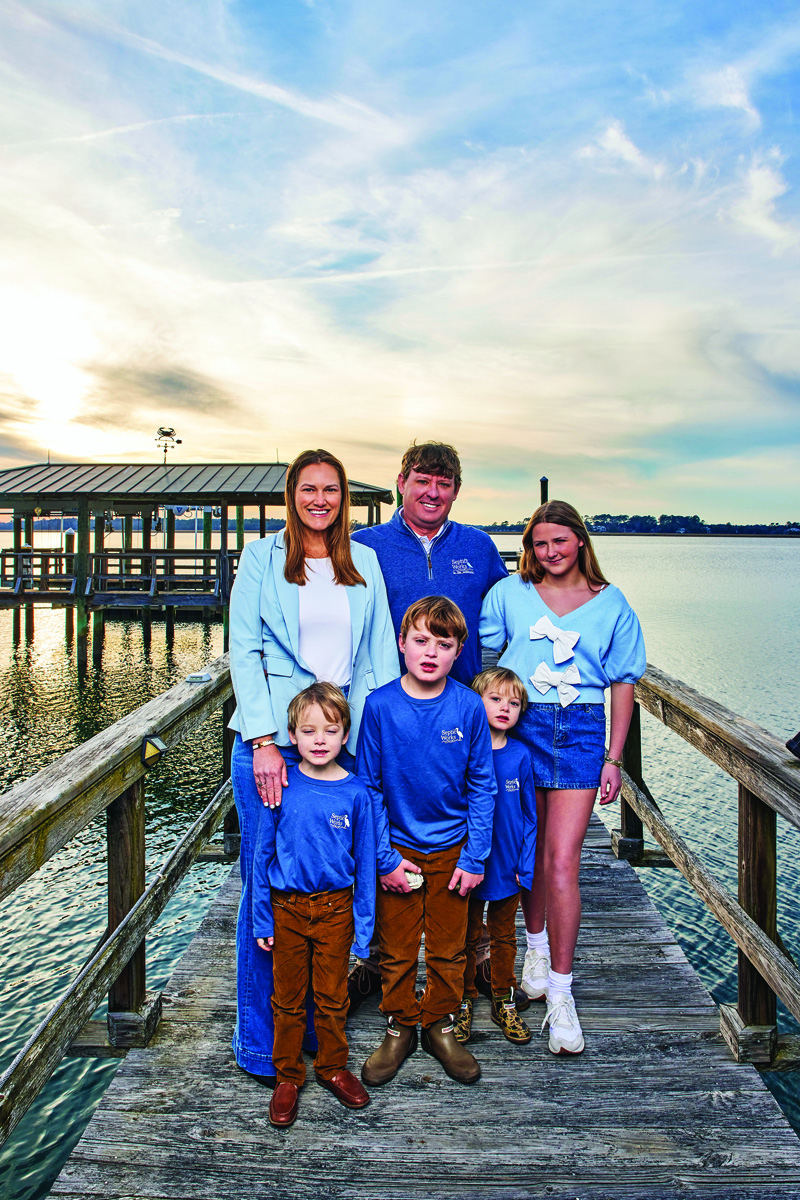
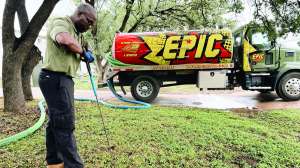
The Septic Works team is up to the task, installing 50 to 60 systems per year, pumping tanks, restoring drainfields, and inspecting systems for real estate sales. The owners, Savannah natives, do it all with one team member, Clark Screen, a former millwright who drives the company’s vacuum truck, helps with drainfields and is a skilled hand with an excavator.
While Frank works in the field, Cameron runs the office and functions as an educator for customers. “I’ve learned a lot over the last five or six years,” she says. “I was a teacher for 16 years, so I feel like I have a knack for explaining things to people. A lot of customers have no background information on septic systems and how they work.”
Natural transition
Frank Schmitz has a bachelor’s degree in business from Columbia College. For about 15 years after graduation, he worked mainly for a construction company that repaired and flipped houses. There he learned plumbing.
During the COVID pandemic, he worked for an excavating contractor who installed onsite treatment systems and water-softening equipment; it was there Frank learned the installation trade. He and Cameron planned to buy that business, but the sale fell through. “So in 2022 we started our own,” Frank recalls.
By that time he had his installer licenses for Georgia and South Carolina. The plumbing side of septics came to him naturally. “The digging and excavating did not,” he admits. “At first I had to hire an excavator operator because I didn’t know what I was doing. But then I played around enough in the field and learned how to do it.”
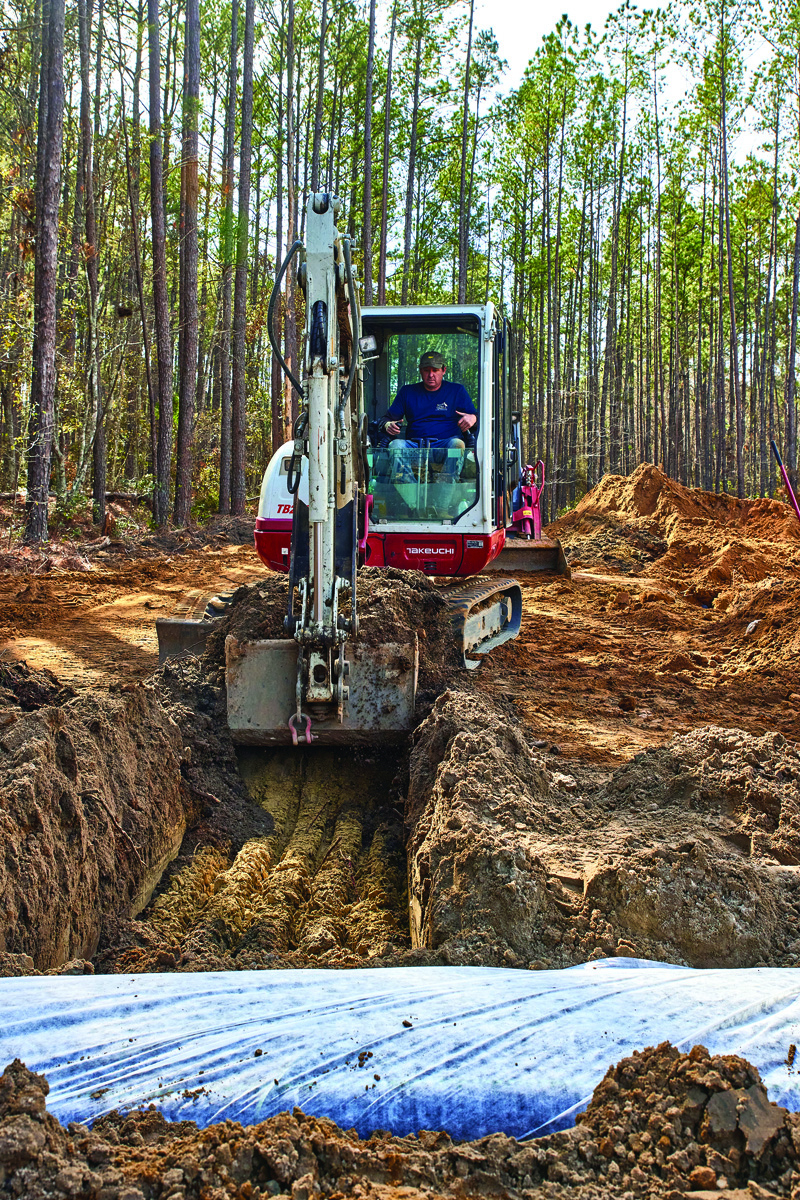
The installation business was slow at first, but pumping took off quickly and pumping jobs turned up drainfield problems that led to replacements: “Other installers’ mess-ups became our new business.” The company grew mainly through word of mouth, leads from the website and relationships with a few homebuilders.
Tackling the terrain
In dealing with the high water tables, Septic Works relies mostly on plastic drainfield media. That’s partly because crushed rock has to be shipped over long distances and is costly: “I like rock and pipe, but it can cost double the price to do a conventional rock and pipe system.” Sand for mounds is also costly to deliver.
His preferred drainfield media is Septic Stack (ADS Environmental Services), which consists of banded bundles of corrugated HDPE pipes with holes and slots that help collect and disperse septic tank effluent. “It works really well in sandy areas with high water tables,” Frank says.
He also uses Eljen geotextile sand filter systems: “It’s a good solution, but you have to get an engineer involved, so it raises the price.” He prefers plastic septic tanks (Infiltrator Water Technologies) for their ease of handling, but will use precast concrete tanks where a high water table makes it difficult to keep the plastic tanks from floating.
The permitting process in Georgia is straightforward. “A soil scientist checks out the site and tells us how deep we can go,” says Schmitz. “We give the information to the county health department, and they tell us how much drainfield we need. Once we have that information, we can give the customer a quote. Georgia requires 36-inch-wide trenches.”

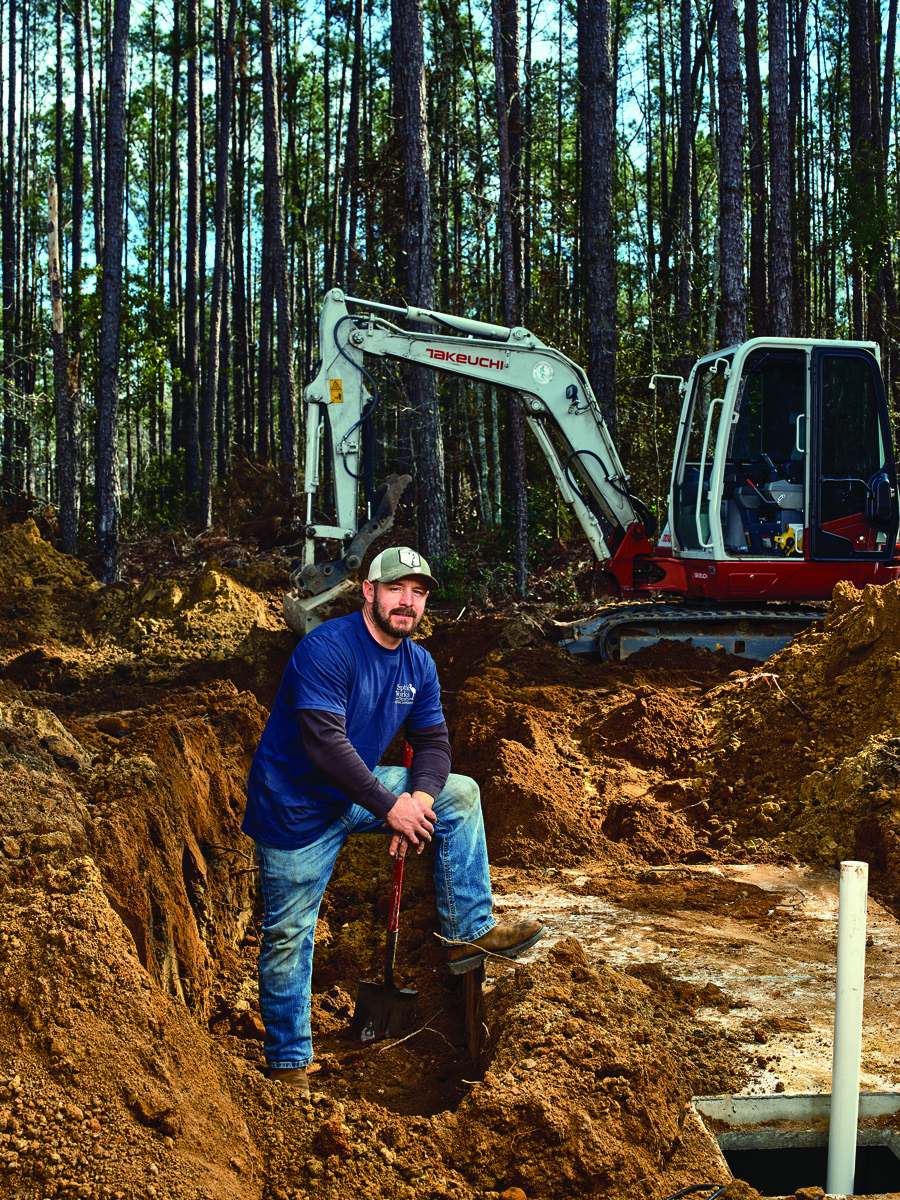
Key equipment includes a 2023 Takeuchi TB240 excavator with a dozer blade that can angle side-to-side, and a 2024 Takeuchi TL8R2-CR standard flow skid-steer, both purchased from Atlantic Coastal Equipment. The company also has a 2001 Dodge Ram 3500 pickup truck, a 2021 Dodge Ram 3500 pickup and a Big Tex trailer for moving equipment.
Quality work helps drive new business. One key is landscaping the finished project. “We leave the site so that it’s sod-ready,” Frank says, “We rake out the drainfield so the homeowner doesn’t have to do anything after I leave except order grass seed or sod.”
On the truck
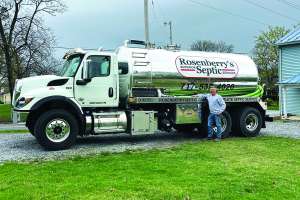
Meanwhile, tank pumping jobs keep turning up problem drainfields. Pumping is generally limited to about 30 miles from the office. The vacuum truck, built by Phoenix Truck Center, is a 2015 Freightliner M2 with a Cummins ISB 280 diesel, Allison automatic transmission, 2,500-gallon steel tanks and a 380 cfm NVE 607 vacuum pump.
“Most of our pumps are for emergencies,” Frank says. “People don’t have a lot of loyalty when sewage is coming back in the house. They typically go with whoever answers the phone first and whoever is the closest.”

Some customers whose drainfields have failed can’t afford replacements right away. In those cases, Septic Works offers Terralift restoration as a temporary measure. “It doesn’t always work, but if it does, it buys them time to save up for a drainfield,” Frank says. “It’s a great tool to have. A Terralift might improve the drainfield by 50% and buy them six months, a year or a couple of years.”
When it comes time for the replacement, Schmitz is careful in estimating: “We try to be very fair on our quotes. We even recommend people get quotes from other contractors, but having a fair price and quality products helps us make the sale.”
For time-of-sale system inspections, Cameron made contacts by attending real estate conferences. “We have a real estate inspection booklet,” Franks notes. “When you buy your house and get your inspection, it tells you everything about your septic system and how to maintain it. It has pictures and tells you what to expect living on septic. People really enjoy it.”
Where it begins
Customer relationships start in the office. When people call, Cameron asks what problem they’re having and tries to walk them through a quick solution. In an emergency, “That might mean opening up the clean-out to relieve pressure so it doesn’t back up into the house before we get there,” Cameron says. “If an alarm is going off, we teach them what to do with that.
“A lot of people move here from the north and have never been on septic. I have a great video I can send them that explains exactly how their system works. I walk through it with them and answer their questions.”
A big contributor to septic system problems is leaking toilets. Septic Works recommends that homeowners check for leaks with each change of the clocks to and from daylight saving time.
To test, they put a dose of food coloring into the toilet tank; if any color gets into the bowl, the toilet is leaking.
Other than that, “The No. 1 challenge is that people just don’t want to accept that their drainfield needs to be replaced,” says Cameron. “We had to get a new roof a year and a half ago. It was about the same price as a drainfield, which is just as important, if not more so. In 30, 35 or 40 years, you’re going to have to replace it.”
To keep the business organized, she runs the financial side — billing, payroll, taxes and more — with QuickBooks software (Intuit). Google Calendar helps keep everyone on track and on schedule. “You can have it on everyone’s phone,” Cameron says.
“We have one account. Whenever I put something into the calendar, we can all see it. As soon as you open it up, it gives you a schedule for the day. It has a link to Google Maps, so when we get in the car, we don’t have to type an address. We just click on it and the directions pop up.”
For promotion, she uses Local Services Ads by Google, which gives users preferential ranking in search results and charges per customer rather than per click.

Years to come
Looking ahead, Frank and Cameron see good opportunities to diversify and grow. “I’d like to do more work with contractors and install more drainfields,” Frank says. “Now that we have a good employee in Clark, I can go out more and do consults and go over permits with people.
“Often, people will call us sight unseen and ask us to give them a quote for a drainfield. It’s always nice before we quote, to have had time to go to the site and do a thorough evaluation. It’s helpful to sit down with customers and tell them what we do — just being friendly with people.”
Cameron sees a growth area in South Carolina, where the company is licensed but hasn’t made big inroads yet: “I really have to keep educated on that because it’s constantly changing over there. It’s the biggest growth area in the territory we serve.”
In building the customer base, a straightforward approach goes a long way, Frank finds: “Honesty is critical in this business. We never take advantage of people. That will ruin your reputation faster than anything.”
Meanwhile, Cameron remarks, “I try to be educational. I try to be my sweet little southern self, make people feel comfortable, make them feel at home. I want them to think all our customers are like family. That is a very strong attribute of ours.”
Continue reading for free