
In system installation videos that companies post online, I see a lot of wide-open flat fields with no hills in the pictures. Trenches of chambers that just stretch on forever — flat, wide-open and the installers are (rightly) proud of how fast the install went.
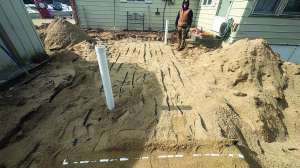
In the area I work in (11 counties of southeast Wisconsin), I run into a lot of sites that are quite the opposite: small, steep, wooded, a lake on the low side and an extremely busy road with no shoulder on the top side. The house is tight against the road on the top side. Electric overhead mains run along the house side of the road, four huge wires wide and low. There is no driveway, only a small parking pad adjacent to the road that fits two cars; and from that parking pad, the lot drops almost straight down. There is no way to get any heavy equipment on this lot unless barged from the lake at the bottom, and even that would be difficult. Even a holding tank can be a challenge on these lots.
These lots have several variables that make installation of onsite systems very challenging.
The first challenge is setbacks to wells. On lakes, density rules; the reason this lot is tiny is because the other lots on each side of this one are tiny also. Once a well gets drilled it really cuts down on usable space. My setback for a soil component is 50 feet from a well, and the setback from any tanks is 25 feet to the well.
Similar setbacks apply to the lake water also. A soil absorption component has to be 50 feet from the lake and a tank has to be 10 feet from the lake.
On lots this small, we need to find the wells on the neighboring lots as well as the lot we are proposing to work on. In this area that could be hard. Although many of the lots do have drilled wells outside the homes, many older lake homes have point wells in their basements. So if we can’t find a well on a neighboring lot, and the owner uses the home seasonally, it could take a while to find out exact locations of wells. The setbacks are from any well, so knowing where the wells are on the neighboring lots is critical.
I know of an installer who installed a holding tank on one of these tight lake lots in the only place a tank fit. During inspection, the inspector said it was too close to the neighbor’s well and the tank would have to be moved, or a well variance would be required. In our area a well variance is tricky because it’s not the homeowner with the holding tank but the well owner (neighbor) who has to apply for the setback variance.
The next challenge is road right of way. In Wisconsin we are not allowed to install systems within a road right of way (without specific written permission). Most rights of way near me are 66 feet wide. In most cases that means 33 feet from the center line of the road. But be careful! I know of an installer who installed a holding tank after measuring 33 feet from the center line of the road, and after the tank was inspected and backfilled the county inspector contacted the installer and said the tank encroached into the right of way. The installer said, it can’t be — we measured from the center line of the road. The inspector said at that location the road is not centered in the right of way, it’s offset.
Rights of way do not have to be 66 feet; I run into different sizes of right of way all the time. I’ve worked on projects where the right of way was 150 feet so we had to be 75 feet from the center line of the road. And even if one lot has a 66 foot right of way, the houses on either side could have different size rights of way. It’s as if municipalities are trying to get the rights of way wider and they do it one lot at a time in some areas.
Challenge No. 3 is the slope. It is doubtful we are getting any equipment on some of these sites.
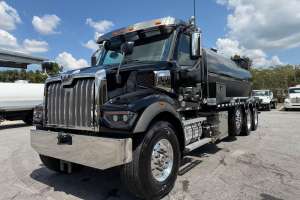
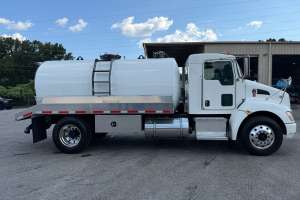
On a site I’m currently working on we had to use a hydroexcavator to dig our excavation about halfway down the hill because we could not get equipment onto the site. I’ve used hydroexcavation on many jobs where we could not get a typical hydraulic excavator on the site. The hydroexcavator can sit up on the road and excavate anywhere on the lot. I’ve had hydroexcavators excavate 300 feet from a road and with about 44 feet of vertical lift. These really come in handy. You don’t have to own a hydroexcavator, they are available for hire. Just make sure to bid accordingly — and accurately. Because the hydroexcavator is taking up a lane on a very busy road, we had to make sure that traffic control was built into our proposal as well.
The second issue with the hydroexcavator or any trucks working from up on the road is overhead electric mains. It seems that most utilities are buried now, but we still have to contend with overhead wires a lot.

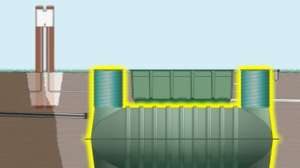
I know of a lot where a holding tank was installed upslope from the house on a very steep and small lot. The tank had to be secured into the hill; if it ever lets go, it would crush the house. It has been in for about 15 years now without any issues.
To get stone down to the tank location, we let gravity help us. We cut 18-inch double walled corrugated plastic pipe with a smooth interior in half the long way. We use these as a chute and pour stone from the top of the hill to where we need the stone down the hill. It sure beats carrying 5-gallon buckets down, and the stone moves quickly down the chutes. This is also a method we could use to abandon the tank and seepage pit which is also halfway down the hill. In some cases we will use redi-mix slurry for the abandonment process and the redi-mix trucks also have chutes to get the material where we need it.
In the case of the site I’m working on now, poly or plastic tanks are the only ones we are getting on this site due to slope, trees, overhead wires, etc. But they certainly have their place and this is one of them. We will not be digging deep enough to bury the entire tank in the ground, but just deep enough to get us a flat spot to set the tank on. And then we will use the chute to get material down the hill to cover the tank(s).
We have performed projects where we had to put an excavator on a barge to get it to an island, and the lake side of one of these small lots; again, if that is the case, the barge cost should be built into the bid.
As with any job, when working on small, tight or steep lots, spend time thinking it through and work out the entire plan for the job up-front. When I meet the homeowner at these types of lots, I explain all the different items that will go into the cost to prepare them for a price that is much different from a flat, wide-open site. Planning is important on these lots for safety as well. The slope, the busy road, the overhead wires, etc., all take planning that is crucial in order for the project to go safely. For these types of projects we also give the local police a courtesy call in advance so they know of the lane closure, and it is important the overhead utility get a courtesy notification as well in case they decide they would want a watchdog present.
Good luck and stay safe!
About the author
Todd Stair is vice president of Herr Construction, Inc., with 34 years’ experience designing, installing, repairing, replacing and evaluating septic and mound systems in southeast Wisconsin. He is the author of The Book on Septics and Mounds and a former president of the Wisconsin Onsite Water Recycling Association.
Continue reading for free