
For 11 years I coached seventh and eighth grade tackle football. I wanted to be the best coach I could be, so I reached out to, visited and learned from some of the best football coaches at the high school, college and pro level. I learned so much I was coordinating and sometimes speaking at coaching clinics.
Every time I visited a coach and watched them coach their players, practice was always about the fundamentals — the basics. These coaches are teaching experienced players how to hold the ball, how to protect the ball, how to stand prior to a snap, where your left foot goes in your stance and where the right foot goes in relation to the left foot. These are true basics. Basics are what help these teams and these coaches be successful.
I want to talk about a fundamental basic that keeps getting overlooked and causes issues for homeowners.
My company does a lot of service work. We troubleshoot onsite system issues on a daily basis. One of the most common issues is settled pipes. When we excavate to repair the settled pipes we find in 90% of situations the pipes were not properly bedded in stone.
In Wisconsin we rely on “Standard Specifications for Water & Sewer Construction in Wisconsin,” which is quite a thick volume. It requires bedding of at least 4 inches of stone below the barrel of the pipe and 3 inches beneath the bell of the pipe. The specifications call for 3/8-inch sewer chips but allows for “other rock materials of regional significance” where their exact specified material cannot be obtained.
For years our company and others that I know have followed this process: When excavating trenches for pipe, excavate 4 to 6 inches deeper than the proposed pipe depth, to allow for bedding stone beneath the pipe. As more of the stone is backfilled around and over the pipe, it is critical that the stone be "tucked" or "haunched" beneath each side of the bottom of the pipe in a stabbing motion with a shovel (aimed downward at the bottom of the pipe from each side). This ensures that the stone is tightly secured beneath the pipe so as not to leave any voids. This must be done along the entire length of the pipe. I have found that it is also important that the bedding material continue up the sides and over the top of the pipe as well for several more inches. It is also very important to make sure that in this stage and during backfill that no larger rocks or hard clumps of soil land on top of the pipe or anywhere close. Keep the backfill uniform and without large chunks that could harm the pipe.
I know that many readers are thinking this is really basic. However, when troubleshooting sewer blockages and other sewer issues, we continually find pipes with large settled sections (typically referred to as bellies) and upon excavating to repair the pipe we constantly find pipes without proper stone bedding. If not bedded, tucked and backfilled properly, pipes will settle; this is unfortunately a common issue. Settling is bad because in the settled area water sits in the pipe, keeping it full or partially full. The longer the length of settled pipe, the more it will fill with water, which slows and in some cases impedes the flow through the pipe. Solids build up and eventually blockages and sewer backups occur from settled sections of pipe.

I know access to stone is not always as easy in some areas as it is for me. I have one gravel pit walking distance from my shop and another one half a mile down the road. I am in an area where the glaciers left abundant sand and stone, so it’s easy for me to say how important stone is for bedding pipe. But as referred to above, even our state specifications allow for using a different aggregate if you don’t have sewer chips in your area. The specifications do mention using sand as an alternative as well.
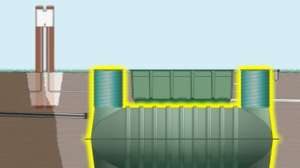
Another issue with stone backfilling we see all too commonly is at the sewer pipe from the house to the septic tank, and at the outlet pipe from the septic tank. It is absolutely critical to backfill septic tank and pump tank excavations with washed stone or sewer chips at the inlet and outlet of the tanks up to and over the top of the tanks.
When the outlet pipe settles, the pipe sinks and the effluent filter attached to it bends down also. Many times we find the effluent filters so tipped that you could not pull the filter out of the housing. This requires excavating the outlet of the tank and re-installing the outlet pipe properly, using all stone backfill from the bottom of the excavation to well over the pipe, and of course resetting the filter. One other basic element here is running schedule 40 (at a minimum) 3 feet onto solid ground (beyond the over-dig) prior to changing to a lighter pipe such as schedule 3034. Even when cast iron was required in Wisconsin, the code required that the cast iron at each end of the tank go from the tank 3 feet beyond the overdig onto solid ground in an effort to protect from settling. Although that requirement might not even be in our code anymore, our company still makes certain we take schedule 40 pipe 3 feet beyond the overdig at each end of the tank.
One might think, well, settling takes a long time. Unfortunately, settling can occur very rapidly. When a tank is not properly backfilled with all washed stone or sewer chips, we find the filters tipped badly within the first year of install.
One other benefit of backfilling tanks with all stone (even on the sides as well) is that settling is minimized or even prevented. Tank excavations really are an issue for settling around the entire perimeter. If it settles on the ends it’s bad for the pipes. If it settles on the sides, customers complain about the settling no matter how much you prepare them for it.
Stone is an amazing product to prevent settling, and prevent the callbacks, blockages and sewer backups that lack of stone will likely cause.
I know this topic is basic. However, I wouldn’t write this article if my company wasn’t constantly finding settled pipes due to improper bedding. I know using more stone adds to the cost. As professionals we bid that extra stone in the price up-front, and do the job right the first time.
Continue reading for free