
Drip dispersal systems have become a common solution for wastewater management, especially in areas without traditional sewer infrastructure. On paper, they offer a decentralized, flexible approach. But in practice, the results tell a different story and highlight the need for better drip dispersal system design solutions.
According to a 2024 analysis of Tennessee Department of Environment and Conservation inspection data, more than half of permitted drip dispersal systems inspected were not compliant with their permits, and approximately 43%–50% of drip zones were malfunctioning. So what’s going wrong?
The root cause: Inadequate pretreatment
One of the biggest contributors to dripfield failure occurs before the wastewater ever reaches the soil, and it’s a critical gap in many current drip dispersal system design solutions.
Many systems, like sand filters, are required to have septic tanks at each home to provide pretreatment, even though BOD is reduced only to around 40. While this may seem beneficial, it often creates more problems than it solves. Septic tanks remove a portion of the organic solids that are actually needed to sustain the biological processes in downstream treatment systems. At the same time, they don’t consistently reduce suspended solids enough to protect the dripfield. This results in wastewater entering the drip system, which is not properly treated, and the soil pays the price.
What happens when treatment falls short
When wastewater with higher levels of suspended solids and organic material reaches the dripfield, several issues begin to develop:
- Accelerated biomat buildup in the soil
- Clogging of soil pores, reducing infiltration
- Reduced oxygen transfer, limiting natural treatment
- Increased maintenance, including frequent flushing and emitter replacement
Over time, this leads to system inefficiency, higher operating costs, and ultimately, failure ... problems that effective drip dispersal system design solutions are meant to prevent.
Better treatment makes the difference
Improving pretreatment is one of the most effective ways to extend the life of a dripfield. This is where system design and the right treatment approach make all the difference.
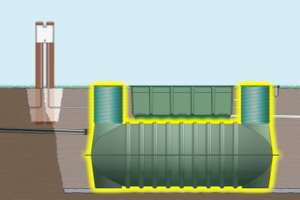
Gainey’s extended aeration wastewater treatment plants are specifically designed to improve effluent quality before it ever reaches the dripfield. By modifying the traditional activated sludge process, our systems consistently achieve higher treatment levels without adding unnecessary complexity.
Our precast systems can treat to 10 BOD₅/15 TSS, and as low as 5 BOD₅/5 TSS/2 NH₃-N with tertiary filtration, helping protect downstream dripfields from premature failure. Because our systems rely on biological treatment with consistent organic loading, they perform best when wastewater is treated centrally rather than being partially stripped of solids at each home. In many cases, removing individual septic tanks allows the system to function more effectively, producing a more stable, higher quality effluent.
Gainey’s wastewater treatment plant benefits:
- Easier to operate than many other currently used systems
- Easier and less expensive to maintain with off-the-shelf components
- Eliminate STEP tanks at every home & their pump outs
- 5,000 psi precast concrete (50–100 year service life)
- More cost-effective over time, with a life cycle cost of around $0.51 per treated gallon
Unlike sand filter systems, Gainey’s extended aeration systems don’t require or benefit from STEP tanks. The systems are designed to receive full concentration BOD, which supports stronger biomass and creates a more robust biological treatment environment. As a result, we can consistently treat down to 10 BOD, and even as low as 5 BOD under certain conditions. This significantly lower effluent (10 vs. 40 compared to sand filters) can dramatically extend the service life of dripfields by up to four times.
Rethinking the role of septic tanks
In some cases, removing septic tanks at each home can improve overall system performance. Centralized treatment systems rely on consistent organic loading to maintain healthy biological activity. When septic tanks remove too much of that load, it can impair the treatment process rather than enhance it. Why spend the money and energy pumping out untreated sewer from every home septic tank when you can send it all to be treated centrally?
The bigger picture
If nearly half of dripfields are malfunctioning, it raises an important question: is the issue the drip system itself, or how it’s being designed and implemented? The answer is often in the treatment approach.
Drip dispersal can be an effective solution, but only when paired with proper pretreatment, thoughtful design, and a focus on long-term performance rather than just initial cost.
How to prevent failure
Preventing dripfield failure comes down to a few key principles that define strong drip dispersal system design solutions:
- Prioritize high-quality pretreatment
- Design for lower effluent limits, not just minimum requirements
- Consider the long-term impact on soil performance
- Avoid overcomplicating systems with hard-to-maintain components
- Focus on life cycle cost, not just upfront cost
Wastewater systems should meet today’s needs while protecting long-term performance, budgets, and the environment. Gainey’s Concrete provides scalable, extended aeration treatment plants for developments ranging from 5 homes to 1 million gpd. Manufactured in Louisiana and built to meet rigorous standards, our systems are designed for reliable, long-term performance.
Have a project coming up? We’d love to help with design and planning.