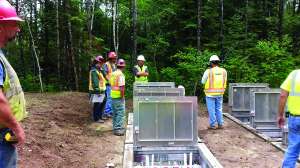
Charlie Doley has spent most of his adult life working in back yards, installing onsite wastewater treatment systems.
“When I started, we installed traditional subsurface beds for single-family homes,” says Doley, owner of Pikeland Construction Inc. in Kimberton, Pa. “Today, the back yards are much bigger and so are the systems.” Doley now installs drip irrigation systems that serve entire neighborhoods, schools and other high-volume developments.
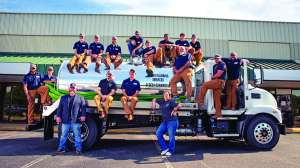
The company, with a crew of 25 field and office workers, serves roughly a 200-mile radius that includes big parts of Pennsylvania, New Jersey, Delaware and Maryland. The firm takes a custom approach to each job, carefully considering site conditions.
Doley has created a deep and flexible team, highly focused on the techniques of drip system installation, and augmented by subcontracted labor and machinery.
Tracking with trends
After graduating from Penn State University in 1981, Doley went to work for an onsite installation company managed by his brother-in-law, Chuck Waddy. A short time later their friend Tom Cosgrove started Pikeland Con-struction, and Doley and Waddy joined him. A few years ago Doley bought the business. Now the three are business collaborators, each working in complementary segments of the onsite system industry.
The company’s focus in the 1990s was on building treatment systems for developers and public entities. “These systems were designed to serve as few as 10 homes or as many as several hundred,” Doley says. “Some of our systems serve an entire school.”
In each case, Pikeland built an advanced treatment plant and subsurface infiltration bed. The approach worked well in the rapidly developing suburban area. When the developer’s system was complete, it was turned over to the municipality to own and operate.
When Doley started, beds of 100 feet by 200 feet were common. At the time, beds were preferred over NPDES-permitted stream-discharge systems because state discharge criteria were strict. As regulators’ policies and attitudes toward beds changed, designers looked to new strategies. The next approach that gained favor was spray irrigation.
Pikeland built many spray systems. But in the past few years, municipal officials and developers have shied away from the concept. “Perhaps it is because of the ‘ick factor’ that emerges when homeowners learn that treated wastewater is coming out of the spray heads in that big, green field,” Doley says. “Perhaps it’s due to regulators’ preferences. Perhaps it is because of the high cost of land.”
Drip irrigation
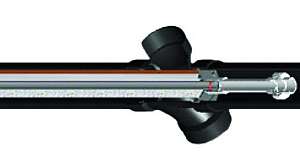
As spray’s appeal waned, regulators and designers focused on drip irrigation. “The drip tubing we install is the same product used for single-family home systems,” says Doley. “Most of the hardware is the same as well.”
The most visible difference between single-family systems and the ones Doley installs is scale. A single-family system may have 2,400 linear feet of tubing in two zones to handle a 600-gpd flow, and the dripfield covers about 5,000 square feet. “Our first community drip system handled a 100,000-gpd design flow directed to a 5-acre drip area,” says Doley. “There were 80,000 linear feet of tubing in eight zones.”
State regulations differ on pretreatment requirements for drip dispersal. The requirements can also vary depending on whether a local jurisdiction or the state itself issues the permit. Pikeland’s community systems are usually permitted by the state under the NPDES program.
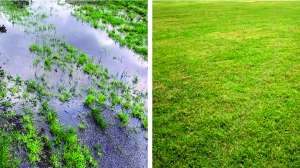
The surface of a dripfield is well suited for passive recreation, parks and similar low-impact uses. “People can enjoy the area,” says Doley. “Kids can fly kites or play Frisbee and never have to worry about when a drip zone is actively dispersing wastewater.” That is not the case with a spray field. Another benefit of drip is that it uses less land for the same daily flow. When exploring drip systems, Doley went to manufacturers’ seminars and toured manufacturers’ and suppliers’ facilities to do his homework. “Drip is a natural progression in technology,” he says. “To move in that direction, we had to be certain we built our business on sound science and reliable supply networks.”
Big systems, new challenges
The company relies on American Manufacturing Company Inc. for its drip system components. Each drip job is different, and each has a different site configuration. “When we are on a site, we can’t box ourselves in and we can’t allow ourselves to be boxed in by other construction trades working on the site,” Doley says. “Each system requires site-specific planning, materials staging, and a well thought out construction sequencing plan. Site protection is essential.”
Pikeland wants to be the first contractor on the site, where its first task is to surround all dripfields with polyethylene snow fencing to prevent soil compaction by an equipment operator or driver. Pikeland selects equipment with a ground loading rate of 6.5 psi or less. Once the site is protected, key features like drip zones, manifold races, control systems and tanks are staked out. “When the job is completed, we pull out all of the protective snow fencing,” says Doley. “Usually, in a few months, the dripfield looks like it did before we started.”
A typical installation begins at the farthest point from the treatment plant and works back toward it. Tubing is installed first, followed by manifolds, pumps and controls. In the field, however, Doley has learned that “typical” may be quickly set aside because of unique conditions. Crews also know that ideal soil conditions may not be around for days on end.
“Soil conditions across large areas can vary significantly,” Doley says. “Naturally damper soils will get priority consideration. As soon as they are dry enough to work, we will do so.” All things being equal, smaller constrained sites present the greatest challenges.
“Our systems are really big, and our contractor clients are not interested in cutting corners,” Doley says. One system supports a townhouse development where the least expensive units cost $200,000. Another serves high-end houses priced at more than $1 million each.
A system for a development of 660 single-family homes was designed for a 180,000-gpd flow, while a 6,000-gpd system serves 12 to 15 homes. When comparing big systems, Doley talks about the dollars per gpd. “Dripfields range from $5 to $20 per gallon,” he says. “The 180,000-gpd system cost about $5 million, and about one-fifth was for the drip component.”
Flexible resources
Pikeland has 25 full-time employees. Eight work in the office. There are eight foremen/project managers and eight operators and laborers. Subcontractors play a large role in the projects. It is common for Pikeland to field a crew of five employees, supported by 10 subcontracted workers. Seldom does Pikeland have fewer than two employees on a site; 10 is about the maximum.
The employees are not constrained by job titles. One worker may install drip tubing in the morning and paint a room in a mechanical building at the treatment works in the afternoon. The employees bring a broad skill set to every job. Maximizing use of those skills is a challenge for the foremen. Skill depth and flexibility have enabled Pikeland to keep all its employees busy. In its 21-year history, the company has had only one layoff. Equipment is another resource readily available through subcontractors. “Relying on somebody else to provide modern, well-maintained, task-focused equipment lets us work to our strengths,” Doley says. “There is no downtime to worry about, no overhead and no monthly payments.” For its size, Pikeland’s equipment roster is slim.
There is a fleet of three single-bottom vibratory plows, which includes Case 2004 and 2005 Maxi trenchers and a Ditch Witch 410 SX. A pair of Case 580K backhoes and a pair of Caterpillar backhoes make up the balance of the big machines. With lots of personnel and jobs spread over a 200-mile radius, Pikeland keeps a fleet of 13 assorted pickup trucks busy. “I have seen multi-bottom tubing plows, but in our soil conditions we find it more feasible to use single-bottom plows,” Doley says. “On some jobs, the crew may use as many as three plows, each performing individually. Each tool and each person specifically matches the work assignment.”
Niche clientele
Pikeland enjoys a comfortable place in a niche market. “On occasion, we install a single-family system for a friend, but that is not our market place,” Doley says. The client list includes major national builders like K. Hovnanian, Realen Homes and Pulte Homes. Local builders who deal solely in the upscale housing market include Hankin Builders and Moser Builders. Public sector projects include the French Creek and Pocopson elementary schools near the company’s office. Pikeland likes to work with clients as early as possible in development planning. Each discipline brings its own unique skills, wisdom and insight to the design table. “We bring the practicality of the installer’s perspective,” says Doley. “Commercial developers are more open to this collaborative approach, while public sector jobs are less open to our input. Each client works in a different environment. We do our best to fit into each project team.”
Doley observes that dripfields are not, strictly speaking, treatment system components since water sent to the drip tubing is clean and ready for reuse. Doley believes the reuse potential has not been fully realized, but “It is coming.” He describes one project at a warehouse near Allentown, where a drip system is being used to introduce stormwater into the soil. There is no treatment works — only a stormwater catch basin and a dripfield. “Getting the water into the water table is important,” Doley says. “The big-pipe systems send the water downstream. Drip keeps the water close to its source, or close to where it fell as precipitation, and puts it into the ground for future reuse.”
Today, the size of his jobs is different, yet the basics are similar to those of the single-family systems he used to install. At the end of the day, and at the end of every job, Doley is not far from his roots. He is in someone’s back yard, helping them treat, manage and benefit from onsite wastewater technology. “It’s where I started,” he says. “It is where I have found success, and it is where I want to be.”
Continue reading for free