The Trump National Gulf Club in Colts Neck, N.J., opened in 2005, but the onsite treatment system wasn’t completed until September 2008. Permitting for the drainfield, a pilot project and one of the largest in the state, took years.
The state Department of Environ-mental Protection (DEP) requires groundwater discharge to meet coliform, pH and total nitrogen limits. Therefore, Gregg Barkley, P.E., of VanCleef Engineering in Hamilton, N.J., chose UV disinfection and an ultrafiltration system that uses thin, hollow membrane strands. Run by a computer, the complex treatment train is cost-effective, surpasses discharge limits and requires minimum maintenance.
Site conditions
Soils are sandy loam atop clay mixed with sand. The water table is 20 feet below grade. The 350-acre site was a vegetable farm.
System components
Barkley designed the system to handle 18,000 gpd. Its major components are:
• Three pumping stations with grinder pumps.
• 2,000-gallon concrete grease trap.
• A treatment plant package from Zenon Environmental Inc., Oakville, Ontario. Package components are:
– 9,000-gallon concrete trash trap (septic tank). All tanks formed in place inside a 40- by 40-foot building.
– 18,000-gallon equalization chamber with two 2-hp Myers pumps.
– 6,000-gallon anoxic cell.
– 12,000-gallon activated sludge tank with two 3-hp Goulds recirculation pumps.
– Four ZeeWeed membrane filter modules from Zenon Environmental.
– Two 5-hp/50-cfm Aerzen Delta blowers.
– Skid with two permeate pumps, two backwash pumps, 200-gallon holding tank, sensors, control panel and computer.
– 5,000-gallon dosing chamber with two 2-hp Myers jet pumps.
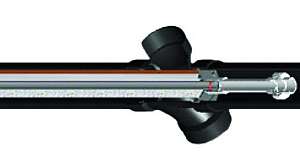
– 20,000 feet of 1/2-inch WasteflowPC tubing and drain-field package from Geoflow, Corte Madera, Calif.
System operation
Wastewater discharges from the clubhouse, restaurant grease trap and pro shop to individual pumping stations, then flows through 2-inch HDPE force mains to the treatment plant. The first four in-ground tanks, separated by 12-inch walls, form a square at floor level.
Wastewater enters the trash trap, from which effluent flows by gravity through an 8-inch pipe into the equalization chamber. Alternating pumps run every half hour for 15 minutes, sending 40 gpm through 2-inch PVC pipe to the anoxic cell. In the cell, influent combines with mixed liquor (stabilized sludge) recirculating from the activated sludge chamber (secondary treatment).
Installer Henry Greenemeir of Greene Environmental Services Inc. in Trenton, N.J., hauled in 11,000 gallons of seed sludge at system startup. A 30-second dose of MicroC, an ethanol-based product similar to corn syrup, is injected into the mixture four times per hour to begin the nitrification/ denitrification process.
“The microbes don’t have the main course because the hydraulic flow isn’t there yet, so we give them all the dessert they want,” says Greenemeir. To ensure a homogeneous mixture, the liquid is gently aerated for 15 seconds every 15 minutes.
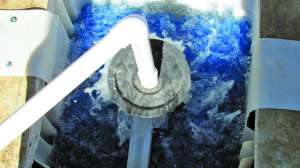
Liquid in the anoxic cell overflows through an 8-inch pipe into the activated sludge chamber, where air rising from 90 3-inch fine-bubble diffusers rolls the mixture. Alternating pumps run every half hour for 15 minutes, returning 350 gpm of mixed liquor to the anoxic cell through a 3-inch PVC line.
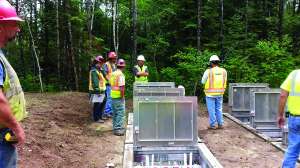
In a corner of the activated sludge chamber, four membrane cassettes hang in a stainless steel rack 18 inches below the water. Each membrane, mounted side-by-side in two alternating cassettes, has 500 square feet of filtration area in its numerous fiber strands and filters down to 100 microns.
When a cassette activates, a dedicated pump draws a vacuum through a 2-inch reinforced hose connected to the top of the membrane. The vacuum gently pulls 10 gpm through the hollow, reinforced strands. The filtered permeate has zero to 5 mg/l suspended solids.
“Conventional systems hold suspended solids at 3,000 to 5,000 milligrams per liter,” says Greenemeir. “The membranes allow us to increase that number to 14,000 mg/l, or 1.4 percent solids. The extended time absorbs all the carbonaceous demand. Our total nitrogen levels for October were 0.30 parts per million. The DEP limit is 10 ppm.”
The system automatically cleanses itself using permeate from the holding tank. Once the permeate pumps fill the tank, they direct liquid to dedicated 3-foot by 6-inch tubes with six UV bulbs. Permeate then discharges to the dosing chamber, where alternating pumps send 40 gpm at 104 feet of head to the drainfield headworks.
Effluent is directed to one of three 6,667-square-foot zones. Zone 1 is 1,000 feet from the treatment plant and Zone 3 is 800 feet away. Each has 24 laterals on 2-foot centers with drip emitters at 24-inch intervals. Each zone has a manhole containing a zone valve, electric solenoid control valve, and an air/vacuum vent to eliminate air blocking the lines.
Installation
Installation of the treatment plant was straightforward. Greenemeir subcontracted the drainfield to Art Frankenfield of AA Frankenfield Contracting in Bloomsbury, N.J. Previously, the site, on a 15-percent slope, was cleared, grubbed, contoured and covered with topsoil.
For the job, Frankenfield designed a three-sheer vibratory plow with 1 1/2-inch-diameter, carbide-tipped bullets. WaterWick in Southampton, N.Y., built it. “Larger bullets allow the tubing to pull in without smearing with mud or filling with dirt,” says Frankenfield, who buried the drip lines 14 inches deep.
Because a wheeled machine lacked traction to pull the heavy plow and would tear up the ground, Frankenfield purchased a John Deere CT332 skid loader on tracks, then mounted the plow in front. “Driving in reverse was difficult because I had no reference to tell which way I was going,” he says. “And my back and neck muscles cramped from hanging out the window.”
Drawing on his fighter pilot experience, Frankenfield made an aiming device from 1 1/4-inch electrical conduit that protruded in a “U” off the back of the skid loader. He welded a vertical bar at the center of the “U,” then reinforced it with diagonal arms. “I could see my bombsight through the wireless backup camera I bought from Harbor Freight Tools,” he says.
A length of tubing clamped to each side of the skid loader’s frame extends 6 inches on either side of the crosshairs. Frankenfield painted those 6 inches red.
A 2 1/2-inch monitor mounted on the dash allowed Frankenfield to align the aiming system with the red line painted on the ground. “The skid loader has a joystick, so it was like flying my F-104 Thunder-chief until the plow caught that 1947 Packard and stopped cold,” he says. The team had found the farmer’s buried junkyard.
After pulling up some car parts with the loader’s hydraulics, Frankenfield increased the vibratory impulses on the plow and raised the pressure to 1,780 psi, enabling the bullets to rip through the remaining buried metal and open holes large enough to insert the tubing without damaging it.
Because the 500-foot rolls of tubing came coiled like a garden hose, feeding it into the ground at 4.5 mph was difficult for Frankenfield’s three men. He bought three PEX tube uncoilers and solved that problem. The crew used two-way radios to tell Frankenfield when to stop so they could splice more tubing together. Installing the tubing took three and a half days. When pressurized, only two lines had cuts from hitting pieces of buried metal.
Maintenance
Greene Environmental holds the one-year service contract. Because the computer controls the entire system and ties into an autodialer alarm, Greene’s state-licensed operator spends just two to four hours per week on maintenance. He also monitors coliform, pH and total nitrogen limits monthly and sends reports to the DEP.
“The discharge must be below 200 colonies per 100 milliliters,” says Greenemeir. “In October, we had five colonies.” The trash tank is inspected, pumped and cleaned quarterly.
Continue reading for free