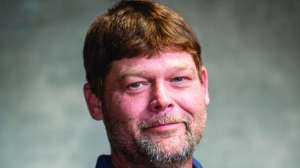
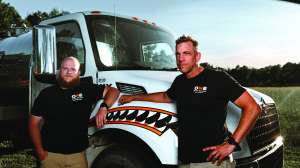
For George Allen, hard work is a cornerstone of success — that’s what helped him build Desert Septic of Casa Grande, Arizona, into a multi-service contracting business. However, a “widowmaker” heart attack in 2023 has helped him place greater focus on his health, which is more important than any business.
The Casa Grande, Arizona-based business’s wide range of services, including septic system design, installation, repairs, inspection and pumping, started out as a side operation while Allen was working in another industry. After leaving his job as a corrections officer in 2005, Allen started a new job as a cement truck driver. In 2006 he took on weekend work driving a septic service truck for a friend who was operating a commercial pumping business.
“We would pump out a subdivision that wasn’t connected to municipal sewer service seven days a week,” Allen recalls. “But every day, he would turn down septic tank pumping work. I told him I would take on those jobs if he didn’t want them. He planned to retire, so I bought one of his trucks and started my own business. I told him I wasn’t just going to pump, I was going to do septic system installs and repairs.”
WORKING DOUBLE DUTY
Allen founded Desert Septic in 2007 and worked double duty until 2009.
“I would park my pump truck at the parking lot, work my cement truck shift, then get back to work in the pump truck before coming home,” he says. “I started out with pumping and inspections but I got online every night to read, study and learn anything about septic systems, how they worked and what the business was like — including looking at issues of Pumper magazine.”
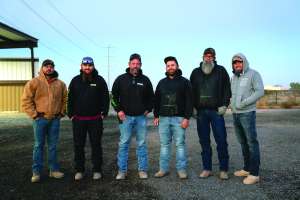
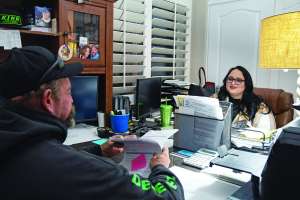
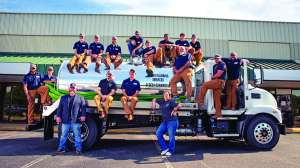
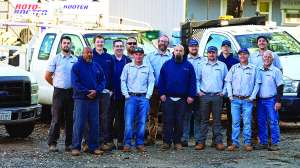
Desert Septic hired its first employee in 2012. The business now employs eight people, including Allen and his daughter, Nikki Arias, who runs the office. Allen typically works in the field on the septic side, while two crew members handle pumping duties.
The company fields three vacuum trucks, including a 2008 Mack with 3,500-gallon waste/300-gallon freshwater carbon steel tank and Jurop pump built out by Tank World Corporation, and a 2000 International with a 3,500-gallon steel tank with a National Vacuum Equipment pump. Desert Septic is currently building out in-house a 1991 International with a 3,200-gallon steel tank and Masport pump. A Crust Busters septic tank agitator rides along for tough jobs.
The summer days are hot in Arizona and work typically begins at 5 a.m., and ends — where possible — at 2 p.m. All of the company’s equipment features heavily tinted windows and ice-cold air.
EQUIPMENT CORNER
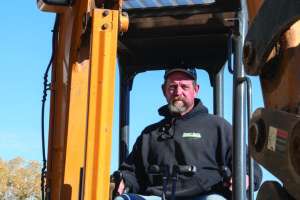
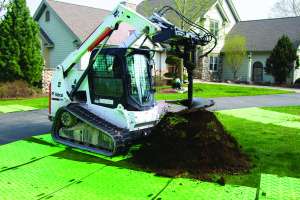
All of the excavators are CASE-branded: a 2011 CX17C, a 2018 CX37C and a 2020 CX60C alongside a 2005 580M backhoe. A pair of CASE skid-steers, a 2017 SR175 and 2022 TR270, round out the earth-moving fleet.
“My dad sold mining equipment and I grew up on CASE,” Allen says. “I find their products to be the most affordable and dependable.”
A range of four Ford trucks — a 2006 F-250, a 2001 F-450, and a 2007 and 2008 F-550 — haul trailers and equipment.
Desert Septic also keeps a pair of RIDGID drain snakes handy as well as two cameras, one by Spartan Tool and another by General Pipe Cleaners.
BUSY WITH INSTALLS
With a growing Arizona population relying on decentralized wastewater treatment, the company currently installs about 250 systems per year and pumps 15 to 20 tanks a week.
“After COVID, people have been looking for acreage — they want to be somewhat self-sufficient,” Allen says. “There are plenty of one-acre properties on the outskirts of town, and there isn’t a sewer pipe within miles. There’s such a rush that people are giving us a deposit, putting their houses up for sale and selling in two days before they have a new floor poured. They need to move a trailer onto the new property since they have nowhere else to live.”
Desert Septic designs a range of septic systems for clients, in both Pinal County and neighboring Maricopa County. Allen prefers to design septic systems, provide drawings and perform soil tests himself, so there’s no delay in getting to an install. However, in Maricopa County, an engineer or registered sanitarian must conduct soil tests on behalf of the designer.
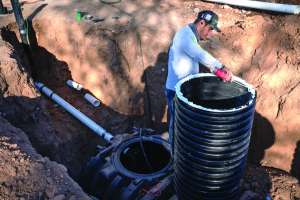
Many of the systems are conventional designs featuring concrete or poly tanks. For concrete, the company uses local suppliers Arizona Septic Precast Products and Neece Precast Products. However, with precast products in high local demand, the company often utilizes Infiltrator Water Technologies poly tanks from Ferguson Enterprises.
SEEPAGE PITS
The company has taken on some commercial work, but the size of the tanks in the luxury residential markets — as large as 4,500 gallons — rivals those projects.
One of the most common designs in Arizona is the seepage pit.
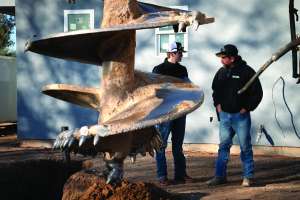
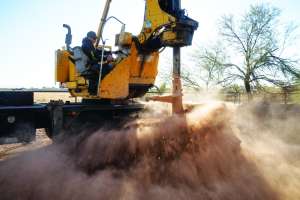
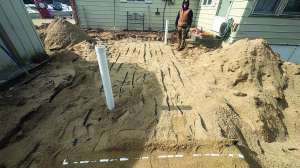
“They’re not common in other parts of the country except Southern California,” Allen says. “We come in with an auger 4 to 6 feet in diameter and we’ll drill straight down 40 to 50 feet. We then push a perforated pipe into the center of the excavation and surround it with gravel so it acts like a vertical leach line. It operates on a very compact footprint, so you can take a lot of 120 feet by 80 feet and still fit a mobile home on it.”
Desert Septic also installs gravel trench systems and chamber systems from Infiltrator.
For rocky soils, the contractor often installs alternative systems, including Norweco drip and Jet drip systems (Desert Septic is a distributor), biomat systems from Presby Environmental Products (Infiltrator Water Technologies), and Eljen geotextile sand filter systems. Desert Septic also uses products by TUF-TITE.
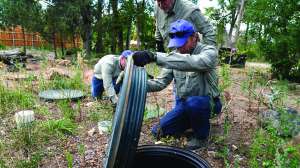
System repairs generally run from drainfield replacement to tank repairs. Many tanks in the area are damaged by the roots of desert-hardy trees that homeowners plant in their yards.
HEALTH CONCERNS
Allen kept up a steady pace of work until April 2023, when he suffered a massive heart attack.
“It was a Friday and I was installing a leach line and I felt nauseated and had pain in my shoulders,” he recalls. “I took ibuprofen and told everyone I’d be fine and that stuff needed to be done. My wife, Leah, a nurse, told me I needed to get checked out, but I didn’t take her seriously.”
Allen returned to work on Saturday, but felt far worse by midday.
“I was having trouble breathing, which wasn’t like me,” he says. “I’m an active guy — I hike, I hunt and I work out at the gym. I called my daughter and she encouraged me to come home, but I finished digging the trenches before I told the guys something was wrong and I was going to leave.”
Leah Kelly-Allen drove him to the hospital where a blood test revealed that he was having a massive heart attack, which had begun Friday morning and extended to Saturday.
“The doctor told me that I had three blockages, one of them 100% — a widowmaker — and that I should not have made it to the hospital,” he says.
The heart attack had crept up on him. In 2017 he weighed almost 300 lbs. and started to go to the gym, lose weight and eat healthier.
“I’m now healthy, active and never been a smoker,” he says. “But I’ve been a Type II diabetic since I was in my 20s.”
After his overall health and diabetes improved, Allen had gone off his diabetic medications and stopped monitoring his blood sugar. But the silent symptoms of diabetes worsened at some point, damaging blood vessels and causing a rapid buildup of plaque in his arteries.
Following triple-bypass surgery, Allen was out of commission for several weeks, then slowly returned to paperwork and handing out assignments each morning. He returned to regular duty about seven weeks after the bypass procedure. He credits a dedicated and well-trained crew for maintaining the business during his convalescence.
“All of the employees stepped up, took over, and handled what needed to be handled,” he says. “They were answering the phones, they were taking care of the customers, my foreman was dealing with the superintendents at the job sites, and my daughter was with me in my home every day.”
NEW LEASE ON LIFE
At age 52, Allen now lives his life differently. He carries a blood sugar monitor that operates at all times and reports to an app on both his and his wife’s cellphone if his blood sugar is either low or high.
He recalls texting customers while still in the hospital on a gurney. But the message eventually filtered through — working hard is good, working too hard is not. He’s now committed to reducing stress levels in his work life, and the lives of his crew.
“If someone calls me now and wants a job done tomorrow, I tell them I’m not their guy,” he says. “I don’t want my employees to be obsessed about meeting unrealistic deadlines either. We always have enough work to keep us busy for the next three months, so I am not going to lose sleep over one job.”
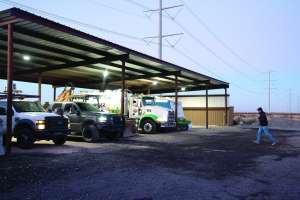
Allen continues to operate Desert Septic from his home acreage, but has recently purchased a one-acre industrial property where he plans to build an office and 4,500-square-foot shade awning to protect workers and equipment from the hot Arizona sun.
“Having a business run from your home, you never get away from it,” he says. “This will give me some space between work and home life.”