Justin and Bonnie Browne started out on different career paths, but they seemed destined to join forces as a power couple in the septic field.
Keeping J. Browne Excavation, a multiservice contracting firm in Leonardtown, Maryland, healthy involves loving what they do, and generating incremental revenue as they seek more profitable endeavors.
Justin started the business in 2005 as a landscaping service, J. Browne Lawn Services. However, demands for excavation work soon changed the focus of the company, which rebranded as J. Browne Excavating in 2007.
“I’ve been running tractors and heavy equipment since I was 14 or so,” he says. “It was a natural area of growth for me. I soon started working for homebuilders who asked me to work on septic system installations. At that point I learned more about these systems and became a certified installer and also branched out into septic system repairs between installations.”
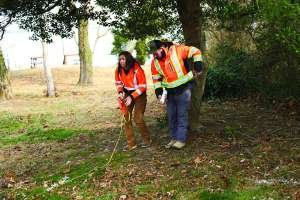
Bonnie was introduced to construction through her father, who owned a painting company. However, even as she attended Catawba College pursuing a degree in environmental studies, she seemed to be assigned primarily to construction-related internships. Her first job out of college was conducting stormwater inspections in North Carolina. Other industry-related work included a position as an environmental health specialist, inspecting stormwater management systems with the state of Maryland and designing septic systems on behalf of local health departments.
JOINING FORCES
Bonnie joined J. Browne in 2017 to take over the septic and office side of the business, allowing Justin to concentrate on construction as head foreman and dozer operator.
In Maryland, septic system installers must be certified on a county-by-county basis. Bonnie is licensed in her home county of St. Mary’s as well as neighboring Calvert County. Installers must also be certified by the state to install different types of septic systems and by the suppliers who provide the tanks.
J. Browne’s service area is located along the Potomac River as it enters Chesapeake Bay, a mix of lowlands and hilly terrain that requires a range of septic solutions for residential and commercial customers within an hour’s drive of home base. About 30 to 40% of the contractor’s work involves onsite septic work, with the remaining focus on construction, including site work and directional drilling. The company headquarters features a 30-by-80-foot shop where a full-time mechanic maintains equipment.
The company provides a one-stop shop, assisting clients with permitting and handling applications for Maryland’s Bay Restoration Fund. The fund offers grants for homeowners and businesses to upgrade failing septic systems in the Chesapeake Bay Critical Area using best available technologies to reduce nitrogen pollution.
“Since the beginning of 2023, regulations have changed,” Bonnie says. “System installers must also provide the system design for repairs. With new construction, they must use the services of an engineer.”
WELL ROUNDED
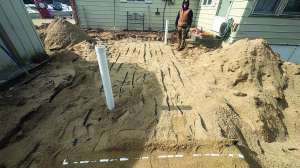
J. Browne designs and installs a range of system types from conventional drainfields, to drip systems and sand mounds.
“Mounds aren’t popular with homeowners on the waterfront,” Bonnie says. “You have to imagine if you purchase a property on the water and the next thing you know, you’ve got a 4-foot sand mound obstructing your view. A drip system can be the answer.”
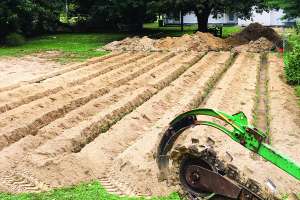
This summer, the company built its first drip system with the aid of a Parsons DP100 cable plow, which plows the dripline as it excavates.
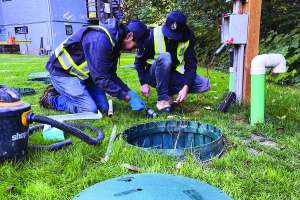
Bonnie is also certified by the state of Maryland to inspect sewer systems on behalf of the buyer or seller during real estate transactions. She often receives referrals from real estate agents following inspections by other professionals.
“They ask me how to interpret the notes on an inspection report and then ask me what can be done to rectify it,” she says.
As some older houses in the area are eventually connected to municipal systems, J. Browne also performs utility connections.
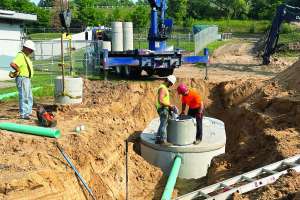
The contractor uses concrete precast tanks supplied by local supplier Superior Tank, including Norweco products, and Hoot precast tanks from Mayer Bros. Where tolerances are too tight for concrete, the company installs plastic tanks provided by Bay Area Environmental.
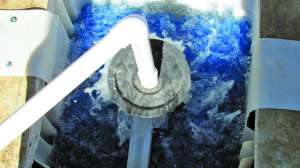
J. Browne also uses SeptiTech STAAR filter systems or BioMicrobics filters supplied by Bay Area Environmental to assist with nitrogen reduction.
WELL EQUIPPED
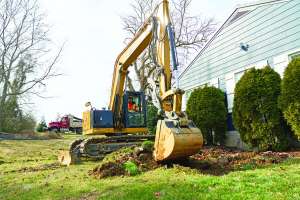
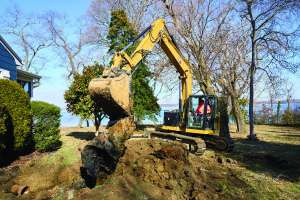
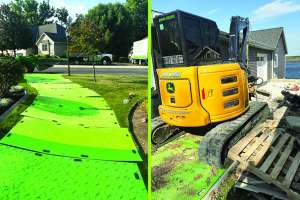
The company fields five excavators. Three made by Cat, a 2014 320, a 2022 317 and a 2023 310, work alongside a pair of Kubota mini-excavators — a 2008 U45 and a 2015 KX080-4. Three skid-steers handle the smaller work: a 2023 Cat 289D3; a 2018 Bobcat T770; and a 2022 Bobcat T66.
They’re assisted by four Mack Granite dump trucks ranging from a 2004 to a 2020 and a 1996 Mack CH613 road tractor. Justin says he likes the durability and reliability of Mack trucks and the availability of parts from local dealer Baltimore Potomac Mack Truck Centers. “When parts are needed, I know they’ll be here the next day,” he says.
The company uses the Parsons cable plow to install electric, water and sewer utilities for new home construction and repairs. A Vermeer D23x30 directional drill allows the contractor to bore under sidewalks and roadways to complete utility work.
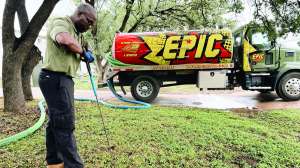
Bonnie advocated for the most recent addition to the fleet, an old reliable 1988 S1900 International pumper truck with a 2000-gallon stainless steel tank and pump from Becker Vacuum Pump.
“We installed six septic holding tanks last year, where there were no alternative designs possible,” she says. “These systems required continuous pumping and we kept recommending other contractors. The vacuum truck allows us to collect incremental revenue and not leave easy money like that on the table.”
The pump truck also creates connections and opportunities for the contractor’s repair services, which provide steady work, and has made septic tank replacement jobs more efficient.
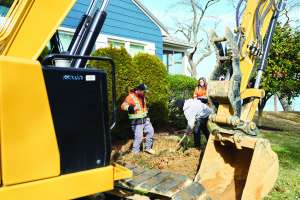
“Maryland no longer allows mid-seam septic tanks, so if they’re discovered during a repair or inspection, they have to be replaced with top-seam tanks,” says Justin. “But we’ve experienced delays waiting for local pumpers to pump out the tanks so we can remove them. Now we pump the tank first thing in the morning, rip it out by 10 a.m. and start to get it backfilled and tied to the house by early afternoon.”
QUALITY CREWS
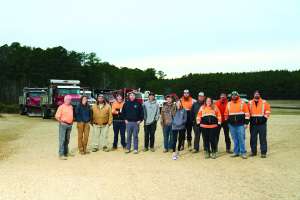
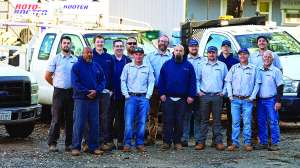
The company currently employs 18 people. Fieldworkers are organized into three crews: one in commercial work, another in residential and a third conducting mostly residential work, along with sewer and utility work, such as boring.
The Brownes say they’re happy with the current size of the company, even though a fourth crew might come in handy when utility boring work is heaviest.
“Bonnie and I and another project manager can handle the office at the company’s current size,” Justin says. “We’ve put together a great team of experienced and well-educated people over the past five to 10 years and we’re happy with that. Instead of getting bigger, we’re concentrating on becoming more profitable and that includes building on the skills of our crew.”
What do the next 25 years look like? The couple are raising a crop of potential next-generation business operators among their four children. Their oldest, Travis, is 16 and helps out with the business during the summer, while Savannah is 13 and assists in the office. Owen, 12, is keen to run the equipment. The youngest, Maverick, is 7 and shows an interest in site plans.
“But we’re not the type of people who will just hand the business over to one of our kids, believing they’ll want to do it for the rest of their lives,” Bonnie says. “We want them to go after what they really love to do first. I think the reason Justin is so successful is because he actually loves this industry so much.”