
Rick Viita and his team rarely encounter the deep and permeable soils that onsite installers prefer.
In northeastern Minnesota’s St. Louis County, in the area of the 61-square-mile Lake Vermilion, shallow hardpan and bedrock are common landscape features. “A typical site on Lake Vermillion has about two feet of usable soil,” says Viita, owner of Viita’s Excavating.
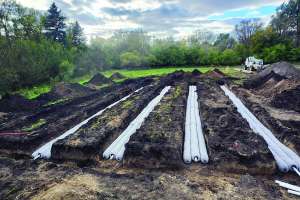
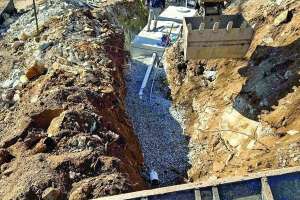
That means mound systems with timed dosing are more the rule than the exception for Viita’s installation crew. The company installs about 30 onsite treatment systems per year including some on the lake’s islands, of which there are 365, all but 86 privately owned.
The company is one of the few full-service septic contractors in the region, handling septic and holding tank pumping and maintenance, system design, inspection, line cleaning and water and sewer hookups. The team also performs general excavation, site preparation, road and pond construction and other earthwork.
Viita has been in the onsite and excavation business for three decades and incorporated his company in 2000. It’s a strongly seasonal business that largely shuts down during the area’s long and harsh winters. In recent years Viita’s son, Spencer, has joined the business, bringing business and marketing expertise to the 15-member team.
Homegrown business
Viita grew up in Cook, a small city where the business is based. Working in soil came naturally: his family had a small farm, and from a young age he also worked for neighboring farms, one dairy and one beef. His father was a heavy equipment operator, which helped spark his own interest early on. “I loved tractors and equipment,” he recalls. At 16 he began helping a friend install gravity septic systems.
After high school, Viita studied heavy-equipment operation in technical college and worked at an iron mine to build financial stability. “I did that just to be able to get bank loans and build up credit,” he says. “It gave me the steady income I needed to buy my first equipment and start out on my own.”
After five years, he launched his own company. “By default, I ended up doing the challenging lots — and that’s been our niche ever since,” Viita says. That early drive to take on tough jobs still defines the company today, including the island projects that require hauling sand and equipment by barge.

Across the water
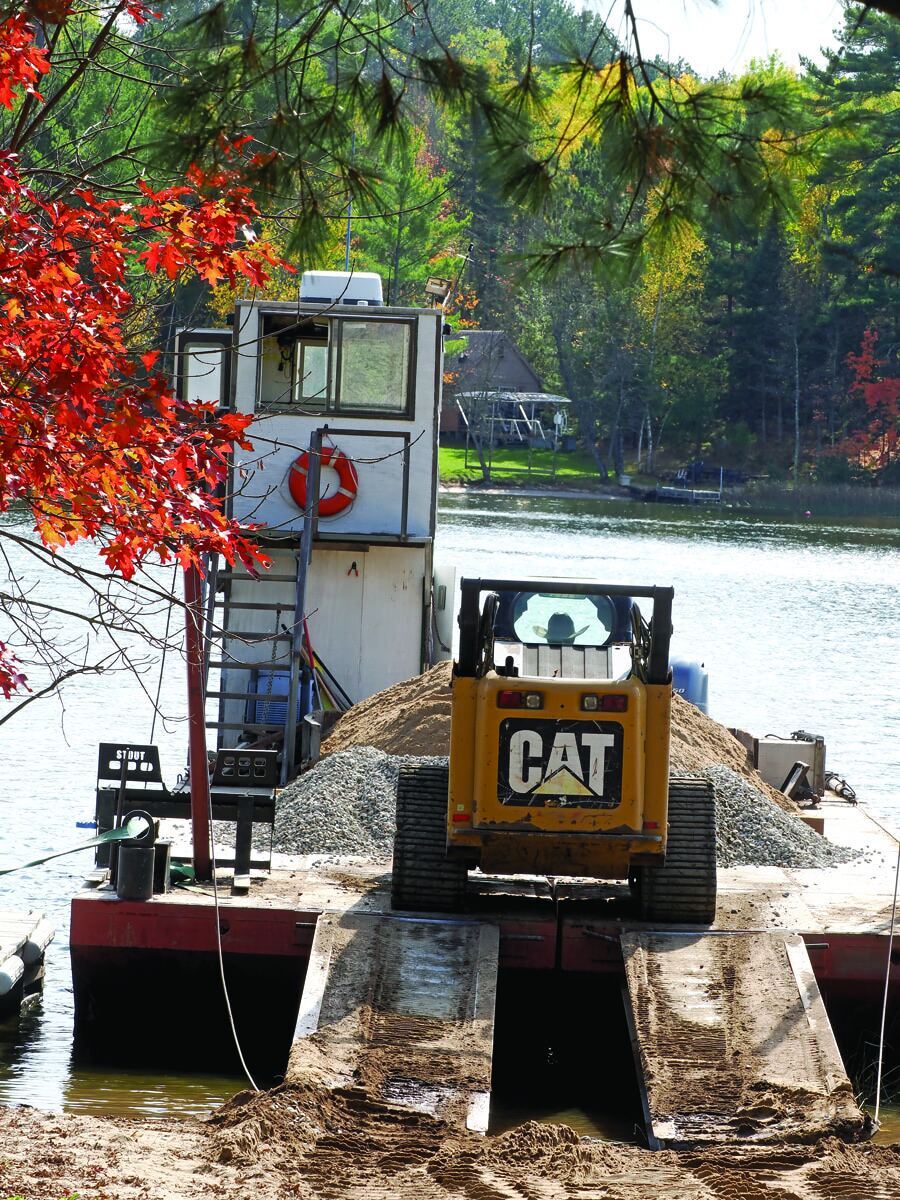
Because islands account for only about 5% of installations, Viita contracts with local and trusted barge operators instead of owning the vessels. Island jobs involve complex and costly logistics.
“Every island site is different,” says Viita. “Some have good access right from a public landing, and others require us to move equipment and sand multiple times to get everything in place. It takes a lot of planning and patience, but we enjoy the challenge.”
Each barge load typically carries about 30 cubic yards of sand along with the necessary machinery for the site. “If the property isn’t far from a landing, we’ll drive our loaded quad-axle dump trucks right onto the barges and haul them to the site,” Viita says. “If it’s not near a landing, we dump the sand onto the barge, then at the landing a skid-steer loads it into a tracked truck that brings it to the mound site. Usually it’s three solid days of barging equipment and materials.”
Viita Excavating used to install peat filter pretreatment systems on islands. “But in the last couple of years, the county has gone to sizing based on contour loading rates,” says Viita. “Under the newer approach, a peat bed ends up about the same length as a mound. With that, we’ve found mounds to be the more practical and cost-effective option for most sites.”
On sites with shallow impermeable layers, sand mounds are the go-to systems: “Even on the mainland around Lake Vermilion, the lots are pretty small, so we time-dose everything. We make our beds a little bit smaller. We use about a 30% reduction, put in a bigger pump tank and time-dose it.”

Tools of the trade
Viita’s machinery inventory includes:
Excavators
- 2013 Hitachi 290 LC-5
- 2012 John Deere 160G
- 2021 John Deere 75P
- 2021 John Deere 26P
Compact track loaders
- 2020 John Deere 325G
- 2021 ASV 65
Wheel loaders
- 2013 John Deere 544K
- 1983 John Deere 644C
The company also relies on a 2008 John Deere 650J dozer and two 2002 International 5600 quad-axle dump trucks.
This combination of machines allows the team to handle everything from small residential system replacements to complex multiday island and commercial projects efficiently and safely.

Doing it right
The Viita team thrives on quality work. That includes landscaping after the system installs: “Our yards look like parks when we’re done. There are some yards where we lay sod, but typically it’s seed and erosion-control fabric. It goes back to professionalism — a site that you’re proud of when you leave.”
Team members also pay attention to details that customers can’t see. “Through the years I’ve gone back and repaired tanks that have settled because the previous installers didn’t properly bed them with sand,” says Viita. “Our tanks are set on select sand compacted right to the top. I’m not on many sites anymore, but the crew takes care of it. They know how to do it right.”
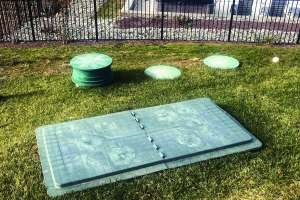
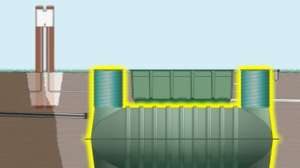
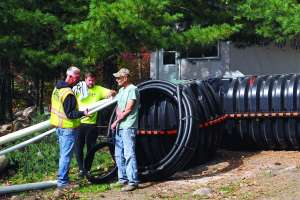
Quality materials also come into play. Viita uses mainly plastic septic tanks (Infiltrator Water Technologies) to avoid deterioration that affects many concrete tanks in the area. “Plastic tanks have become a great option because of their current structural integrity, ease of placement and the fact that they eliminate the corrosion issues we sometimes see with concrete,” Viita says. “Both materials have their place — it depends on the application.”
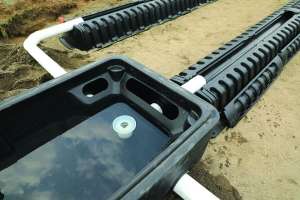
Goulds is the main pump supplier. Ultra-Rib-Style risers (Orenco) provide leak-free seals on septic tanks and holding tanks. “In northern Minnesota, about 85% of risers are leaking. That’s not based on our installs. That’s from what we observe in our pumping business — the frost moves those risers. On all of our concrete tanks, we use Ultra-Rib risers, so we have no seams.”
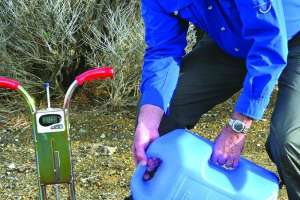
On the maintenance side, Viita Excavation operates two vacuum trucks: A 2006 International 4,000-gallon pump truck and a 2010 Freightliner 2,500-gallon pump truck. The trucks pump about eight tanks per day on mainland properties and on islands via barge. A Crust Busters tool comes in handy for stirring tanks and breaking up solids to ease removal.
Electrical control panels are another frequent service item. “We’re repairing, replacing or adjusting one of those probably every third day,” Viita says. “They take a beating from the weather. When we can mount boxes inside the homes, they last a lot longer — the only challenge is that the homeowners need to be there when we arrive.”

Union strong
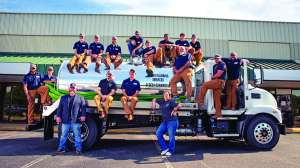
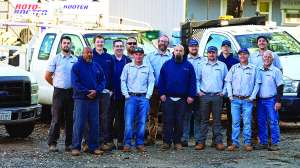
Viita takes pride in hiring, training and retaining a highly skilled team. His wife, Amy, is his true partner and handles accounts payable. His son Spencer manages estimating and is transitioning into leadership. Zach Cheney, his son-in-law, is lead installer; Pat Fosso is foreman and runs field operations.
Other key team members include Mark Toivela, lead pumper; Thomas Turk, service technician in training; Bob Howe and Scott Erickson, truck drivers; Paul Griffin and Charlie Lerfald, operators and crew members; Sara Niska, office coordinator and dispatcher; Tadd Nelson, mechanic and fabricator; and Cole Snidarich, TerraGator operator.
Like most companies in the trades, Viita’s Excavating has faced its share of turnover until about 10 years ago when the company affiliated with the International Union of Operating Engineers Local 49. “I used to struggle with retention just like everybody else. In this industry, you need five years before you really know what you’re doing,” Viita says. “Employees would get very good and then move on because our seasons are short. Employees are what make a company.”
Union wages and benefits, including retirement, helped the retention problem. Also valuable is the training available through the union.
“The Operating Engineers have a training center near Hinckley,” Viita says. “I was fortunate to go there one winter and work as a part-time instructor. I got to see all the acreage and the programs that were available. So our operators go there every winter for free training on OSHA, MSHA and confined space entry, and on all the equipment. They’re getting trained in a big sandbox, not in customers’ backyards.”
Viita also serves on the mentorship committee that is developing a program to be offered through the Minnesota Onsite Wastewater Association. The goal is to strengthen industry professionalism and help members build sound, sustainable businesses. “The business side is just as important as being able to put that pipe in the ground,” he says. “Sharing knowledge and experience helps new contractors price work correctly and grow with confidence.”

New generation
Viita’s son Spencer has added a strong business acumen and technology integration to the company: “He started with us as a laborer. He didn’t have the passion for the equipment like I did. He went to the College of St. Scholastica for business and marketing, and that’s where he comes in.”
Spencer has taken the company’s use of technology and run with it, finding new ways to make operations more efficient and connected. “Our service techs can take photos right onsite, and the whole team can see them instantly,” Viita says. “If Zach runs into an issue during an install, he takes a picture and Pat, Spencer or I can see it right away to help him through it.” The company uses the BusyBusy by Alignops mobile time card app, designed for construction and similar industries.
The app also supports scheduling, dispatching and bill paying and payroll by way of integration with QuickBooks accounting software. In addition, for system designs, Spencer uses NewSeptic land and septic planning software, a GIS-based program that includes geographic data, a septic components database, mapping tools and much more.
Business is going so well that marketing consists of, by Viita’s estimate, 95% word of mouth: “It does help that, being our size with our pickups and vacuum trucks, people see our logo always driving around.” That bodes well for a prosperous future.
Continue reading for free