
Upgrading a conventional septic system to meet total nitrogen limits
Problem: A wastewater treatment site in Minnesota was originally designed with a standard septic tank treatment system that had operated reliably for years. However, new regulatory requirements introduced stringent total nitrogen discharge limits that the existing system was not designed to achieve. Sampling data quickly confirmed that the conventional septic tanks could not provide the biological nutrient removal necessary to meet the updated standards. The site required a solution that would achieve compliance without the cost of a complete plant replacement, minimize disruption and perform reliably in Minnesota’s cold winters.
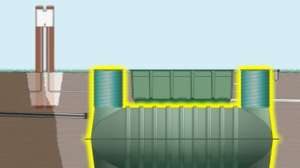
Solution: EarthTek converted the existing treatment system into a SABRE Sequencing Batch Reactor. The retrofit leveraged existing infrastructure while incorporating advanced aerobic treatment and controlled operating cycles to promote nitrification and denitrification. The unit was specifically selected for its flexibility, compact footprint and proven performance in cold-weather applications. Buried tank installation further enhanced temperature stability and biological activity year-round. Automation and controls were added to manage treatment phases and optimize nitrogen removal.
Result: After completion of startup, the upgraded unit has consistently achieved compliance with the new limits, allowing the site to remain operational without regulatory violations. The conversion has delivered improved effluent quality, operational reliability and long-term compliance, demonstrating how an existing septic system can be effectively upgraded to meet modern nutrient requirements utilizing a custom-designed treatment solution. 800-972-9940; www.earthtek.com
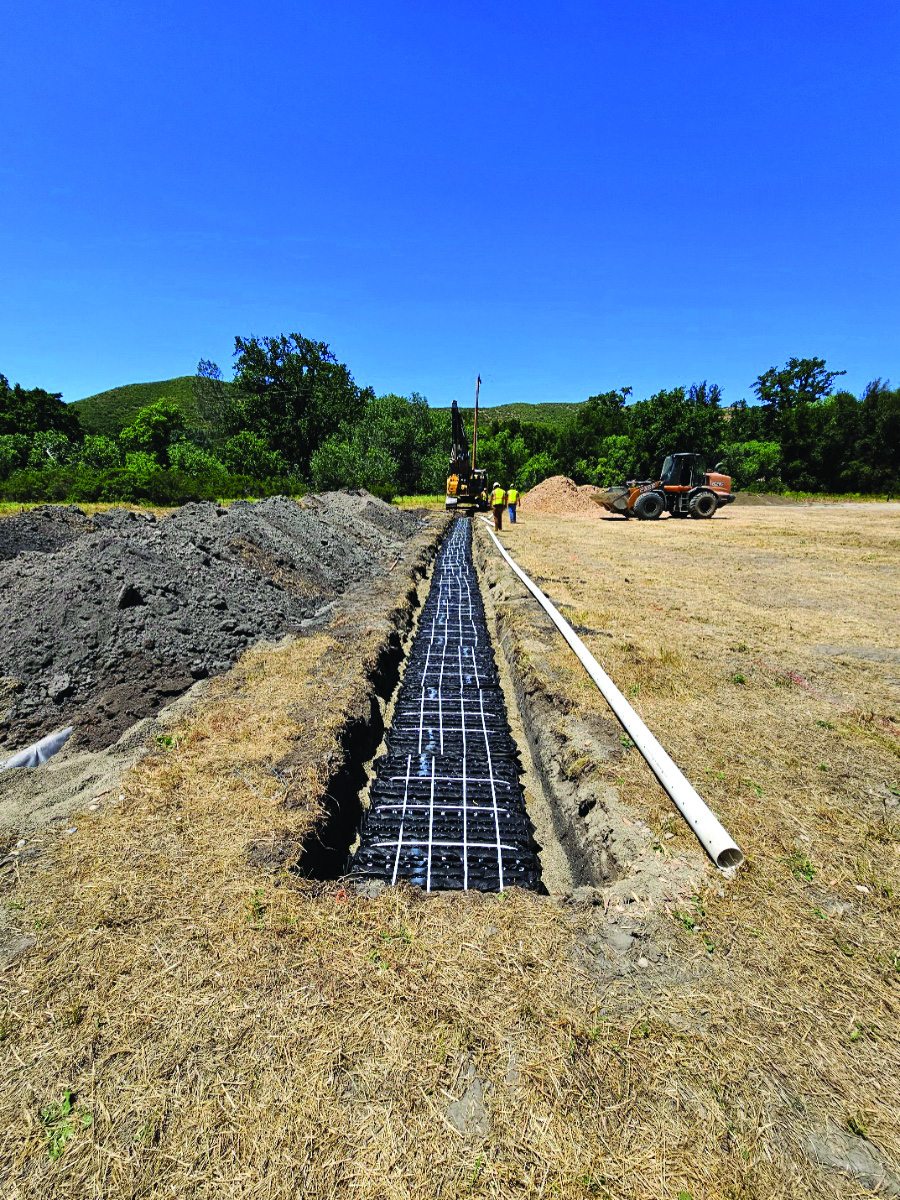
Passive denitrification a fit for site with challenging conditions
Problem: Pinnacles National Park, located in Central California, is renowned for its striking spires, canyons and as a refuge for the endangered California condor. Protecting the pristine landscape and delicate ecosystems is a top priority, especially when it comes to wastewater treatment. When the park sought a sustainable solution to meet nitrogen reduction goals, the Eljen Geotextile Sand Filter was selected and installed in its nitrogen reduction configuration.
Solution: The site’s conditions, low groundwater, rocky terrain and a high-value natural habitat made Pinnacles an ideal candidate for the GSF’s passive denitrification capabilities. Unlike mechanical treatment systems, the GSF requires minimal maintenance and no power, which reduces operating costs and environmental impact. The layered geotextile and sand filtration process ensures advanced treatment, significantly lowering nitrogen, BOD and TSS levels while protecting surrounding water resources.
Result: Since its installation, the GSF has provided reliable performance with a small footprint, aligning with the National Park Service’s mission to conserve natural resources for future generations. This project illustrates how innovative, low-maintenance technologies like the GSF can serve sensitive sites where both performance and sustainability are critical. 800-444-1359; www.eljen.com

Aerobic biological technology installed in a coastal city wastewater treatment plant
Problem: A coastal city on the Aegean Sea is a renowned tourist area with pristine beaches for domestic and global tourism with a population of 3,500 during the winter months. During the peak season (April through October) the population reaches 15,000. The city’s 300,000 gpd wastewater treatment plant was failing due to this population increase. To meet the treatment requirements, a sizable expansion was needed. This solution, however, was geographically and economically unfeasible. The effluent wastewater was reused for the required irrigation of the olive groves on the hillside. This practice, however, caused an unfortunate increase in E. coli and intestinal Enterococci population in the sea at nearby beaches resulting in the loss of beaches’ Blue Flag status.
Solution: Thirty-two IMET Wastewater Treatment Modules were installed into the aeration basin of the existing infrastructure without any additional construction or expansion.
Result: The city achieved meeting the effluent requirements at all times by sustainable reduction of COD, BOD and TSS. Treated wastewater continued to be reused for the needed irrigation. The city reported that the implementation of the technology achieved significant reduction of E. coli and intestinal Enterococci population in the sea, thereby allowing its beaches to regain the coveted Blue Flag status. While the required effluent quality was maintained, biosolids production was also at an extreme minimum, helping the city reduce disposal costs. 216-906-1066; www.imet.net

Chambers and recirculating media filter provide solution for challenging site
Problem: Boulder Canyon Group Home is a facility in a renovated mountainside inn building that will have 12 bedrooms accommodating up to 24 clients and 17 staff members. The existing wastewater treatment system was installed in the right of way under the bike path and was undersized with a nonfunctioning pump system. The 15.7-acre property is sloping with vertical rock in some areas and a creek running alongside. Site limitations and the requirement to install the system outside the Colorado Department of Transportation right of way was further complicated by the requirement of the installation of 80,000-gallons of fire cistern capacity.
Solution: The new system designed by Church Onsite Wastewater Consultants includes a 1,000-gallon grease interceptor tank, two 2,000-gallon single compartment septic tanks, a 2,000-gallon, recirculation/dosing tank and an Orenco AX-100 recirculating media filter. A pressurized open-bottom sand filter consisting of 168 Infiltrator H-20 traffic-rated chambers was also installed under the parking lot. With limited area for the tanks to be installed outside of the DOT right of way, installer CWS Excavating had to crane the septic tanks over the building to avoid shutting down the busy road. Due to limited site access and challenges getting import sand to the area, the water cistern tanks needed to be installed before the soil treatment area.
Result: The design flexibility of Orenco and Infiltrator’s products allowed for a high performing wastewater solution on this challenging site. 800-221-4436; www.infiltratorwater.com

Treatment units and remote monitoring reclassify plant’s operations
Problem: Countryside Mobile Home Park in Sophia, North Carolina, needed its more than 50-year-old wastewater treatment plant replaced. The neighborhood and park residents wanted a system that would be neither seen, heard, nor smelled, while the property owner wanted something that would be easy to maintain.
Solution: Orenco Systems’ AdvanTex technology fit the bill. Plus, by including Orenco Controls remote monitoring capabilities, officials approved a permit reclassifying the plant from needing daily operator visits to weekly. The project’s design included 65 lots with 15,000 gpd permitted flow and a 7.5 mg/L BOD5 daily maximum. Because of site constraints, proximity to residents and effluent requirements, consulting engineer Kevin Davidson of Agri-Waste Technology proposed using two AX-Max treatment units and flow equalization. After positioning the AX-Max units toward the back of the site, crews set three 10,000-gallon precast concrete tanks for primary tankage. Two sequential septic tanks allow for ample solids retention and storage, and an equalization tank buffers the flow during peak usage.
Result: With dependable wastewater treatment in place, the park has been able to add new mobile homes. Lab samples show strong treatment results that are consistently well below regulatory levels. “The old plant was loud and smelled terrible, affecting everyone in the park,” says Michael Clayton of AQWA, the area’s Orenco dealer. “Replacing it has greatly improved life for the local community, making it a rewarding project for our team.” 800-348-9843; www.orenco.com

Replacing a failed sand mound with a low-profile alternative
Problem: After their sand mound system failed, a remote housing community in Pike County, Pennsylvania, needed a wastewater treatment system to replace it. The new treatment system had to serve 10 homes while occupying less space and maintaining a lower profile than a conventional sand mound. Due to local regulations, the community also needed the system to be cost-effective to operate and easy to monitor.
Solution: Kiley and Associates designed an installation with Premier Tech’s Ecoflo compact biofilter to meet the community’s needs. The compact biofilter offers a reduced footprint and reliable treatment without electricity or mechanical components. In Pennsylvania, the system can be installed in an at-grade bed, reducing overall height by up to 6 feet compared to a traditional sand mound. To further address operational requirements, they paired the installation with an advanced telemetry system, enabling remote performance monitoring and eliminating the need for routine onsite inspections.
Result: Reinfurt Excavating retrofitted septic tanks from the community’s existing infrastructure and installed the compact biofilter units in an at-grade bed, using the same footprint as the former sand mound. The addition of telemetry allowed the community to monitor the system’s performance remotely, lowering routine inspection costs while maintaining visibility into the system’s operation. 570-220-7937; www.ecoflo.eco
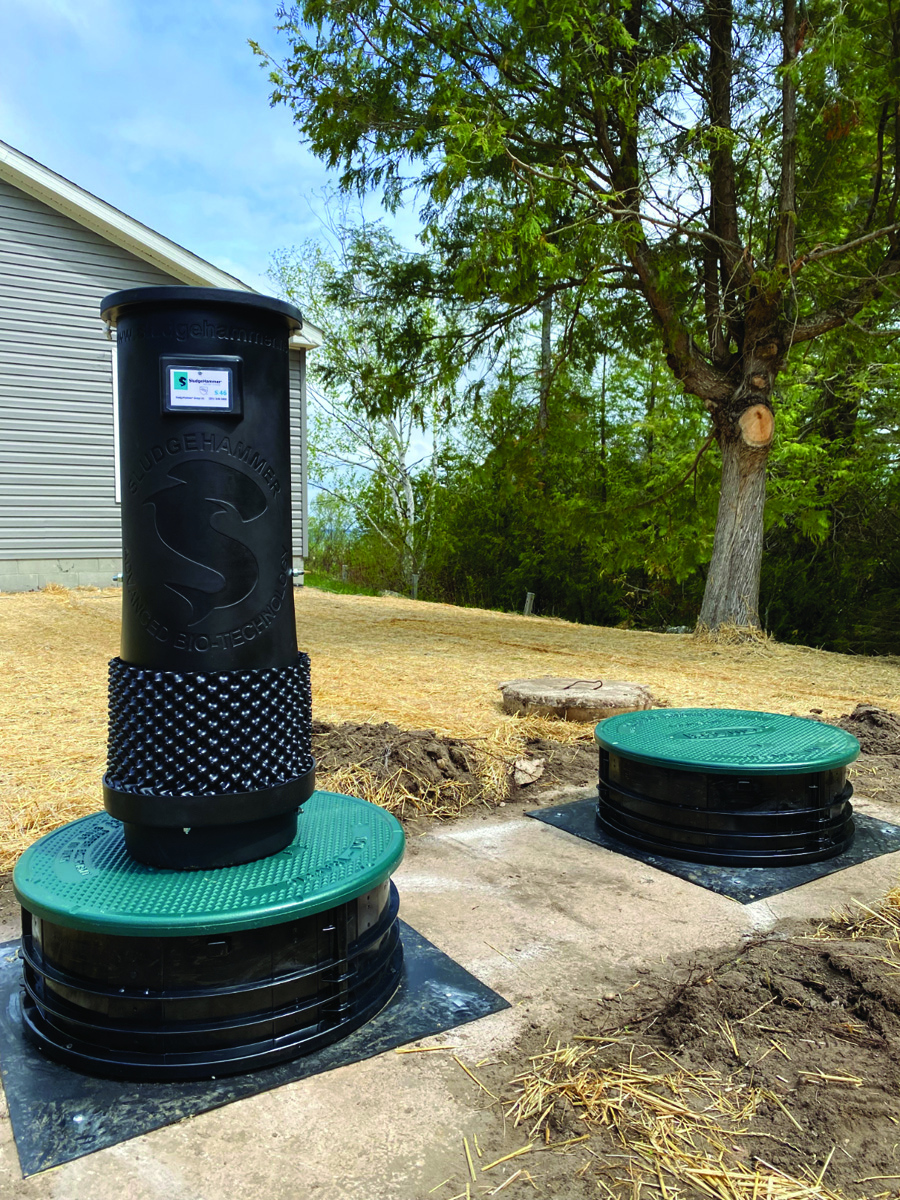
Decentralized wastewater treatment system protects sensitive coastal environment
Problem: The Sunset Shores residential community, located in Empire, Michigan near the Sleeping Bear Dunes National Lakeshore, required a long-term wastewater solution capable of serving more than 50 homes in an environmentally sensitive coastal setting. Existing onsite systems were limited by sandy soils, shallow groundwater and proximity to Lake Michigan. A proposed municipal sewer extension presented significant cost, disruption and permitting challenges, making it financially impractical for residents. Any alternative system needed to comply with strict State of Michigan Environment, Great Lakes and Energy treatment standards while minimizing environmental disturbance.
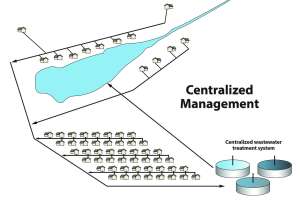
Solution: SludgeHammer’s engineering team designed an EGLE-permitted decentralized wastewater treatment system centered on HSW treatment technology. Individual residences discharge to a low-pressure effluent sewer network conveying wastewater to a centralized treatment area. Design flows exceed 12,000 gpd to accommodate full buildout and seasonal population increases. At the treatment site, ABG fixed-film bioreactors provide high-rate biological treatment, consistently achieving effluent concentrations of less than 25 mg/L BOD and TSS, with significant reductions in total nitrogen through extended aeration and biological assimilation. The modular treatment train allows scalable capacity, redundancy and simplified operation while maintaining stable performance under variable loading conditions.
Result: The decentralized sewer program delivered a cost-effective and environmentally responsible alternative to municipal sewer construction. The system met EGLE approval requirements and provides long-term treatment capacity for current and future residents. By reducing infrastructure costs, preserving sensitive coastal landscapes and protecting nearby surface waters, the project demonstrates how decentralized treatment systems can successfully serve large residential developments in environmentally sensitive areas. 231-348-5866; www.sludgehammer.net
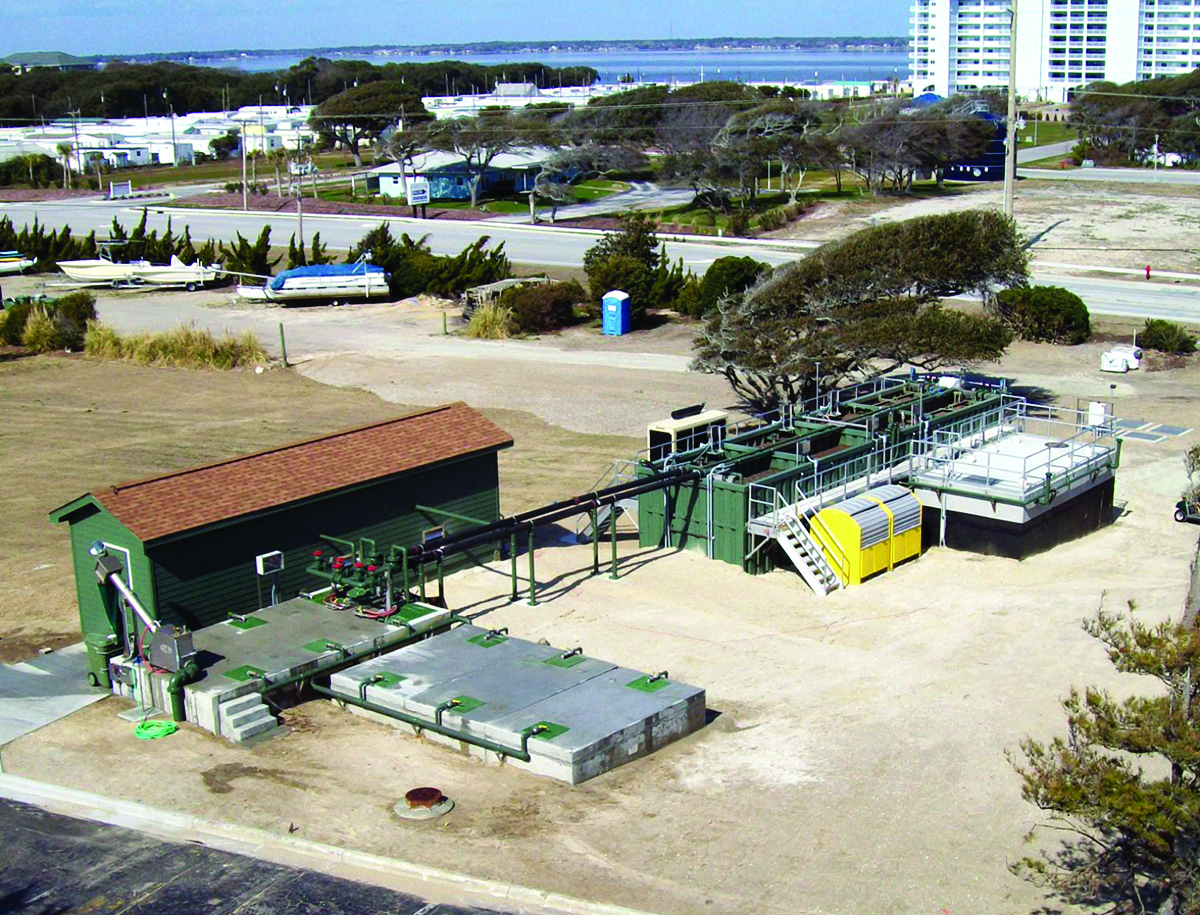
Ultrafiltration provides private development with water reuse capabilities
Problem: When developers of a condominium complex in Indian Beach, North Carolina, sourced wastewater treatment systems, it did so with two primary requirements: efficient land utilization and high effluent quality to meet stringent guidelines. The planned development included more than 200 condominium units near oceanside property. Developers required a system that would minimize land usage to keep project costs down. State regulators advised the developers to discuss combining its wastewater system with the owner’s association of an adjacent housing development whose existing wastewater treatment system was aging and required augmentation. Its subsurface disposal field necessitated a treatment system capable of producing high quality effluent that could be reused/reclaimed.
Solution: The parties agreed and selected the TITAN MBR wastewater treatment system from Smith & Loveless. The combined scheme required a 101,000 gpd treatment system with screening that could meet the local guidelines for subsurface discharge. The system’s modular design allowed for minimal land usage. Systems utilize flat-sheet membranes to meet or exceed the most stringent regulatory standards (including California Title 22) for direct discharge and secondary reuse applications. Designed with rugged stainless steel componentry and prewired cable trays, it is a factory-built plug-and-play system. The only thing that needs installation on site is the fine screen. Preengineered systems range in capacity from 1,000 gpd to 0.1 mgd.
Result: With the robust process design and flat-plate membrane performance, the project was successfully permitted and installed in 2009, where today it continues to meet the needs of the residential communities. 800-898-9122; www.smithandloveless.com
Continue reading for free