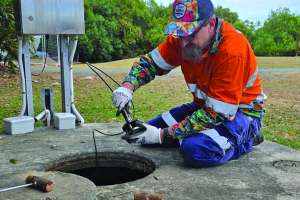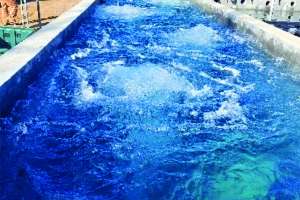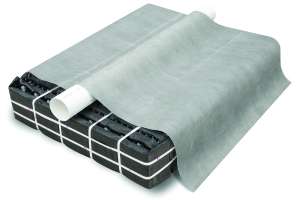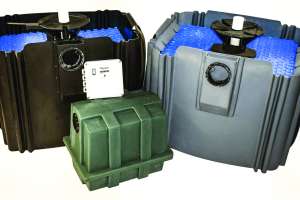
Colton Janes (right) and Sloan Griffin investigate the soils on site and discuss the LPP Infiltrator drainfield design. (Photos provided by AQWA)


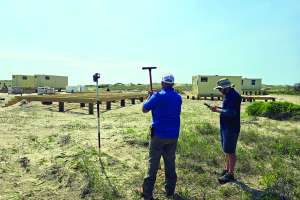
Colton Janes (right) and Sloan Griffin investigate the soils on site and discuss the LPP Infiltrator drainfield design. (Photos provided by AQWA)
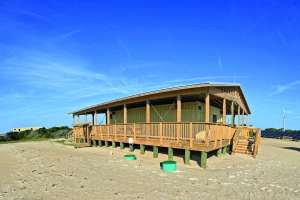
Following severe storm damage from Hurricane Dorian, the National Park Service needed to replace the Long Point Cabin Camp located at the Cape Lookout National Seashore on North Carolina’s Crystal Coast. Due to this 28,500-acre barrier island’s remote location on the sandy Outer Banks and a long history of severe coastal weather, the new campground needed an advanced, hurricane-rated wastewater system capable of handling extremely variable seasonal flows.
AQWA Treatment and Collections Solutions of Wilson, North Carolina, was tasked with providing design support, equipment preassembly and manufacturing services for the project. The company is an Orenco AdvanTex dealer and worked with project engineer Colton Janes of Janes Environmental, Ritz Construction and Infiltrator Water Technologies to design a highly specific septic system to meet the site’s unique environmental needs while complying with local regulations.
“We are a small business in Wilson, North Carolina, specializing in decentralized wastewater treatment collections and dispersal systems, primarily utilizing products manufactured by Orenco,” says Michael Clayton, AQWA’s sales manager. “We use plastic tanks like Infiltrator builds to provide preassembled collection system tanks. We also do some light manufacturing and engineering design support.”
This specific project involved a highly variable seasonal campground featuring a shower and bathhouse, a bunkhouse and an RV dump station.
“The washhouse, the bunkhouse and the RV dump station are the wastewater sources,” Clayton says. “Those systems feed into the STEP collection tanks. We pump the septic tank effluent to the treatment system, which is housed inside of the fiberglass building.”
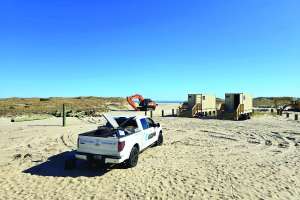
While Orenco’s technology is well proven, the site’s location on the North Core Banks added a layer of complexity to the system’s design and execution. The barrier island consists entirely of shifting sand, possesses no existing municipal utilities and has no roads. As a result, the site could only be supplied by barge.
These unique conditions altered the original engineering design. Initially, long gravity collection runs to a grinder lift station were proposed for the project. However, installing gravity runs would have positioned the collection lines deep within the island’s high water table and shifting sands, which would have put them at risk. As a result, AQWA worked with the contractor to develop an effluent sewer collection system instead. This pivot provided required primary treatment directly in the tanks and made the shallow-bury installation much easier to execute in the sand.
Because the campsite is located on a federal national seashore whose usage varies by the season, the engineering team didn’t have reliable data on anticipated average daily flows. So, to ensure compliance, they used North Carolina’s regulatory tables to establish a baseline design — ultimately sizing the system’s hydraulic capacity for an estimated 2,000 gpd peak flow.


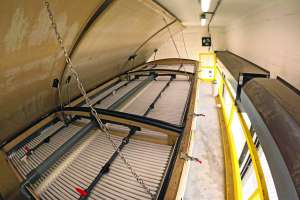
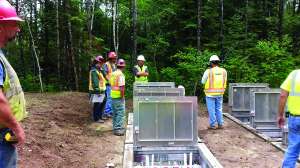
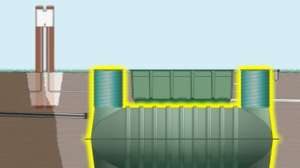
To resist corrosive salt water, high UV levels and hurricane-force winds, the water treatment unit is housed inside an Orenco Composites DuraFiber building. Primary treatment begins at the source, with the RV dump station discharging into a 1,000-gallon Infiltrator tank and the collections from the bath house and the bunkhouse served by two 1,500-gallon Infiltrator tanks.
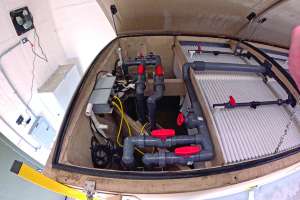
These tanks are equipped with internal baffle walls and 48-inch pump vault units containing Biotube filter cartridges. The effluent is moved by Orenco turbine pumps, which are governed by Orenco telemetry enabled VeriComm control panels and Orenco mechanical floats. The floats are programmed for high-level alarm/lag enable, on/off and low-level alarm/redundant off functions.
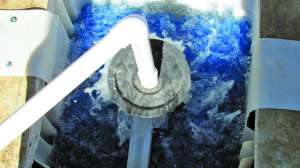
The effluent is pumped through 1 1/4-inch discharge lines directly into the central Orenco AX-Max 125-21 Advantex treatment unit, which sits securely on a flow-through composite platform supported by wooden piers. Inside the AX-Max, recirculation pumps dose the AdvanTex treatment media at regular time dosed intervals, while discharge to the drainfield is pushed by pumps on a demand-dosed basis. Both pump sets are programmed to operate in a duplex alternating mode.
The treated effluent leaves the building through a 2-inch pipe to the low-pressure pipe disposal area where it enters an indexing valve vault located at a higher elevation than the disposal beds to ensure proper operation and avoid freezing. The sequencing valve creates a two-zone discharge heading to Bed A or Bed B. To prevent siphoning and support system venting, a 1-inch Geoflow air-relief valve has been installed prior to the indexing valve, creating a two-zone discharge heading to Bed A or Bed B. The effluent lines are then reduced to 1 1/4-inch Schedule 40 PVC pipe until reaching the 3-inch manifold, which feeds the laterals of the LPP field.
The LPP dispersal field is built upon a design flow of 1,500 gpd and a soil long-term acceptance rate of 1 gpd per square foot, requiring a minimum total disposal area of 1,500 square feet. The actual drainfield design exceeds this, providing a total bed area of 2,160 square feet split evenly into two 1,080-square-foot beds. The drainfield consists of 168 Infiltrator Quick4 Plus standard units. Each bed utilizes six 58-foot laterals placed every 3 feet. The laterals are drilled with 5/32-inch holes, spaced 4 1/2 feet on average. During operation, the flow per hole is calculated at 0.499 gpm, resulting in a total field flow rate of 35.9 gpm. The system’s dose volume is 196 gallons over a runtime of 5.47 minutes.
Because there is no municipal power grid, the entire facility operates on an independent microgrid utilizing a solar array and a wind turbine. The solar and water well equipment are housed in two separate Orenco DuraFiber buildings. To monitor the system’s variable flows, Ritz Construction installed an Orenco TCOM telemetry control panel inside the wastewater building. The panel features an uninterruptible power supply and a cellular modem, allowing operators to seamlessly monitor data and receive automated alerts during microgrid power outages.
Getting this highly specialized equipment into the ground meant getting it across the water first. To make this happen, “All equipment was first delivered to a marine construction company in Beaufort, North Carolina,” says Clayton. “It was then placed on a barge, weather permitting and barged out to the project. And once it arrived at the dock on North Core Banks, it was driven a number of miles up the beach by heavy equipment.”
Crews towed the single-piece DuraFiber wastewater treatment building directly across the beach sand to the campground. The building came fully complete with two Stormtite 620 steel roll-up doors, which featured additional steel reinforcement to meet hurricane ratings. Meanwhile, the pump house and solar battery house were delivered as two-piece structures which were preassembled at the marina before barging.
For the drainfield installation, Ritz Construction crews had to excavate 14 inches down to create a perfectly level bottom for the beds. The absolute grade of the beds had to remain 12 to 18 inches above the documented soil wetness condition, which was measured at 32 inches below the existing soil surface. The LPP pipe was installed within the Infiltrator Quick4 Plus chambers and units were carefully covered with filter fabric.
Finally, 6 inches of clean, Grade 1 beach sand was added over the top to secure the units and ensure the proper cover depth.
Due to the extremely variable flows associated with this seasonal campground facility, the AdvanTex system was designed to require relatively low maintenance over time. Quarterly physical inspections of the system components are considered adequate for proper ongoing operation.
The island’s shifting sands are an ongoing challenge. “A simple example would be that when we went for the final startup and park service employee training, a number of the lids had been covered by a foot or two of wind-blown sand,” Clayton says. “A benefit of the way the treatment and the fiberglass buildings were designed is that those are on elevated decks and so they will be easily accessible all the time.”
Continue reading for free