
In the 1950s George Navo, a plumber from the East Coast, headed out west with his new bride and settled in Grass Valley, California, a small town in the foothills of the Sierra Nevada Mountains in the heart of Gold Rush country.
Unable to find plumbing work, he did odd jobs, including septic work. “Then he got a loan, bought a ‘piece of crud’ truck, and started a company, Navo & Sons, that was partly plumbing, partly septic pumping,” says his grandson Chris Navo, who currently manages the company along with his semiretired uncle, Mark Navo.
Over the following decades, under the leadership of George’s sons Randy and Mark, the company expanded into installations and inspections; bought two Roto-Rooter franchises; added septic design services and water and sewer restoration work; and became licensed to do maintenance and monitoring. “So we do everything from fixing a faucet to designing a septic system,” Navo says. “And on top of that we purchased the main supplier that builds and manufactures septic and plumbing parts for the area.”
Along the way, the company continually improved operations. They developed a robust training program, an innovative pricing structure and creative hiring practices.
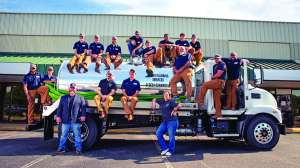
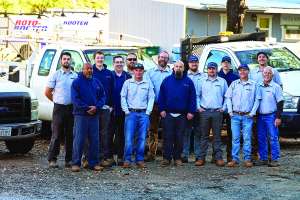
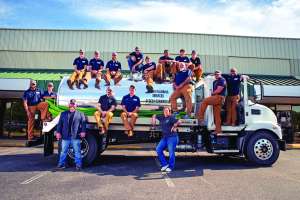
Navo oversees a staff of 36, many of whom are family including his daughter Lexi Gerving (part-time customer service), his brother Josh (pumper), his cousin Grady Navo (installations and repairs) and his brother-in-law Bill Curtis (warehouse mechanic). His wife’s sister Sherri Curtis oversees the administrative side of the business while 30-year-veteran employee Wade Avilla manages field operations.
ADDING SERVICES

Pumping was the main focus of the company for many years and is still about 60% of sales. Installation services were added around 1995 — but for an unusual reason. “Because we’d been around since the 1950s, we’d gotten this reputation that we were great installers,” Navo says. “But we weren’t. We had never done it. The community just thought we did. So my father got his sanitation license because why would you not do a service the community already thought you did? It was the easiest advertising we could ever do.”
The company is also licensed to do plumbing and electrical, so they have no need to sub out any of their installation work.
A separate division is the company’s design firm, which works not only on company projects but for other installers, pumpers and homeowners in town. “I put it as a completely different department on purpose,” Navo says. “Because if I put it in-house, it would make people think they were forced to use us. So each division is only competing in its area and then it’s up to the customer to make a choice.”
Customers might hire them for any or all parts of a job. “We are about the soft sell, not the hard sell,” Navo says. “When you do so many services for every type of customer, including your competitors, if you’re too aggressive you won’t have any sales. Everyone knows they can count on us to help without stealing the customer from them.”
VARIETY OF SYSTEMS
The company does 60 to 70 installs a year for systems costing anywhere from $20,000 to $100,000.
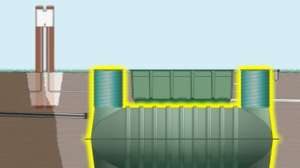
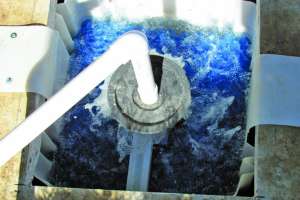
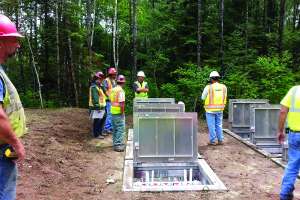
The most common pretreatment systems used in the company’s service area are from Orenco Systems (AdvanTex), Eljen and Infiltrator Water Technologies (ECOPOD), Navo says. Sand filters can still be installed, but they’re not very cost-effective in California, especially with the cost of labor and overhead. The company still installs quite a few pressure-dose and standard systems, but does not do aboveground or mound systems as they’re not practical in their area.

In California, septic system manufacturers must be approved in each county, so what the company can do in one county, they may not be able to do in another.
The company does perc and advanced floor and soils testing to determine what the soil needs are for each project. Soils in the area are quite variable. “Literally every system is custom-built for that lot, that house,” Navo says. “No systems are ever the same, other than maybe overall styles. My home was an $86,000 pretreatment system and my next-door neighbor was an $8,000 standard gravity flow system and they’re literally right next to each other.”
The company’s installation equipment includes eight Kubota excavators in various sizes; a John Deere excavator that can fit through a 40-inch gate, used for minor repairs; a Kubota skid-steer to move dirt around; and an older rarely used John Deere backhoe.
Navo says a lot of the trade families of old are still around and the company relies on them to supply rock and dirt, miscellaneous parts and trucking services.
MODERN-DAY UPGRADES
Navo grew up in the business and learned every aspect. He came on full time in the early 1990s and, with an aptitude for numbers and books, wasted no time updating processes and procedures.
“All of our dispatch was on little pieces of paper,” he says. “If it was for that day, you’d put it on the left side of your desk, and if it was for another day you’d put it on the right. They handed me a typewriter and said, ‘This is how you type up the work orders.’ I’m like, I don’t know how to use a typewriter.”
Using an old program on his father’s computer, he created the company’s first dispatch program which kept track of everything. Today, they use ServiceTitan software and all areas of the business are managed digitally.
Navo also focused on the importance of company image. “A lot of people look down on the septic industry or they make it a joke,” he says. “I wanted to make sure we had a company that tried to be more elevated. So, our commercials and ads are very clean, respectful, professional. Our trucks were white at the time — which is maybe not the smartest idea for a septic company, but the idea was to have things clean and organized. It’s a dirty business, so whatever you can do to differentiate yourself makes you rise to the top.”

Navo also implemented a flat-rate pricing system, after learning about the concept in the 1990s at the Pumper Show (now the WWETT Show). “From there we created our own flat-rate system used by our entire company for every single service,” Navo says. “So customers can get an up-front price prior to us doing any work, and there are no surprises. And my crews don’t have to figure out markups, hours, sales tax or anything.”
Navo says setting it up was a lot of work, but using it simplifies the process. They have 2,100 different tasks and over 4,000 prices in their price book for all the different services. “And the cool thing about it is this price book is not based upon me, it’s based on the hundreds of employees who have worked on it to come up with ideas to create the book,” Navo says.
COMPREHENSIVE TRAINING PROGRAM
A few decades ago, the company began developing an in-house training program. Today they have over 100 classes on every activity the company is engaged in. Curtis selects which classes will be offered each month. Employees are paid overtime to attend classes, which are held early mornings for 45 minutes. Attendance is optional other than for new hires.
Classes not only improve people’s skills in the area they work in, but give them knowledge about the other company divisions so they can talk intelligently to a customer. They might also learn about financial, sales or relationship issues.
Most classes are held at the office, but some require training in the field. “Most of the install learning is in the field,” Navo says. “But the classes back at the facility are important for a different reason. We teach the employees who don’t do installs what we do, such as ‘Introduction to pressure-dose installations — what we do and why,’ or, ‘Introduction to AdvanTex and Geoflow drip leachfields — what we do and why.’ They get the overall concepts. We have probably 15 of those types of classes.”

Company employees are the teachers. Anyone can teach a class as long as they’ve done that service and have been with the company for a year. It helps teach them, Navo says. “Some people learn by doing, some by listening, some by seeing, but other people learn by teaching. So having all of it strengthens instructors and students.”
TAKING ON TOUGH ONES
With their broad expertise, in-house talent and a full complement of resources, the company can take on any project and is often asked to handle unique and challenging jobs.
One recent project was for a local school. The original design was for a wastewater treatment plant that was so complicated it would have cost $100,000 in maintenance fees a year. But they were able to design a new style of treatment using AdvanTex AX-100 pods, going to a Geoflow drip leachfield, and brought the annual fee to $3,000 a year. The project took over two years from initial design to final payment.
The company is currently working on a project in the mountains in which the leachfield might have to be installed under a highway. “Properties in the town are built on the side of a mountain,” Navo explains. “It’s all rock. There’s no land. Just the house. But there’s some decent soil under the highway. It’ll probably be some sort of gravity flow deep trench with soil over the top of it.”
These are the types of projects the company loves and excels at, Navo says. “We get some weird calls and we figure out weird ways of doing stuff.”
Continue reading for free