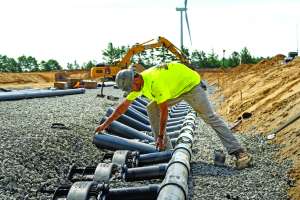

The town of Kingston, Massachusetts, needed to double the capacity of its existing wastewater treatment plant. The answer? Pair construction of a new wastewater treatment plant with six new leachfields housing a total of 13,000 Infiltrator High-Capacity H-20 chambers — one of the largest installations in Infiltrator history.
The client
Kingston is a town of about 14,000 people. Previously, a two-tank sequencing batch reactor met the town’s wastewater requirements. A small dispersal system at the town transfer station processed 125,000 gpd. A larger dispersal system processing 375,000 gpd fed into a series of temporary leachfields for six months of the year. For the remaining months, the town used disinfected wastewater for irrigation. However, the aging infrastructure produced high nitrogen loads that impacted local shellfish beds and recreational beaches.
The new wastewater system

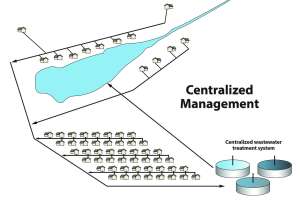
To serve future population growth, engineering and construction firm CDM Smith of Boston proposed building a new centralized wastewater treatment plant, doubling the capacity of the wastewater system to four SBR tanks and replacing the flow of 375,000 gpd at the larger leachfield with a new 575,000 gpd leachfield for a total of
700,000 gpd.
The firm specified 13,000 Infiltrator High-Capacity H-20 chambers to serve the new leachfield, each providing temporary storage of 110 gallons. Each chamber’s 10-inch louvered sidewalls promote infiltration and evapotranspiration while reducing fines in the system. The Infiltrator units were chosen, in part, because their traffic-rated design offers a strength of 32,000 pounds per axle, with 18 inches of compacted cover, to accommodate potential vehicle traffic over the area, which would be converted to public recreation space and trails.
The installer
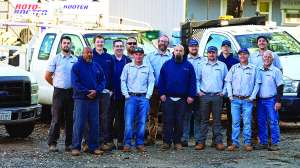
C.C. Construction, with headquarters in Plymouth, Massachusetts, was founded in 1983, initially specializing in residential septic installation and landscape work. The company now predominantly takes on commercial and medium-to-large-size civil construction contracts, primarily in Eastern Massachusetts.

“We specialize in large-scale treatment systems as well as wastewater treatment plant and linear sewer work,” says Brian Cooney, C.C. Construction vice president. “We’ve worked on contracts specifying Infiltrator before, but this is certainly the largest installation of its kind we’ve ever worked on.”
The contract
The installation contract for Effluent Recharge Site No. 3 included:
- Installing a silt fence for erosion control around the perimeter of the work site.
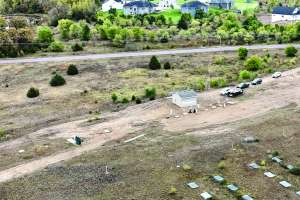
- Clearing, grading and excavating six large drainfield beds, each about 40,500 square feet in area and laying down a 6-inch bed of 3/4-inch coarse stone.
- Placing Tensar Biaxial Geogrid (BX1100) over Infiltrator chambers, as well as textile filter fabric.
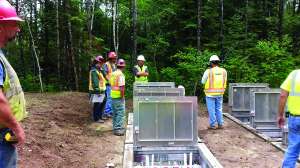
- Placing and assembling the Infiltrator H-20 chambers.
- Furnishing and installing one primary precast concrete distribution box and associated butterfly valves and PVC piping.
- Furnishing and installing six secondary distribution boxes, butterfly valves, level spreaders and associated PVC piping.
- Cutting of existing force main and installing approximately 2,650 feet of 14-inch HDPE fused force main pressure pipe to connect the new wastewater treatment plant to the primary distribution box.
- Installing lengths of gravity-fed 12-inch SDR 35 PVC pipe to connect the primary distribution box to six secondary distribution boxes.
- Clean water testing and commissioning of the drainfield system.
- Installing approximately 1,000 linear feet of access road/multiuse path with vehicle gate.
- Paving, loaming and seeding the area, following construction.
Project construction
The project officially began in April 2024 with C.C. Construction erecting an erosion control silt fence around the perimeter of the construction site, in support of conservation of two animal species, the Blanding’s turtle and the eastern box turtle.

“We then waited 14 days for the environmental scientists of the Massachusetts Natural Heritage and Endangered Species Program to complete a ‘turtle sweep’ and round up any turtles that were caught inside the perimeter fence,” Cooney says. “Any turtles they found were placed on the other side of the fence.”
Construction artillery brought to the site by the contractor included:
- A pair of Komatsu crawler excavators: a 2019 PC490LCi and a 2021 PC360LCi
- A 2022 Caterpillar 972M loader
- A pair of 2018 Volvo A35D articulated haulers
- A 2023 Caterpillar D3 bulldozer, outfitted with wider tracks, resulting in lower ground pressure.
Site clearing, excavation and placement of rock beds began in mid-April and concluded halfway through June.
“We really hit the ground running in June with the Infiltrator installations,” Cooney says. “At the peak of construction, we had six workers on site each day.”
The generous 14-acre work site gave the C.C. Construction crew plenty of room for staging as the construction project advanced. “We had a pretty well-balanced site for the most part, which obviously makes it easier from a material management perspective,” Cooney says.
He notes that assembling the Infiltrator chambers was probably the easiest part of the entire project. “You begin each row with a starter unit, then move to the middle units, overlapping each chamber with a tongue-and-groove system,” he says. “Each row is capped by an end unit, and the rows are then connected using a header pipe. We were impressed by the Infiltrator product and by the efficiency of assembling the chambers. Once we had the install system down and we established our workflow, we were able to install quite a few chambers each day.”

Work concluded in October, following clear water commissioning of the system and preparation of the surface. Cooney notes that the Infiltrator units held up well under the weight of construction vehicles used to spread loam across the site.
Project roundup
Despite the complexity of the project and the number of Infiltrator chambers requiring placement, Cooney says the project went off without a hitch.
“We had a good plan,” he says. “As a team — client, engineer, suppliers and constructor — we were able to communicate and make sure we understood everything required to make this project successful.”
Continue reading for free