
A viable system or systems for responsible community wastewater management must provide effective and manageable treatment at a reasonable cost, and that’s easier said than done.
To accomplish these goals, each community needs to evaluate all available treatment options that require significant diligence from community residents, and they will likely need to acquire a substantial amount of information from external sources.
There are two primary methods for treating wastewater, with the primary factor being how close homes or businesses are to the treatment system.
Centralized Management
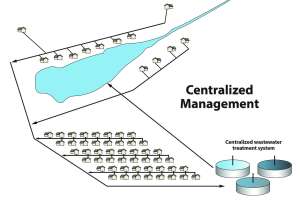
Municipal-style centralized systems collect wastewater through a large network of pipes and deliver it to a central treatment facility. There are several collection and treatment methods available. Centralized collection and treatment systems serve large cities and small communities.
The treatment concepts used in large municipal systems are generally similar to those used in decentralized treatment systems. The methods used to accomplish these tasks, however, are different due to volume, contents, operating systems and discharge standards.
A vast majority of centralized systems discharge to a river, stream or other water body. As shown in the diagram, all wastewater is routed to a single location. A municipality most commonly owns these systems.
Decentralized Management
There are over 32 million OWTS, serving approximately 25% of the U.S. population. These systems are most commonly located in rural or peri-urban areas. Individual and small multiple-household OWTS are frequently referred to as decentralized, onsite or septic systems.
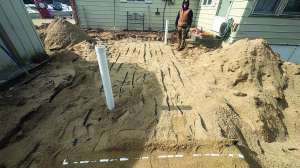
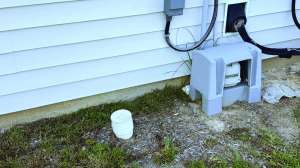
There are many treatment options for individual properties. Most of these options discharge effluent into the soil for final treatment. Individual onsite systems need adequate space and appropriate soil to facilitate treatment. The exceptions are a self-contained treatment system that discharges the effluent to the surface or a water body. These decentralized systems are most commonly owned and managed by individual property owners.
This approach is particularly beneficial in rural areas, small communities or rapidly urbanizing regions where centralized infrastructure may be impractical or too costly. Decentralized systems can be tailored to local needs and use a wide range of technologies to treat wastewater efficiently. These systems promote water reuse, reduce environmental pollution and enhance resilience by minimizing the risk of systemwide failures. Additionally, decentralized treatment supports sustainable development by integrating ecological principles and reducing the energy footprint associated with long-distance wastewater transport. Some key advantages of decentralized wastewater treatment are:
- Cost-effective infrastructure: Decentralized systems reduce the need for extensive sewer networks and large treatment plants, lowering capital and maintenance costs.
- Scalability and flexibility: Systems can be tailored to local needs and expanded as communities grow.
- Environmental protection: Local treatment reduces the risk of pollution from systemwide failures and supports water reuse for irrigation or other purposes.
- Energy efficiency: Smaller systems often consume less energy and can incorporate renewable energy sources.
- Resilience and reliability: They are less vulnerable to disruptions and are more likely to continue operating independently during emergencies.
- Community empowerment: Local management encourages community involvement and awareness of water conservation and sanitation practices.
As shown in the figure, decentralized management includes individual onsite systems as well as small and large cluster community-scale systems.

Multiple-household onsite systems collect wastewater from a small number of homes (two to 100s) and deliver it to a nearby site. Typically, they are called cluster onsite systems because they use treatment options similar to those in individual homeowner systems and treat lower volumes of wastewater than centralized systems.
Distributed Management
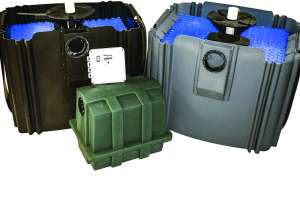
Distributed is a method to manage wastewater infrastructure where a responsible management entity combines onsite, cluster and centralized treatment in a cost-effective and sustainable structure. It often involves systems such as septic tanks, onsite package treatment units, community-sized media filters and graywater recycling for nonpotable reuse, which can reduce energy use, infrastructure costs and conveyance losses while improving resilience during outages or floods.
Benefits include localized treatment, potential water reuse for irrigation or toilet flushing, and simpler maintenance in rural or peri-urban settings. Challenges include maintaining treatment performance over time, ensuring consistent regulatory compliance, managing odors and financing initial capital as well as addressing variability in waste streams and soils. When well designed, operated and monitored, distributed management ensures that decentralized systems complement centralized networks, enhance rural development and support sustainable water management in communities with limited infrastructure.
Many communities may need a combination of what are viewed as centralized and decentralized, which leads to a distributed approach.
Example of Distributed Management

Broad Top/Coaldale, Pennsylvania: This low-income community of 10 villages and less than 2,000 people has historically used “straight pipes” to discharge household wastewater directly to local streams. The challenges in this community were small lots, poor site conditions, low income and two governmental entities.
To solve the problem of inadequate wastewater treatment, they created a sewage advisory committee, hired a professional and created a consensus on the solution. For areas with denser development, the solution was a modified gravity sewer and an aerated lagoon. The rest of the properties installed cluster systems or individual systems. The solutions included sand filters and recirculating filters with subsurface or surface discharge, mounds, at-grades and conventional systems. The most important aspect of Broad Top and Coaldale’s success was their ability to gain the trust of their citizens and maintain that trust throughout the planning and construction process. The creation of the committee, in which anyone could participate, went a long way toward nurturing that trust. Most of these systems are actively managed by the township, and if not, they must be annually inspected.
There is no one-size-fits-all solution for solving wastewater treatment challenges, and a multilevel scale is often needed to most cost-effectively treat and distribute wastewater back into the environment.
Continue reading for free