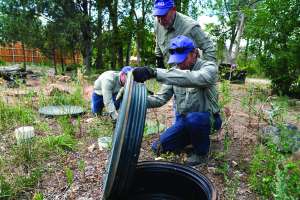

For septic system installers, what lies beneath the surface is often a high-stakes mystery. Before excavation begins, crews must accurately locate existing tanks, PVC lines and drainfields without striking unmarked utilities. In these uncertain environments, the Mighty Probe from T&T Tools has become an essential instrument, blending precise tactile feedback with vital electrical protection.
The Mighty Probe is a professional-grade insulated soil probe engineered for harsh conditions. Unlike improvised rods that bend or snap, this tool relies on a high-strength alloy steel shaft. It is available in multiple lengths and thicknesses, including a 3/8-inch hex rod that provides a 20% increase in stiffness over standard round models. At the business end, a heat-treated, replaceable tip penetrates dense clay and rocky terrain. For frozen or highly compacted ground, T&T Tools offers a heavy-duty slide adapter that converts the probe into a mini slide hammer, driving the shaft deep into the earth.
“Septic professionals use it daily to locate tank boundaries, identify buried lids and find obstructions, all without having to dig blindly,” says Stephanie Thompson, marketing professional for T&T Tools. “It’s a simple tool that saves a tremendous amount of time and labor on every job.”
The true value of the Mighty Probe in the septic industry lies in its tactile feedback. Because the spring steel transmits underground resistance directly to the operator’s hands, experienced installers can literally “feel” the difference between an obstruction and a target. A smooth glide indicates clay, sharp vibrations signal rock and a sudden drop in resistance reveals a void. Most importantly, operators can distinguish the distinct resonance of striking a concrete septic lid versus a PVC sewer line, allowing for pinpoint excavation that saves hours of exploratory digging.
However, the defining feature of the Mighty Probe is its focus on operator safety. Septic installations often occur in residential yards riddled with buried electrical lines. To mitigate this hazard, the probe integrates a 6-inch composite isolator between the steel shaft and the oversized T-handle. While it serves as secondary protection and does not replace personal protective equipment, this dielectric barrier provides a crucial safeguard against incidental contact with energized power lines.
“Professionals in this space are constantly locating buried tanks, tracing lines and identifying obstructions, often in unknown soil conditions and sometimes near energized infrastructure,” says Thompson. “They need a tool that gives reliable tactile feedback underground, holds up to daily use and doesn’t put them at risk.”
800-521-6893; www.mightyprobe.com
Continue reading for free