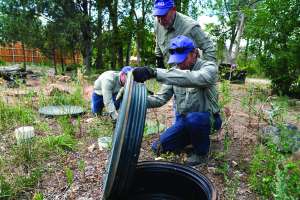

A few months ago, I saw a clean-out I had never seen before — a pop-up. I am guessing some of you haven’t heard of it either.
We all know clean-outs are an essential part of every pipe carrying wastewater. Clean-outs are strategically placed and necessary so that areas most prone to clogs can be accessed and cleared out. Clean-outs are sometimes located in basements or crawlspaces but are better located outside of the structure prior to the septic tank. It can either be one direction to clean the pipe either forward, backward or bidirectional to clean in both directions.
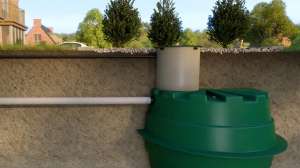
Clean-outs should be accessible at the surface and located in a protective enclosure such as a valve box. Local plumbing codes dictate the location of clean-outs. However, codes are minimum standards, and the installer should place clean-outs at locations where it’s most likely to be needed for future maintenance.
Pop-ups for septics?
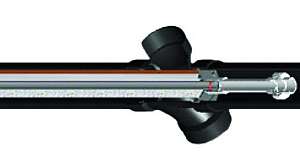
So what is a pop-up clean-out? A pop-up clean-out, also called a relief well or pop-up relief valve, is a specialized plumbing and wastewater component installed on an exterior sewer. It features a loose-fitting or spring-loaded cap designed to lift up automatically under pressure rather than being threaded tightly closed. Standard clean-outs feature a threaded PVC plug that requires a wrench to remove, sealing the pipe completely. A pop-up clean-out, by contrast, sits flush with the ground and has a cap that rests inside the pipe collar.
When water flows normally, the cap stays in place, keeping dirt and debris out. However, if the mainline backs up, the rising water and pressure push the cap upward, opening the line to the surface. The primary reason to install a pop-up clean-out is disaster prevention. It acts as a safety relief valve for the home’s plumbing system. With most onsite wastewater treatment systems a pop-up clean-out is unnecessary, but it may be an item to consider given the following:
1. Prevents Interior Sewage Backups
If a septic line clogs, wastewater backed from the home has nowhere to go. It will inevitably seek the lowest point of escape inside the house — usually a basement floor drain, shower stall or toilet. By giving the sewage an easy, low-resistance exit point outside the home, the pop-up cap lifts and releases the backup onto the lawn instead of your floors. However, wastewater outside the home presents a public health and environmental concern.
2. Safeguards Against Backflow
In areas prone to heavy rains and high water tables, water can push backward toward the interior plumbing of the properties. A pop-up clean-out ensures that this external pressure vents into the yard rather than forcing its way past plumbing traps.
3. Provides an Immediate Visual Warning
Because the cap pops open and releases wastewater onto the ground during a blockage, it serves as an unmistakable visual indicator that the mainline requires immediate professional maintenance or jetting, long before the issue destroys indoor living spaces.
4. Maintains Easy Access for Maintenance
Even with the pop-up capability, the unit still functions as a standard maintenance port. The cap is easy to remove to insert camera scopes, drain snakes or hydrojetting equipment to clear the downstream blockage.
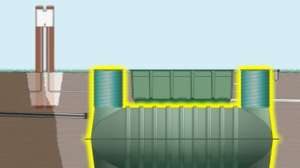
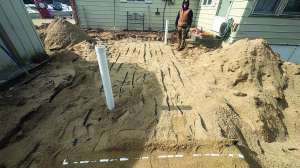
During installation the area around a septic tank is challenging for piping installation. Ideally the pipe is laid on undisturbed natural soil, but for many reasons, this is not always possible. The pipe joints (weak spots) should be over native soil rather than in the excavation to ensure that it does not settle. Settling may result in leaks or cause related components like tees and/or effluent screens to shift out of their proper (plumb) orientation. All pipe penetrations through all tanks must remain watertight after backfill. Thus, it is critical to ensure that there is minimal movement of the outlet pipe during the backfill process as this can alter the working liquid elevation in the tank and may damage or displace the effluent screen. Tamp the backfilled soil under the pipe to give it a firm foundation. The section of pipe across the excavation from tank to undisturbed soil should be rigid (Schedule 40 PVC or stronger) to eliminate deflection.
The clean-out I saw had been installed due to concerns with the slope of the pipe from the house to the septic tank. It had settled and was no longer a uniform slope to the tank and actually had a slight back slope. This improper slope was causing water and solids to remain in the pipe, which over time will accumulate and cause back up into the home or in this case, surfacing of effluent.
For this property owner, the easy solution was a pop-up clean out. The more long-term solution is digging up the pipe and properly bedding it. While a pop-up clean-out can save thousands of dollars in property damage, it’s not a fix. If the device pops off, it indicates an issue with the main sewer line that needs to be cleared or repaired.
Continue reading for free