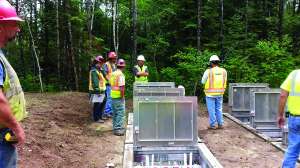
The AeroFin system, backfilled with sand and ready for inspection.


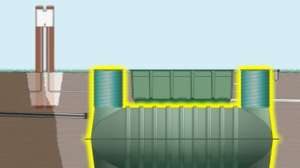
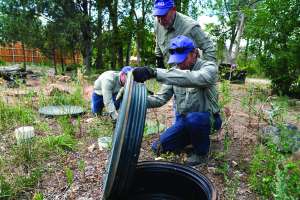
A riser installed with Orenco external splice box on the outside of the pump tank.


The AeroFin system, backfilled with sand and ready for inspection.
A riser installed with Orenco external splice box on the outside of the pump tank.
The state of Michigan contains more than 11,000 lakes, and many homeowners enjoy lake access. But when legacy septic systems fail, they must replace them with new systems that respect current regulations requiring water offsets of 50 to 100 feet, depending on the county. Travis Gemmell, owner of Walnut Grove Excavating in Clarksville, Michigan, often finds that satisfying both the regulations and the customer requires a lot of creativity.
In this particular case, the client is a homeowner with a two-bedroom home in Gowen, Michigan. The home is provided with lake access through a channel running adjacent to the backyard. Located in Montcalm County, regulations require any drainfield to be located a minimum of 50 feet from a waterway. When the septic system began to back up, the county required a replacement system to meet the current code.
Walnut Grove Excavating was established in 2017. The contracting company employs a crew of five and offers a wide variety of services, from septic tank and drainfield installation to excavating, grading and land clearing.
“We specialize in septic system replacements,” Gemmell says. “We probably install 150 to 200 septic systems per year, and only 10 or so are new installs. Often, some of the older excavation companies find that the replacement installs are too complicated, and they bring us in.”
Comeau Environmental Solutions of Middleville, Michigan, provides a range of services from alternative septic system design to environmental consulting. While local sanitarians provide designs for traditional septic systems, they refer designs for advanced and alternative treatment systems to specialists.
The drainfield on the existing property was located closer than 50 feet to the channel connecting the homeowner to Lincoln Lake. The available property had little room for traditional septic systems. Worse, access to the backyard was blocked by a 10-foot-tall shed and a series of overhead electric power lines.
Designer David Comeau devised a system featuring components from Infiltrator Water Technologies, all supplied through Valley Milan in Coopersville:
A Barnes pump (Crane Pumps & Systems) was used in the IM-300 to convey effluent to the AeroFin system and an Orenco external splice box was mounted on the exterior of the pump tank.
“The compact nature of the AeroFin wastewater treatment system allowed us enough reduction in surface area that we had just enough room to get in under 50 feet from the lake,” Gemmell says. “The AeroFin system is really narrow, and we find we’re using it on a lot of lake lots, which keep shrinking as the requirements for drainfields are expanding.”
Walnut Grove brought a crew of three workers to the site. The construction equipment battalion included a CAT 310 excavator, an engcon tiltrotator, a Trimble 2D Grade Control System from SITECH, a Kubota SVL75-2 skid-steer, and a Kubota KX040 excavator to fit under power lines. As a midwinter job, the excavators had to break through about 10 inches of frost.
The septic tank was located at the bottom of the property, closest to the channel, with the pump system moving septage uphill, about 4 feet in elevation, to the drainfield located alongside the garage, in front of the house.
“Moving the septage uphill to the drainfield allowed the homeowner to meet the 50-foot clearance,” Gemmell says. “Because of the compact nature of the AeroFin system, we only needed to excavate about 24 inches down from grade on the drainfield, then add 6 inches of sand to the base and finish off with 6 inches of cover.”
Gemmell says the installation process for AeroFin systems is straightforward. “The AeroFin requires a small venting air pump, pushing air through a half-inch line,” he says. “Just be sure to plan ahead for the venting and the power supply for the air pump.”
“When we excavated for the septic tank, we didn’t have any place to put the dirt,” Gemmell says. “For each bucket, we had to pivot up, swing over a fence, dodge a tree and put all the dirt where the drainfield was going to go. Then we had to take all that dirt, scoop it up again and put it back over the tanks.”
Excavating the drainfield was equally difficult because excavated dirt had to be lifted over the top of the shed and below the power lines, then dumped so a skid-steer could move it to the front yard driveway. Bringing the sand and cover material to the drainfield was equally challenging.
“We didn’t want to bring heavy machinery to place sand, due to the overhead power lines, and we didn’t want to accidentally crush any of the AeroFin components as we distributed the cover material,” Gemmell says. “Instead, we brought in a Stone Slinger from Custom Hydrovac in Cutlerville to distribute a truckload of base sand. We quickly assembled the AeroFin system and by the time the driver returned with the cover material we were ready for it.”
Although county inspectors typically inspect the entire system before cover is supplied, they made a special allowance for the tank portion of the project on account of the tight clearances and timelines.
“We were allowed to take pictures and have those approved,” Gemmell says. “They then came and popped the lids and checked the measurements.”
The entire project took two days to complete.
“We always like to make our installs clean and neat,” Gemmell says. “The old-school way was to put a 4-by-4-inch post in the middle of the yard with an electrical outlet on it, which became an eyesore after many years. We like to mount any electrical connection or alarm on the house, nice and neat. We spray-painted the electrical conduit going to the house the same color as the fence, so you don’t really see it.”
The system design and attention to detail appear to be turning heads. “Neighbors alongside this project became interested in having the same type of system installed,” Gemmell says. “We’ve already installed another of these projects on the same lake.”
Continue reading for free