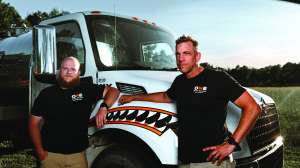

Tim Petz moved to Colorado because he thought rocks were cool, and what better place to live than the Rocky Mountains for a rockhound.
When Onsite Installer first featured Petz back in 2014, he was 10 years into owning his business, All Service Septic. Before that, the Ohio native earned a geology degree from Ohio State University and took a job with a small wastewater firm in Colorado, Church & Associates, to run soils analysis for the engineers.
The owner of that company, Ed Church, guided Petz into the world of wastewater treatment, and the work appealed to him. “I got good at it and started my own business eight years later,” Petz says. “That was 23 years ago.”
Now with over two decades of experience as a business owner, Petz has seen the wastewater treatment industry in the Denver area of Colorado change for the better and sees even more reason for hope on the horizon.
Day-to-day
In the early years of All Service Septic, Petz spent a lot of time in the Aspen area engineering systems for giant mansions being built in the mountains. The city was booming, and the market for new septic systems was surging along with it.
“I don’t go to that area much anymore just because of the distance,” Petz says. “The local economy around Denver and the local mountain community provides a lot of work for us now.”
That work consists of about 50% new site engineering and 50% repairs. The market Petz serves is made up of a lot of existing systems that were installed in the ’70s and ’80s, and Petz says many of them are on their last legs.

“I engineer and repair,” he says. “Clients call me and say they have a problem and I go check it out. So my everyday activities are I go into the field, drive up into the mountains and observe and inspect septic systems. I look at the capacity, the drainfield and see if it’s actually failing. If it is, I propose an engineered fix.”
Another trend happening in the area is people wanting to upgrade their two-bedroom cabin on the top of a mountain to a full-time residence, and they want four or more bedrooms. With that, the septic system needs to be upsized.
Tackling the terrain
“We don’t have soil in the mountains, we just have rocks,” Petz says. And though that may be perfect for a geologist, it isn’t ideal for conventional septic systems. Because of that, All Service Septic relies on BioMicrobics FAST systems.
“I work for BioMicrobics also and design a lot of FAST treatment systems for homes, which is very appropriate for Colorado as the soil is not conducive for treatment at all. It’s rock.”
It’s not just homes either. Petz and other designers in the area use BioMicrobics for large treatment systems. “A lot of the FAST designs coming from myself and other engineers are RV parks. RV parks are huge and probably for the last year or two, have been huge in Colorado barndominiums. Everyone wants an RV to travel around, but the RV parks didn’t really have appropriate septic systems. So as an engineer, we’ve been able to design large 5,000 gpd FAST systems for RV parks.”
Petz has designed systems using BioMicrobics for years as the technology has proven ideal for the conditions he regularly faces.

“The FAST treatment system has been very appropriate for high altitude and for the rocky environment,” he says. “It can be installed in poly tanks and therefore very easy to move into the mountain terrain. At stark driveways and some sites in the mountains, you’re never getting concrete. Just the slope alone, it’s very hard on equipment and trucks.”
Once the systems are installed, All Service makes sure they are not just dropped in and forgotten. “We also operate and maintain them. Once we install a system, my FAST team, as I call them, go around and maintain hundreds of systems that we’ve put along the foothills of Colorado, and we provide continued operation and maintenance and support for our customers.”
The team
The crew is made up of subcontractors, but many that have been with Petz since day one, so together they make up the team of All Service Septic.
“Erik Hamilton is my right-hand man and we do wastewater together,” Petz says. “Erik has been doing wastewater for literally 30 years with me. We both started at the same company.”
And then there’s family help. “Richard Petz, P.E. — he is my father. So I play an engineer, but I’m a geologist. But he is the real engineer that once I do a design, he goes through my numbers and makes sure I do it right.”
Steve Compton is also a geologist and the team’s southern engineer, tackling full commercial engineering projects. And rounding out the team in Jason Clemens, a helper who does everything they ask of him. A treatment specialist who aids in installation.
What’s changed
For Petz personally, a lot has changed in his three decades as a wastewater professional both as a company and industry-wide.
“What I’ve seen most in the industry that has changed is the implementation of treatment products,” he says. “We’ve realized that with restaurants and high-strength waste environments and certain situations we can’t do conventional wastewater. Well, you could, but you only get 10 or 20 years of life out of the field.”
Like many other places throughout the country, population density in the Denver area is growing and with that lots are getting smaller. “Now, we can make drainfields smaller in Colorado when we add treatment, pressurize and dose. So, I think the biggest thing I’ve seen change in 30 years would be the products that allow us to do different things on smaller sites with higher strength.”

Along with treatment technology, Petz has seen machinery improve enough to start aging out techniques he used 10 years ago. Back then, roughly one out of 10 installations required blasting to fracture bedrock to the point it could accept effluent. That isn’t the case as much anymore, slightly to Petz’s disappointment.
“I’m a geologist and an engineer, and I love pushing that button and saying fire in the hole,” he says. “But honestly, equipment and machinery has gotten so much better. We just put a jackhammer on a backhoe and crack the rock. We fracture the rock, put soil above it and add treatment.”
Push for reuse
Another change is the elevated motivation for water conservation. Petz is an active member of Colorado Professionals in Onsite Wastewater, and a topic that he and the state association are strong advocates for is wastewater reuse.
“I mean that’s the whole onsite world,” Petz says. “We are trying to clean it up and do something else with it. If you don’t have a good water source, you want to reuse what you have. If you have water, you want to put it somewhere it won’t contaminate or harm anything.”
The topic of water conservation in Colorado is nothing new. The Colorado River is the major supplier of water to its surrounding area and over the past 25 years, has experienced a significant drop in its levels. The unusual lack of snow in the Colorado mountains this winter didn’t help things either.
“We’re spending the money and energy on putting technology into septic systems and treating effluent to a higher level,” Petz says. “Right now, as a Colorado community, we’re trying to see how we can reuse that and develop regulations around it.”
It’s a big task because anything having to do with changing regulations comes with plenty of hoops to jump through, but Petz knows the technology is there already to make it a true possibility.
“Treatment products in Colorado are really coming together, especially membranes,” he says. “I can design membrane systems that are attractive to people. A system that produces clear, colorless, odorless water instantly.
“In the future, we would like to dose clean effluent to a vault where we can reuse it to wash our cars, or dust suppression or watering the lawn. It stays on the property to use wherever. That’s our long-term vision for Colorado.”

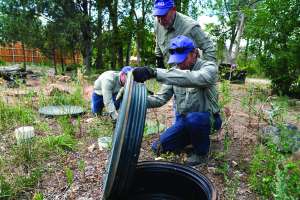
Petz (front) and Hamilton look over a control panel and alarm (Orenco) during a maintenance service.
Customer service and the future
Like the systems they design, Petz and his team work to maintain the relationships they’ve made with customers and to build new ones.
“We pride ourselves on customer support,” Petz says. “We take it seriously. We answer our phones and if we can’t deal with the project, we try to point them in the right direction.”
With his position, Petz is often the first septic professional on site for customers. Part of providing a professional and pleasant experience for them is knowing how to speak the language in a way they can comprehend.
“I bring it down to the customer’s level of understanding by just talking about soil and how it interacts with sewage, why we have a field and why we have a tank,” Petz says. “That the whole point of the septic system is to capture and treat and put it back into the watershed in which we live.”
Along with a simplified description, he provides something they can see. “Pictures are wonderful. If you can show them pictures of a tank and explain what it does it’s a big help.”
Taking care of his customers, understanding the landscape, utilizing the proper treatment and working to improve the way they use water has proved fruitful for Petz and All Service Septic and there is no signs of that slowing down anytime soon.
“The future of All Service Septic looks good,” Petz says. “We’re solid, we’re busy.”
Continue reading for free