Raymond Contracting installs mostly simple onsite systems — conventional systems and treatment lagoons. But that doesn’t mean the company cuts corners on quality.
“We are in fierce competition with Johnny Lowdollar,” says Lloyd Jakoubek, who with wife Terri owns the company, based in Raymond, Neb. “Our customers want and are willing to pay for the focused experience and skills we bring to the jobsite, and that is what sets us apart.”
Jakoubek started in the onsite industry in 1976, Terri joined him in 1997, and they have been comfortable in the field ever since. Raymond Contracting is located in a developing area of Lancaster County, about 15 miles northwest of Lincoln.
The couple started the business in 2000. “When we were looking at various business opportunities, we did a cost analysis on various pieces of equipment and found that a backhoe was the least expensive and had the highest rate of return,” Jakoubek says. They immediately focused on onsite installation.
They work in a 60-mile radius, and about 80 percent of their work is installation of new and replacement systems. As the job requires, Raymond Contracting can field one or more state-credentialed site evaluators, perc testers, system designers or system inspectors.
A typical customer’s new home costs more than $200,000 and some are in the $1 million range. “People who put that much into a house don’t want substandard systems or the problems they bring,” Lloyd says. “They want to be educated and are a lot easier to work with.”
Last year, based on the number of permitted installations, Raymond Contracting was the largest onsite installer in Lancaster County and the second largest in Nebraska.
Collaborating with customers
For a customer, selecting Raymond Contracting for a project is more than just hiring an installer. In the initial contact, the Jakoubeks evaluate the customer and his or her understanding of the situation. “While customers are screening us, we are screening them,” he says. “We use a checklist to interview prospective customers.”
The checklist gathers information about the site and the existing or proposed home. During this con-versation, the Jakoubeks learn a lot about the landowner’s knowledge and understanding of onsite systems.
Sometimes, soil conditions will satisfy state permit requirements for a conventional system, but the Jakoubeks’ experience with those soils tells them conventional is not the right choice. Recently, a landowner insisted on an in-ground system rather than the lagoon system Lloyd and Terri both proposed. Although both systems met the regulations, they turned down the project, rather than risk harm to the company’s reputation.
The Jakoubeks like to be the first contractors on a site. Walking the site with the landowner lets them offer ideas on the site development plan. Lloyd points out the areas best suited for the onsite system, the house and other improvements. “Before we move any equipment to the site, we have been there as many as six times, consulting with the landowner, the homebuilder, the plumber and the general excavating contractor,” he says.
Raymond Contracting spends a lot of time educating customers. “Our primary customer is the homeowner,” Terri Jakoubek says. “Over the years, homeowners have learned to be better listeners. The primary onsite system site-evaluation tool is the perc test, and in some soils the soil profile is also a factor in site-suitability determinations.”
The Jakoubeks counsel and advise their clients, helping them to understand the relationship between their lifestyle and the demands it will place on the system. This is in addition to the regulations that cover system sizing, which in their county is based on the number of bedrooms and the perc rate.
“Plan for expansion” is a standard message that Lloyd delivers while helping to select the system location. Terri perc tests an area large enough to accommodate a doubling of the minimum absorption area. In their designs, treatment tanks are often specified with at least 25 percent reserve capacity. “I am known as the Perc Test Queen,” Terri laughs.
She has developed a standard procedure for perc testing. “You can’t just drill a hole and pour water in it,” she says. “Poor techniques and procedures can jeopardize a site. Sloppy procedures yield unreliable results.” Perc tests conducted at different depths give a good understanding of soil permeability. Often, Terri conducts the initial test at three depths to find the optimum conditions. After evaluating those results, she tests more holes at the preferred depth.
System alternatives
Soils in the area are such that the Jakoubeks see few advanced treatment systems, locally called “engineered systems.” Raymond Contracting has installed just three of these systems. “Our soils are either deep and well-drained and support conventional in-ground systems, or they are heavy clay,” Lloyd says. In the latter case, sewage lagoons are the system of choice.
“The county’s minimum lot size of 3 acres generally enables us to find a suitable site for either of these systems,” Lloyd notes. When local relief requires, conventional systems include a lift pump that moves the effluent upslope to the gravity distribution system. Lloyd and Terri use Quick 4 chambers from Infiltrator Systems Inc. Conventional system sites must have a perc rate of five to 60 minutes per inch. Engineered systems are required for perc rates faster than five minutes or slower than 60 minutes per inch.
In a typical year, 25 to 30 percent of Raymond Contracting’s new systems are sewage lagoons. These are passive systems, and when there is no need for an effluent lift pump, there are no mechanical components. There is no treatment tank, either. Everything that reaches the building sewer is delivered to the lagoon, which is designed and sized to allow passive natural oxygenation, evaporation and biomicrobial digestion complete the entire treatment process.
Lagoons are always rectangular; a lagoon for a three-bedroom home is at least 53 feet square (2,809 square feet). Each additional bedroom requires another 1,269 square feet. These systems have a nominal operating depth of 24 inches with a reserve freeboard of an additional 24 inches.
Raymond Contracting refers all such work to a preferred provider. Lagoons need minimal pumping — solids are removed about every 30 years. “These systems are popular for their lack of maintenance and their simplicity of operation,” Lloyd says. “They are also about half the cost of a conventional septic system.”
When designing lagoons, Lloyd encourages owners to build reserve capacity. The downsides to a lagoon system are aesthetic. “When a lagoon is the only option, landowners develop an appreciation for that technology, and their aversion diminishes,” Lloyd says.
Focused resources
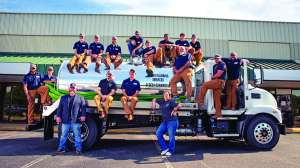
For work in the field, Raymond Contracting has selected equipment well suited to the limited range of systems the company installs, and with an eye on the cost-benefit ratio. Four machines satisfy the needs of the four employees.
The roster includes a 2002 John Deere 310SG backhoe, a 1992 Ditch Witch 4500 trencher, a 1987 International S series tandem dump truck, and a 1985 GMC C2500 with a hydraulic auger. “Terri uses the auger in her perc test work,” chuckles Lloyd. The company also owns a 2005 Ford E350 utility van and a 2007 Ford F350 pickup.
The division of labor is straightforward. Terri and Lloyd are state-certified site evaluators, system designers and installers, and Lloyd is the equipment operator. Terri is the office manager. In the field, their son Vern Jakoubek and Ted Neuman are part of the team.
“Septic systems are what we are all about, and part of our message is one of environmental stewardship,” says Terri. Raymond Con-tracting is a member of the Lincoln and National Home Builders Associations, NOWRA and its affiliate the Nebraska On-site Waste Water Association (NOWWA). These connections bring the company education and business ideas. A Better Business Bureau membership sends a message of reliability. The company exhibits at local home shows.
Lloyd usually takes the lead on the sales team, and he and Terri prefer face-to-face customer contacts. About 50 percent of their telephone contacts mature into contracts; that jumps to 80 percent when the contact starts with an in-person encounter. Lloyd observes that Terri’s strengths include making septic systems understandable to women. In its education and sales outreach, the company uses the materials provided by the Cooperative Extension Service at Nebraska State University.
Inspection mandate
When not marketing or installing systems, Raymond Contracting benefits from a new county requirement that all onsite systems be inspected at real estate transfer. Lloyd is a county-approved system inspector.
Raymond Contracting does about two dozen inspections a year, and 40 percent identify problems that require repair or replacement. “Our job is to document what is in the ground,” says Lloyd. “The county health department reviews our report and issues its conclusions.”
During inspections, every tank is opened and the liquid level is checked. Pump-out is not required. The setbacks from features such as wells, buildings, property lines and streams are recorded. A system that discharges to the surface is considered unsatisfactory and requires repair.
Lloyd expects demand for inspection to grow as houses turn over more frequently. “That is good news during times like this, when new home construction is falling and there are fewer construction-driven new installations,” he says.
Last year, about 20 percent of the firm’s business was related to inspections and repairs. A high percentage of malfunctions can be tracked to running toilets. “At a house that had been vacant for several months, we found an ongoing surface malfunction,” he says. “We discovered a leaking toilet was the cause.”
In system repairs, replacements and new installations alike, the company’s goal is to create systems that properly treat wastewater and protect groundwater and the environment. The Jakoubeks emphasize that they build relationships with customers. Terri observes, “We are in this for the long haul.”
Continue reading for free