When 315 acres abutting the Black Hills National Forest became available, Jim and Dusty Schad of Schad Construction Inc. bought it. Father and son, noted for custom-built homes in Rapid City, S.D., envisioned a unique, upper-end development fitting into and preserving the surroundings. Although neither are developers, they picked the 1- to 3-acre building sites, then drew in the roads and lot lines.
But the state Department of Environment and Natural Resources denied permits for conventional onsite systems because those in the Black Hills were contaminating Rapid City’s water supply. “We thought the project would die,” says Dusty Schad. “Bringing city sewer five miles to Canyon Springs Preserve wasn’t an option.”
After doing research, the Schads chose an extended aeration, activated sludge process unknown in their state. It took 18 months for state, county and local authorities to accept the system’s NSF/ANSI Standard 40 Class 1 certified system design, and the fail-safe mechanisms the manufacturer used to keep homeowners from tampering with or failing to maintain the units.
All the streets and sewers are now in place. Once a lot is purchased, the home is custom-built and the onsite system installed by the Schads’ new company, Crystal Mountain Systems Inc. Four systems are operational and 12 homes are under construction.
Site conditions
Soils are 6 inches of topsoil followed by 2.5 to 6.5 feet of sandy lean clay over silty sand/gravel with cobbles and boulders. Percolation rates average 23 minutes per inch. No limestone bedrock or water is present. The 2-acre lots have no neighbors in front or behind. Box Elder Creek, which runs through the property, has large sinkholes that flow into limestone caves that discharge into the Madison Aquifer, the prime source of water for Rapid City wells.
System components
Mitchell Kertzman, P.E., of Renner Associates LLC in Rapid City, designed the system to handle 21,750 gpd from 87 homes. Its major components are:
• Eighty-seven 500-gallon, single- compartment fiberglass septic tanks from Ecological Tanks Inc., Downsville, La.
• Eighty-seven 1,000-gallon Model EZ 500 Aqua Safe aerobic treatment units (ATUs) from Ecological Tanks.
• As needed, 500-gallon fiberglass lift stations with 1/2-hp WS 50 or 1-hp WS 100 pumps from Monarch Industries, Winnipeg, Manitoba.
• Sixteen 1,000-gallon dosing tanks from Ecological Tanks.
• Thirty-two 4-inch dosing siphons from Fluid Dynamic Siphons Inc., Steamboat Springs, Colo.
• 6,150 feet of ARC36 Bio-Diffusers leaching chambers from Advanced Drainage Systems Inc., Hilliard, Ohio.
System operation
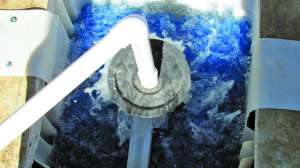
Raw sewage flows through a 4-inch PVC service line to a septic tank, then into the ATU. Wastewater enters an outer mixing compartment where air, introduced by a compressor through four drop lines around the perimeter, creates hydraulic displacement and a constant source of oxygen for aerobic bacterial activity and reproduction.
As organisms digest the nutrients, the liquor enters an inverted cone-shaped clarifier from the bottom. Solids settle in this quiet zone and re-enter the mixing compartment. Clear, odorless effluent flows upward either to gravity-feed through 4-inch Schedule 40 PVC laterals to the concrete manholes or to lift stations where pumps send the fluid to the manhole. The discharge from each house enters the manhole separately for sampling and to identify nonoperating units.
Depending on how many houses are on each manhole, 6- or 8-inch gravity sewers direct the liquid to the dosing tanks. Liquid entering a dosing tank fills it to the trip level of the twin siphons, which fire alternately due to different water column heights inside.
As the liquid in the tank reaches the high-water line, an air bubble is forced around the invert of the trap and discharged out the leg of the first siphon to operate. This action starts the siphon and empties the tank to the elevation of the discharge invert. The siphon that didn’t operate loses nearly half the liquid in its trap. The air displacing the water causes this siphon to operate next. All siphons have solar-powered cycle counters readable from outside the tank.
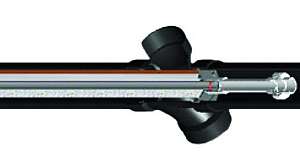
Via serial concrete drop boxes, a 4-inch PVC gravity sewer disperses the flow from the dosing siphons to 18 drainfields with two zones. Each zone contains five to 10 infiltration laterals. “Instead of clustering the treatment plants together, we created large drainfields,” says Dusty Schad. “They average 15 by 75 feet, with the longest at 126 feet. Because Aqua Safe systems are new to the state, we didn’t take the allowed 20 percent drainfield reduc-tion, so they are probably oversized.” The system has no filters.
Installation
Freddy Frantom Jr. from Ecological Tanks helped with the approval process, representing Schad at state and county hearings. The major concern of all authorities was that homeowners would not maintain the systems. Frantom designed an auto dialer to remove home-owners from the equation.
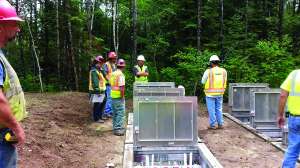
To simplify installation and ensure that all the tanks are level, Schad uses fiberglass to attach the septic tank to the aerobic module, creating a 16-foot-long component. Including the lift station adds 8 more feet. The lightweight assemblies have an eyebolt in each corner. “We use Ecological’s choice of resin, fiberglass and dye to avoid possible chemical reactions between brands,” Schad says. The assemblies are transported individually on a flatbed trailer.
Holes are dug at least 12 inches wider than the tanks. The elevation of the piping determines the depth. “We sometimes add extra Tuf-Tite risers to achieve the required 3 inches above ground,” Schad says. Tanks rest on 6 inches of sand to prevent settling. Tanks are filled with water to the discharge pipe before backfilling with native topsoil to the bottom of the inlet and outlet piping.
For concealment and to avoid people landscaping over the air compressor, Schad detaches it from the treatment tank and mounts it beside the home’s air conditioner-heat exchanger. The 3/4-inch Schedule 80 PVC airline is buried 12 inches deep. The electrical control box for the compressor, visual and audible alarms, and auto dialer is in a weatherproof enclosure next to the heat exchanger.
Each drainfield is divided into two alternately dosed zones. Where infiltration beds are used, the center-fed distribution piping is installed in a continuous loop. Each zone has an average of three laterals, but some have five. A drop box fills the upslope leg first, then the subsequent ones in sequence. The drop box also can isolate one or more trenches while the remaining ones continue to operate. Backfill over the drainfields was seeded with a mixture of native grasses.
Schad Construction built a 20-foot-deep, 3-acre stormwater retention pond that holds 5.5 million gallons and is stocked with trout. “The Doty Volunteer Fire Depart-ment is building a new station next to our project, and we’re installing the onsite system,” Rusty Schad says. “The Black Hills has one major forest fire a year, and the pond has a tri-hydrant, enabling firefighters to pull water in emergencies.”
Maintenance
Following maintenance guidelines from Ecological Tank, Schad developed a two-year service contract that the three regulatory agencies had to approve. The contract must be signed at the time of sale. “Most buyers are receptive to it because they don’t want the responsibility,” he says. “Knowing this, we even offer a five-year contract.”
Crystal Mountain Systems is the service provider, inspecting systems twice per year. Technicians adjust the electrical control, if applicable, and service the mechanical components. They check the effluent for color, turbidity, scum overflow and odor. When necessary, they call a pumping service to clean the septic tank and treatment plant. They check the air compressor for blockages and clean or replace the filters. An inspection takes about 20 minutes.
The system discharges to the drainfields at pollutant levels significantly lower than the discharge from the Rapid City Municipal Wastewater Treatment Plant. The plant reported 10mg/l CBOD5 and 10 mg/l TSS during the second week of April 2006.
According to Baylor University in Waco, Texas, the 30-day average discharge from the ATUs was 2.4 mg/l CBOD5 and 2.1 mg/l TSS. The EPA maximum for discharge to Rapid Creek is 30 mg/l CBOD5 and 30 mg/l TSS.
Continue reading for free