The 28-unit Elm Grove Trailer Court in Annandale, Minn., faced state condemnation because of numerous complaints about sewage flowing down the road. After rejecting the onsite project, a local engineering firm told the property owner to call Mark Hayes of Minnesota Geo-technical Services, a company in Maple Lake known for finding solutions to difficult situations.
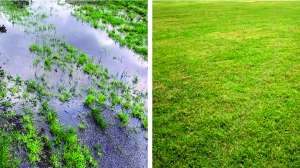
Upon visiting the site, Hayes saw youngsters riding bikes through sewage. “The two grinder stations were leaking and pumping mostly swamp water,” he says. “I found burned-out pumps, broken piping and a broken water meter.” According to the Department of Natural Resources, the water data provided were identical for eight consecutive years.
Hayes, a hydrologist and designer 1, ran the suspect water data through mathematical equations to determine hydraulic flow from the trailer court. He calculated 70 to 75 gpd per bedroom, or about half the 150 gpd allowed by state code. Although the 28 houses with three bedrooms contributed about 6,000 gpd to the system, swamp water pouring in through broken pipes and leaking grinder stations was overloading it. “I have no idea how much untreated sewage enters the swamp each day,” says Hayes.
His next challenge was fitting the new system into the confining footprint of the old one. The pressure bed Hayes designed met the property owner’s budget, satisfied the state and county health departments, and is working perfectly.
Site condition
Soils were mostly coarse sand and gravel with the water table 4.5 feet below grade. The trailer court, surrounded on three sides by swamp, sits on a knoll with a narrow swale running east from the center. The onsite system, on the pinnacle of the knoll, is encircled by trailer houses.
System components
Hayes designed the system to treat 7,000 gpd. Its major components are:
• Two 900-gallon concrete grinder stations from Darwin Precast Systems Inc., Darwin, Minn.
• Four 3/4-hp Goulds grinder pumps
• Seven 2,000-gallon, one-compartment concrete septic tanks from Darwin Precast Systems
• 2,000-gallon concrete lift station tank with four 1/2-hp Goulds submersible low-head pumps
• 146- by 54-foot pressure bed in four quadrants
• Two custom-built control boxes from Alderon Industries, Hawley, Minn.
System operation
Hayes divided the trailer court into four sections. The south portion gravity feeds through the 4-inch PVC sewer main into the first of seven septic tanks. He subdivided the north section, enabling each half to gravity-feed to the first tank.
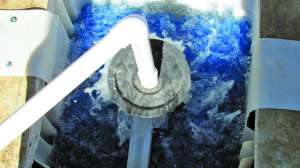
Wastewater from the remaining two sections flows into the east or west grinder station, is pumped to the high point of the sewer main, then gravity flows into the first tank. Effluent draining from the last tank enters the lift station, where four alternating pumps run four minutes, four times per day, sending 310 gallons at 30 psi through feeder lines to the distribution manifold.
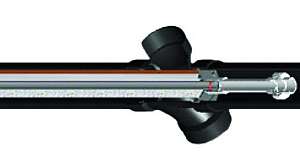
One of four Schedule 40 PVC 2-inch pressure lines spaced 3 feet apart with 1/4-inch holes disperses the 1/4 inch of water over its designated 64- by 26-foot pressure bed.
Installation
Ron Mares and son Nick from Mares Excavating in Annandale installed the system. Their first challenge was reaching the knoll. The only access was the trailer court’s narrow, single-lane road with counterclockwise one-way traffic. Residents were warned to stay alert.
Ron Mares called a locating service to locate the utilities, as the ground was saturated with cables and nobody knew which ones were live. “When we started excavating the mounds, the backhoe pulled up numerous electrical, phone and gas lines and no one lost any services,” says Hayes.
The next obstacle the crew battled was numerous layers of large, heavy plastic sheets. “We didn’t know why they were there until the backhoe unearthed the original septic tank and drainfield under the mounds,” says Hayes. “The trailer court’s previous owner had laid the sheets over ponding as it appeared and covered them with topsoil.”
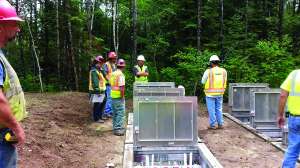
Once the 146- by 54- by 4.5-foot-deep pit was excavated, the men built a retaining wall from 68 landscaping blocks 5- by 2- by 2-feet-high and lined the sides with rubber liner.
It took two days and more than 100 trips by dump trucks to deposit 1,024 cubic yards of clean-washed sand in the pit. Residents were told to stay off the road. Over the 48-inch-deep sand went 9 inches of rock, pressure lines, 4 more inches of rock covered with geotextile fabric, and 12 inches of topsoil seeded with pasture grass.
The grinder stations on the east and west ends of the property were custom-made to fit the narrow space between utility lines and trailer houses. Mares installed an audio/visual alarm panel on each station.
To maintain the swale (drainage area) running east from the middle of the property, the septic tanks and lift station tank had to go outside the pit along one retaining wall. “The most involved thing was finding the live feeder line from the first house, because that determined the elevation of our first tank,” says Hayes. “In the process, we found many more abandoned utility lines.”
The main control panel, with heavy lock, was mounted so that no one could rip it out of the ground. To counter homeowners’ belligerent attitude toward flushing anything they wanted, Hayes developed an education program. He printed information off the Internet and left it on every door and in every mailbox. A few days later, he paid a personal visit.
“The owner had told them that their rent was going up because of the new system,” says Hayes. “I added that if he had to replace grinder pumps at $800 apiece, their I-can-do-what-I-want attitude would price them right out of there.”
Hayes’ plea to use their heads worked for a while. “It’s been three years now and we’re right back to square one,” he says. “Somebody is flushing the wrong things again.” The property owner, however, is back in the health department’s good graces and happy with the system.
Maintenance
The property owner has a contract with a Wright County pumper for regular service. Hayes visits the site twice per year to take water usage numbers and ensure that everything is running properly.
Continue reading for free