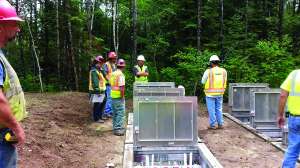
Mt. Carmel, an unincorporated community in western Iowa, has a church, parsonage, community center and 39 homes. Each had a septic tank discharging through a common 6-inch clay tile sewer to daylight in a farmer’s field.
In 1999, the Iowa Department of Natural Resources (DNR) condemned the community, but provided no solution. The local U.S. Department of Agriculture (USDA) office would not fund a lagoon or provide a solution. In 2008, it put the project out to bid, and Dicker-son Mechanical in Colfax, Iowa, won it. Owner George Dickerson Sr. worked with Jim Carroll, P.E., at the USDA to design the systems.
Dickerson’s bid called for 27 individual gravity systems with their own drainfields, 12 homes hooked to grinder pumps discharging to three absorption beds, and separate gravity systems with drainfields for the church, parsonage and community center. Extenuating circumstances forced him to alter many designs in the field. He battled large stones, drainage ways, buried foundations, pet cemeteries and other obstacles, but completed what had been planned as a 180-day project in 97 days. All systems are working perfectly.
Site conditions
Soils are 16 to 24 inches of topsoil, then red clay with mottling. The water table is 4 to 7 feet below grade. The land is flat with some waterways.
System components
Carroll designed the 29 individual onsite systems (homes, church and parsonage) to handle 450 gpd each. Their major components are:
• 1,500-gallon concrete septic tank. All tanks have dual compartments and were made by Northwest Concrete Prod-ucts Co., Storm Lake, Iowa
• A300 Zabel effluent filter
• Distribution box from Tuf-Tite Inc., Lake Zurich, Ill.
• 200 to 500 feet of 18-inch Envirochambers from Hancor Inc., St. Nicephone, Québec
• 11 1,000-gallon pump tanks with 3/4-hp Liberty submersible pumps.
The cluster system handles 1,500 gpd. Its major components are:
• 12 1-hp Barnes grinder pumps in 2- by 12-foot-tall fiberglass containers
• Three 1,500-gallon septic tanks
• Three 1,500-gallon settling tanks with 1-hp Liberty effluent pump in second compartment
• Three 80- by 120-foot pressure-dosed beds.
The community center’s individual onsite system handles 2,000 gpd. It has:
• Two 2,000-gallon septic tanks
• A500 Zabel effluent filter.
System operation
All septic system laterals were replaced with 4-inch PVC Schedule 40 pipe. The 27 homes with gravity systems send flows from the septic tank through the distribution box for gravity distribution to the drainfield. The other 12 require pump tanks to lift the effluent to the distribution box before dispersal.
The 12 homes on the cluster system are split into three groups of four. Each group connects to a grinder pump discharging to a septic tank that gravity feeds to a settling tank. Effluent from each group is dosed to a separate absorption bed. The larger septic tanks at the community center address shock loads and loading from dishwashing water. The kitchen is only used to reheat food.
Installation
Dickerson and county supervisors held a town meeting before starting construction to introduce the project. Because he would replace every lateral, Dickerson told residents to expect their yards to look as if they were bombed.
“I’m positive that honesty helped smooth the road,” he says. Shortly before each installation, Dickerson visited the homeowners to explain what type of system they were receiving and answer questions.
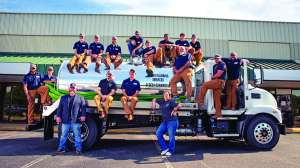
When Dickerson’s five-man crew began excavating with their two Case backhoes, they hit numerous old foundations. One of the first, from a tavern, took eight hours to remove. “The homeowner and local officials knew it was there, but hadn’t told us,” he says. Fortunately, Carroll County needed fill and hauled away the tons of rubble. The holes were backfilled with fresh soil.
The crew found houses with three or four septic system laterals and separate ones for showers and washing machines. All tied into the clay tile sewer and had to be removed. An unending supply of 16-inch to 4-foot-diameter fieldstones impeded excavations.
Some yards also held departed pets. “We were usually in the middle of an excavation when someone would run out of the house and stop us because we were approaching Fluffy’s grave,” says Dickerson. “The amazing thing was that we could always twist the lateral 6 or 7 feet without affecting elevation.” They also avoided driving over graves while backfilling.
Most of the 42 old septic tanks were crushed and backfilled. Two, however, were buried under concrete floors in residential garages with restrooms. “We put new tanks outside the structures and asked the county to arrange for their connection,” says Dickerson. “I don’t know how I could have covered that in my contract.”
One resident insisted that the system go in the drainage way to protect his dog kennels and wife’s vegetable garden. After numerous discussions over several weeks, the homeowner allowed Dickerson to install the system properly and tile the drainage way. “We stopped every-thing, did the job, and got the heck out of there before he changed his mind,” he says.
Something different
Endless tree roots and LP gas lines thwarted the workers. Residents seldom knew where their gas lines were, and Iowa One-Call doesn’t locate them. After hitting the first few, the crew tried locating them with shovels, but the lines jogged all over.
“From then on, I shut off the gas at the tank and dug, knowing we could repair the break and relight the appliances,” says Dickerson. (His company also does plumbing, heating and electrical.)
The field purchased for the cluster system’s absorption bed was too small to hold the required 4,000 feet of chambers, and the elevation dropped 7 feet. Dickerson switched to a pressurized dose system and divided the homes into groups. His crew directional-bored 2-inch PVC mains from the pump stations to the drainfields.
Dickerson had the 3/16-inch holes in the 1 1/2-inch distribution lines milled to eliminate burrs. “I’m hearing reports that burrs created by hand-drilled holes are catching material and clogging the orifices,” he says. Laterals on 11-foot centers rested on 16 inches of 1 1/2-inch washed septic rock. Orifices were 60 inches apart.
The systems performed well through a severe winter with only one alert from a faulty alarm. In January, the pressure-dose fields were buried under heavy snow, and Dickerson worried about erosion when it melted. He returned after a February thaw to find the soil in place. “We opened all the tanks and everything looked wonderful,” he says. “I was so relieved.”
Although residents were told not to mound snow on their drainfields or back pickup trucks on them, Dickerson photographed evidence of both offenses and will hold a town meeting to address them. He also is bidding on several similar projects.
Maintenance
Carroll County owns every system. Dickerson Mechanical will maintain them with county sanitarian Carey Kersey for the first year. County supervisors then will choose different contractors to provide maintenance.
Continue reading for free