We get many questions and have discussions as we go around the country about fill soils and what can be done about them. If you follow this column or have taken one of our workshops, you know the first answer is to avoid or prevent situations where you install into fill soils.
We always talk about our guiding principles, one of which is KINN: Keep It Natural, N______ (where you fill in the last “N”). However, that leaves open the question, what do I do?
Before speaking directly to that question, let us just say that in the 50-odd years of experience between us, the times we have been in the worst situations as designers and site evaluators are on fill sites. There was one system in particular where we designed a mound on a fill site. To make a long and painful story short, despite all of our best design ideas, the system failed miserably within six months of startup. So when we suggest avoiding fill soils, we are very serious in our advice.
Killing structure
When you move any textured soil other than sand, the soil structure is destroyed. That liberates the silts and clays to migrate when water is added. The loss of pore space from destruction of the structure and the clay migration results in a loss of infiltration capacity. When this happens, it is difficult if not impossible to predict the long-term acceptance rate for soil.
This means that in general you will want to build in as many safety factors as possible when you estimate the expected daily flow and the soil-sizing factors. The result will and should be a much larger system on average than would typically be designed.
If you are on a site that requires fill to provide adequate separation distance for treatment purposes, or to raise the system above grade because of floodplain or other setback requirements, you should require that the fill be sand. The sand should consist of a variety of sand-size separates. That is, it should be a combination of fine, medium and coarse sand particles.
Ideally there should be no more than 5 percent by volume silt and clay size particles. It should not be all coarse sand or all fine sands. With coarse sand, you may not get the desired treatment in that medium before your limiting condition. With fine sands, it is difficult to predict how they will accept sewage tank effluent (this is true even of fine sand soils in natural settings). A pressure distribution network should be used to disperse the effluent as uniformly as possible over the area.
Strategies for loams
If the soil texture of the fill consists of sandy loam to loam, there are several strategies you can use. First, follow the KISS principle on any fill soil. That is, keep the system as shallow as possible. The soil surface, even on fill, is subject to more freezing/thawing and wetting/drying cycles, which will promote establishment of soil pores that can conduct water.
Here, the best strategy is to chisel plow the surface when dry, establish vegetation, and leave the area undisturbed for as long as possible before beginning construction. Of course, often the developer of the property needs the system now, so it is usually not possible to leave it for more than a season without relocating the system.
After preparing the surface, the method for applying effluent to the fill soils should be to spread it out or disperse it as much as possible. This means using pressure distribution: a mound, an at-grade system, or drip irrigation. Use any means available to control the distribution and to use as much of the area as feasible for dispersal.
For finer-textured soils such as clay loams and sandy clay loams, all the same approaches apply, except that a deeper ripping or plowing of the surface is desirable. Again, this is to promote establishment of as many soil pores and pathways as possible to improve infiltration.
Special cases
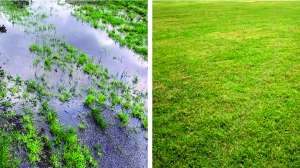
One special situation to be aware of is where the fill has been placed to fill in a depression or drainage way in order to provide a more level site for construction. Recognize that if the imported material has filled in a depression, and if there is a high water table near the surface in the depression, the water will rise within the fill and become level with the water table in the higher areas around the depression.
In other words, placing the fill may not provide all of the separation from the water table that you expect. Then you not only are dealing with reduced infiltration capacity in the fill material — you also have a saturated condition that will further reduce the capacity of the soil to accept and treat the tank effluent.
It is very difficult to determine where the surface of the water table will be in fill material. It is often not possible to use soil coloration characteristics as an indicator, as you would do in natural soils. The color of the material will reflect the location that the fill was removed from, and not conditions in the present location.
Also, recognize that if the fill is placed in the drainage way, water will still seek to run from the surrounding landscape through that area. So during wet seasons, any system installed in that location will be subject to large amounts of additional water.
We often hear it said that with all the technology choices available today, we should be able to locate a system to provide treatment almost anywhere. But no matter how good the technology, if it is placed in a location that will be subject to periodic inundation, the treatment we are looking for will not take place.
If you take on a job that seems to involve using fill soils, remember first to see if the fill soils can be avoided. If not, approach design and installation very carefully, and try to build in as much additional capacity as possible.
Continue reading for free