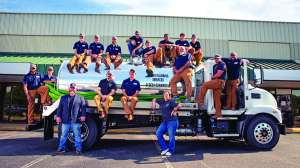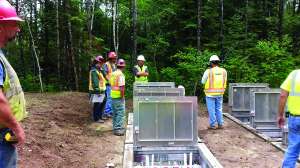
As they moved from digging basements to installing septic systems, the team at J.L. Schmitz and Sons brought along some technology from the old job to do better at the new one. It’s nothing fancy, but a small adaptation of a gravel conveyor means less work and better results for Pete and Al Schmitz and their customers around their home base of Monticello, Minn., just northwest of Minneapolis.
Founded in 1975 by John L. Schmitz and his sons Pete and Al, the business started in excavating, farm drainage and irrigation installation. They soon added farm liquid waste handling to their services.
By 1978, they were installing Harvestore slurry storage systems, and they soon found a new market for commercial pumping of slurry tanks and lagoons, then applying the material to farm fields. They still run four liquid manure applicator trucks.
They eyed another growth opportunity in 1987 when Pete and Al decided to install their own septic systems while building their homes. They thought it was nice to be working in sandy soil instead of the farm fields. “For us it was easy compared to installing drain tiles where you’re constantly in the mud and clay,” Al Schmitz says. “We also saw there was a need for septic installers in our area.”
Entrepreneurial spirit
Today, the company installs 15 to 20 onsite systems per year. The fleet includes a Cat 312C excavator, a Cat D-5G dozer, a Cat 950 loader, a Cat 257 multi-terrain loader, a Cat 226 skid-steer loader, a Parson 150 Trencher, a 580 Case backhoe, a Mack dump truck, a Mack Lowboy tractor, and four vacuum trucks on Mack chassis with 3,300-gallon tanks for septic system servicing and other waste pumping and hauling.
After buying a gravel conveyor in 1995 for use in backfilling basements, they soon found a way to use it in their septic system business for placing rock in drainfields, pressure beds and mound systems. “It’s such a labor saver, because you don’t have to shovel or rake rock to get the pipe to the proper elevation, and you do very little of it around the pipes,” says Pete, the elder of the brothers.
When backfilling a basement, the conveyor can throw aggregate up to 50 feet. It took some refining to make it useful for septic systems. The changes included slowing the conveyor, fabricating a hopper, and attaching a 4-foot-long handheld 8-inch flex hose to distribute the rock to the proper grade throughout a drainfield or mound.
“It takes about 10 minutes to hook the conveyor to the back of the gravel truck,” says Pete. “You pull a couple of safety clips and stretch it out and you’re ready to use it right then and there.”
Precise installation
It takes one person to operate the 20-foot conveyor and another in the drainfield to handle the hose for precise installation of the rock. It takes 15 to 20 minutes to unload 15 tons of rock from a truck. “What we like the most about using the conveyor is the better quality we’re giving the customer,” Pete says. “We don’t drive a Bobcat loaded with rock all over the drainfield, compacting the soil.”
The system also ensures clean rock. “We’re not willing to put dirty rock in a drainfield or bed, so we avoid dumping the rock on the ground as much as possible,” says Al. “Any time you put the rock onto the ground, you’re contaminating some of the rock with dirt and grass.”
The innovation also reduces waste of rock. “You’re going to lose a lot of rock every time you dump aggregate on the ground and try to pick it up,” Al says. Moving it directly from the truck to the conveyor and into the drainfield saves money and reduces cleanup time. That means a more efficient operation, and assurance to homeowners that their yards will be free of rock when the job is done.
The system also saves wear and tear on the company’s compact track loader, which is fitted with rubber tracks. “We were able to get 2,475 hours out of our tracks when we were told to expect about 1,100 hours,” says Pete. “Our machine isn’t crawling in the bed system. There are no rocks getting in the tracks or cutting the rubber bogies and track.” He says a Caterpillar salesman told them the machine got more hours out of its tracks than any other he knew of.
Aid to business
The brothers also know they’ve picked up some work because of the conveyor system. “We explain to the customer exactly how we’re going to place the rock into their drainfield and that we’re not going to be putting rock on their driveway or lawn,” says Pete. Customers respond positively.
Pete relates a story about a home on a small lot with little room to get to the backyard. The woman wanted them to go through a neighbor’s yard instead. Not wanting to make her responsible for any damage to a neighbor’s property, Pete came up with a plan. “We told her we’d cut down a basketball pole and weld it back in place when we were finished,” he says. “When the job was done she said that was one thing that got us the job, along with using the conveyor.”
Leaving the jobsite as if it were their own is one of their goals on every job. “We take pride in our yards, and we want customers to be able to plant grass or install sod right away,” Pete says. “They shouldn’t have to do anything else.”
They’ll even use the conveyor in the few situations when tight spaces keep it too far from the installation. “We’ll take the conveyor and drop the rock into our excavator bucket and then dump it into the mound or drainfield,” says Al. That keeps the aggregate clean, prevents waste, and keeps heavy machinery off the installation —even though it means a little shoveling and raking that normally is not needed.
Another family secret
The Schmitzes have also developed their own saddle system to hold drainfield lines in place — it works well with their gravel installation method. They build the saddles during winter when installation work is slower. “We’ll take old PVC pipe and instead of throwing it in the garbage, we’ll cut the pipes in half and chop them up into one-inch strips, which become the saddles,” explains Pete.
At the site, the saddles are attached to 18-inch-long 1-by-2 boards driven into the ground to the proper elevation, using a laser level system. “That puts every saddle at the exact elevation it needs to be,” says Pete.
Al observes, “We set our pipe in the saddle, and we don’t have to touch that pipe at all as we’re installing the rock with the con-veyor system.” That’s easier than trying to keep piping at the proper level as they place rock around it.
Being always willing to try something new or a little different has served them well. It’s a spirit they got from their late father, says Pete: “He taught us to never be afraid of taking risks.”
Continue reading for free