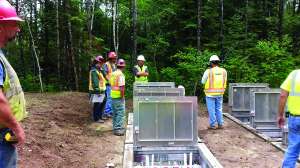
Jeff Wellhouse of Breezewood Properties Inc. in Neenah, Wis., wanted to develop a 60-home subdivision in the Town of Greenville northwest of Appleton, Wis.
The town had a Conservation Subdivision Ordinance that determined the number of lots per development and their minimum size. The ordinance and poor soils over much of the site encouraged a cluster onsite system because it reduced site disturbances and potential problems caused by individual conventional systems.
The onsite plans developed by a Minnesota firm looked too complex to Wellhouse, especially since the town expected to operate and maintain the system. Installer Dan Arnoldussen of Earth Works in Kaukauna, Wis., agreed, seeing too many unnecessary, high-maintenance components. Wellhouse then hired Dave LaBott, CPSS, MPR, of Baudhuin Inc. in Sturgeon Bay, Wis.
LaBott’s solution involved a trash tank, surge tanks, fixed activated sludge treatment (FAST) units, lift station, dosing tank and four mound systems. The installation, the first of its kind in Outagamie County, enabled Wellhouse to proceed with his plans for Crestview subdivision.
Site conditions
Soils are sandy loam with the water table at 48 to 108 inches below grade. The topography is hilly. The elevation on the 80-acre parcel drops 60 feet from west to east. Agricultural fields surround the site.
System components
LaBott sized the system to handle 27,000 gpd. Its major components are:
• 18,000-gallon one-compartment concrete trash tank. All tanks made by Wieser Concrete Products Inc., Maiden Rock, Wis.
• Two 18,000-gallon one-compartment surge tanks.
• 8-inch plug valve, Val-Matic Valve and Manufacturing Corp., Elmhurst, Ill.
• Two 3/4-hp Goulds WS0712B submersible sewage FAST dose pumps (40 gpm/26 feet total dynamic head).
• Three 9,000-gallon pretreatment tanks, each with 9.0 FAST aerobic treatment units from Bio-Microbics Inc., Shawnee, Kan.
• 6,000-gallon lift station with two 15-inch Orenco effluent filters and two 1-hp Goulds WE1012 effluent pumps (40 gpm/55 feet TDH).
• 450 feet of pre-insulated 2-inch force main from Insul-Pipe Systems, Buda, Texas.
• 12,000-gallon dosing tank with 2-hp Goulds WS2012BHF submersible sewage pump (157 gpm/42 feet TDH).
• EZflow geosynthetic aggregate drainage tubes, Ring Industrial Group, Oakland, Tenn.
• Main and dose pump control panels, SJE-Rhombus, Detroit Lakes, Minn.
System operation
The town would not issue building permits until the system was installed. Home construction began this spring. Leaving the sewer lateral, wastewater enters an 8-inch PVC gravity feed main discharging into a lift station. It is pumped to a 48-inch manhole at the head of the treatment train, then flows through an 8-inch PVC pipe to the trash tank. Trash tanks do not need to meet the state’s size requirements for septic tanks.
Effluent gravity feeds from the trash tank to the first surge tank, then passes through a plug valve into the second surge tank. Duplex pumps in the tank send equal amounts of effluent through a 2-inch PVC force main to three 36-inch manholes. Each discharges through a 2-inch pipe to a FAST unit (only two are now on-line).
Treated effluent gravity feeds from the units to two 48-inch manholes, then into a 4-inch PVC line, where a ball valve recirculates the liquid back to the first surge tank. Until 40 homes are on-line, wastewater will recirculate to feed the bacteria in the advanced treatment units.
When the first surge tank reaches capacity, the ball valve closes, sending liquid via gravity to the lift station. It passes through the effluent filters into the second compartment, where pumps send it 400 feet uphill to a manhole. To eliminate freezing, the 2-inch PVC force main is pre-insulated with 12 inches of closed-cell polyurethane.
From the manhole, effluent gravity flows 190 feet through a 4-inch pipe to the dosing tank. Alternating on-demand pumps send 2,372 gallons (543 gallons drain back) through a 6-inch force main to one of four 62-foot-wide mounds. Each has four laterals on 7-foot centers. Currently, only the bottom two cells are operational.
Depending on their length and distance from the dosing tank, distribution lines are 1 1/2 or 2 inches. The longest measure 360 feet and the shortest 160 feet. All laterals have a squirt valve on both ends. The mounds, separated by 12 feet, have a 17-foot down toe. A 6-inch force main divides the separation zones lengthwise.
Installation
Another contractor cut in roads and installed the sewer laterals and force main. In November 2008, Arnoldussen’s four men installed the mound system. The two active cells will handle 18,000 gpd from 40 homes.
Arnoldussen hired a farmer to plow the area, then hauled in 2,100 tons of ASTM 33 sand. “Dave’s design enabled us to work on three sides of a mound, so my drivers kept dumping and we kept spreading sand to a depth of 18 inches with a Caterpillar bulldozer,” he says.
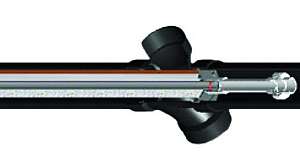
After excavating 3-foot-wide trenches in the mounds, the men inserted three EZflow tubes instead of aggregate. Laterals with hand-drilled 5/32-inch orifices every 4 feet went inside the tubes. The two active mounds received a geotextile fabric covering followed by 12 inches of seeded, fertilized and mulched topsoil. Mounds 3 and 4, plumbed and stubbed, await the construction of the remaining houses.
In January, Arnoldussen met with Mark Wieser of Wieser Concrete to coordinate excavation of the tank holes. “We had to dig them in the proper sequence so Mark’s 90-ton Link-Belt crane could reach across and safely set the 30-foot-long tank halves,” Arnoldussen says. The process took two days.
“The timing was good because groundwater froze in the bottom of the holes,” says Arnoldussen. “When the crane arrived, we dug out the ice and bedded the holes with 8 inches of gravel. We didn’t worry about equipment sinking or cave-ins because the soil was frozen hard.”
Meanwhile, Falcon Drilling and Blasting Inc. of Eureka, Wis., dynamited an 800-square-foot area of limestone bedrock to make room for the lift station tank and pipe trenches. “We needed a 6-inch separation, but Falcon over-blasted by 2 feet, which is typical,” says Arnoldussen.
The crew filled the void with compacted washed stone and stockpiled the blasting spoil for Wellhouse to use on roads. They used the excavation spoils to backfill holes.
The Greenville engineer, Martenson & Eisele Inc. of Menasha, Wis., sent a technician to observe the installation.
“The town had some standards that went beyond state code,” says Arnoldussen. “For example, we had to air-test all lines to its specifications. That was great for me because I knew everything was good.”
The county health department inspector also observed every phase of installation. “Even the entire zoning department came out one day,” says Arnoldussen. “Every-body asked questions, but they liked what they saw and heard.”
Maintenance
Greenville formed a sanitary district to manage Crestview subdivision following manufacturer-recommended procedures. The district will also pump tanks, clean effluent filters, check pumps (mounted on rail systems), and monitor alarms. When the system produces sufficient flow, Arnoldussen will squirt-test the laterals to ensure equal distribution. In spring 2009, Wellhouse began selling lots.
Continue reading for free