The greatest challenge Paul Ashburn and Ed Cogar faced in their nearly 40-year career wasn’t figuring out which onsite system would work best under which tricky site conditions. To them, that was the fun part.
The most challenging part for the two owners of Ashco-A-Corporation was getting regulators to accept and approve innovative treatment technologies. Ashburn and Cogar built their careers around being open to new technologies. At times that has taken some finesse.
The two friends didn’t set out to open an onsite installation business. In the end, starting Ashco-A-Corporation in Morgantown, W.Va., turned out to be the best idea they had since they left college.
After serving in Vietnam, the two ex-Marines wanted to find more than a job — they were looking for a career. So one day over a couple of beers, they launched a plan to create Ashco, a name that uses the first few letters of their last names.
Relying on the help of a brother-in-law already in the onsite installation business, the partners bought a truck and outfitted it to carry septic tanks. Then, while juggling full-time jobs, they would pour and set tanks at night.
“We worked part-time for about a year and half,” says Ashburn. “Then we got too busy. Ed worked full-time at Ashco first, and I continued to work elsewhere to help support the business. But it wasn’t long until we were both full-time at Ashco.”
Beyond the tank
“Back then it was different. It was, ‘Do you want a septic tank or not?’ Now there are so many other options,” says Ashburn. He regards the 1980s as the dawn of alternative systems and an alternative way of thinking.
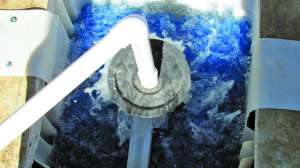
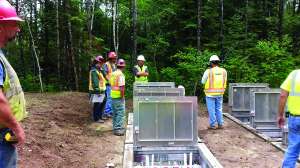
In fact, he was sure the new way of thinking would propel the industry to new heights, and he was right. Today, Ashco regularly installs alternative systems that address specific site conditions. They include the company’s own RFS II recirculating sand filter, which they developed for commercial systems that can treat up to 100,000 gpd.
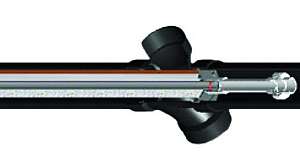
They use it in subdivisions, commercial establishments, state parks, training facilities, and highway rest areas. Two other systems they developed are the RFS III for small residential systems of 600 gpd or less with nitrogen reduction; and the RFS III-T, developed as an add-on to the secondary process to achieve tertiary-quality effluent.
“West Virginia, like most other states, has its challenges, with high water tables, steep slopes, high bedrock, shallow soil or no soil,” says Ashburn. “The trick is to stay within the design standards for the state you’re working in.” Ashco installs a variety of systems to meet unique challenges. They include:
- Drip irrigation systems with GeoFlow drip tubing.
- The Ecoflo peat system from Premier Tech Aqua.
- The Residential Home Aeration Unit (HAU), commercial aeration systems, and extended aeration systems from Jet Inc.
- In-Drain system (pod system) from Eljen Corp.
- Treatment units from Orenco Systems.
Only yesterday
Since Ashburn and Cogar can remember a day when alternative systems wouldn’t have been considered, they believe in building solid working relationships with health departments and county, state and federal environmental agencies.
“We’ve developed a whale of a relationship with the health departments,” Ashburn says. “It does no good to think you’re above these organizations. You’re in it together. These relationships develop over time. It took 10 years to develop a relationship with Pennsylvania’s regulators. I’ve been working on projects there since the 1990s.
“Know the regulators — who they are; what their names are. Become almost friends with them. Honesty is essential when working with regulators. Be honest about what you’re trying to do and the kinds of systems you want to install. Then convince them that the industry has to be involved in making decisions. There’s no use in developing technology that can never be used.”
Ashburn and Cogar say regulators began to respond to them out of respect. It’s through such respect that they’ve been invited to sit on state regulatory boards. They are members of the West Virginia Sewerage Advisory Board and attend its annual conference, where they can make recommendations to state regulators and find an audience for industry concerns.
“We’re part of the founding fathers of NOWRA,” says Ashburn. “We were there for one of the first meetings they ever had in Atlanta. I think we’ve had an impact on the onsite industry, especially in helping get industry and regulators on the same page. ”
Networking pays
Knowing how to develop good industry relationships can pay off handsomely. Because of the partners’ diligence in that area, Ashco now works in four states: West Virginia, Pennsylvania, Indiana and Massachusetts. Getting their foot in the door took time and dedication.
“Get a local contact,” says Ashburn. “Someone who can help you develop the relationships you need in that state, someone who has some influence.”
For example, Ashburn met Ralph Reed of Ralph Reed Excavating in Indiana at a training seminar at Purdue University. That meeting gave him the opportunity to work with Reed, meet others in Indiana’s onsite industry, and build relationships. Eventually, he was able to work in Indiana on his own.
Once the work comes in, taking care of the customer becomes the priority. Customer service begins with the telephone. “When someone calls in, that’s your first opportunity to make a good impression,” says Ashburn. “Treat people like you’d like to be treated. The customer knows little about wastewater; they come to you with trust.
“It’s your responsibly to provide them with a system that meets their needs. Know your products. Once your customer pays for a system, they have to live with it for a long time. You don’t want to put systems in and then have to go back. It’s your reputation. I can’t emphasize this enough: Make sure your products work like you say they will. And when you put a system in, follow up with it.
“If a system we install does have problems, we will take care of them. We tell our customers, ‘If an aeration pump goes out, you don’t have to worry about it. We’ll install another one. If it’s something else, we’ll take care of that, too.’”
Ashco also takes on all the “paperwork nightmares” to get the permits needed to install systems. “We became efficient at permitting,” says Ashburn.
Management is key
Ashburn says a good management program is key to the onsite industry. The company has delivered that for years. The company’s service contract is an integral part of the business plan. Prices start low for residential customers and get higher for more intricate systems. Commercial contract prices vary with system size, distance from the office, and whether the system uses surface or subsurface discharge.
“Our service department is self-supporting now,” says Ashburn. “We don’t have to take money from anywhere else in the business to keep it going. We manage the pumping, we check the tank, baffles, drainfield, and all the mechanical parts. We probably have 500 systems under our service program right now.”
For new construction, the company has a large equipment fleet. It includes two Hillside Industries monorail boom trucks, a National 17-ton truck crane, an International road tractor, and two 40-foot flat-deck trailers. Earth-moving equipment includes a Caterpillar dozer, a Cat 416 rubber-tired backhoe, a Kobelco 904 track excavator, and a John Deere Z35 mini-excavator.
Treating people well
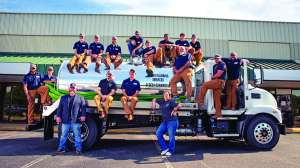
While maintaining this equipment, the owners pay even more attention to their staff members, always letting them know how much they are appreciated. Ashco employs 15 people, and most have been with the company for years. Ashburn attributes that longevity to good management policies.
In the office, Ashburn’s wife Barbara, financial manager, has been there for 33 years. Michelle McGee, accounting and payroll, has been on board for 17 years, and Lisa Travis for seven. Jim Bagwell, service manager, has 15 years of service, and technician Lee Conner has been with the company for 22 years. Steven Wayne Bucklew, production manager, is another key player.
“We normally work year round,” says Cogar. “We’re pretty good at keeping staff through the winter, and the economic climate hasn’t really affected us.”
Ashco’s customer service philosophy and quality products keep the company on top of an industry with multiple challenges. The partners have put in the time it takes to make the business stand out.
“It’s not a nine-to-five job,” says Cogar. “We never stopped at eight hours. Lots of things have changed. You need a lot more technical expertise than you did 40 years ago. But the goal is customer service. And we think we do a good job at that.”
Continue reading for free