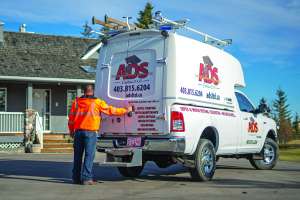
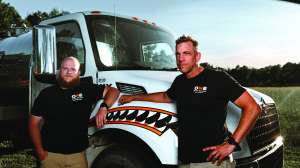
From the time Clayton Foster started in business in his teen years, he had his eyes on bigger things than residential septic systems.
It wasn’t long before his company, Acreage Development Solutions, began offering complete site work for new homes — not just the septic system, but the water system, tree and stump removal, the driveway and the hole for the foundation.
While that one-stop shopping package for builders and homeowners is still a differentiator for the company, Foster and his team increasingly focus on larger and more challenging commercial onsite projects in their territory southwest of Calgary, Alberta.
“We definitely see good things coming out of our commercial work,” says Foster, who owns the business and runs it with the help of his other half, Lainey Luft. “That’s where we’re going to focus — midsize to large commercial projects. Some of those are multimillion-dollar projects. It’s exciting, but there’s a lot to learn, too.”
Starting young
Acreage Development got its start in 2008. Foster came to the business with a solid foundation from working for his parents’ company, Ken Foster Construction, which specialized in excavation and installing onsite systems. “I always liked equipment,” Foster says. “I would go with him to jobs from as young as I can remember.”
Today his company works within a 75-mile radius around home base in Millarville, covering three counties and the south side of Calgary. “Through my family I had a lot of connections,” says Foster. “If I’d had to go into business from scratch it would have been a lot harder. I had a really good opportunity, and I didn’t want to waste it.”
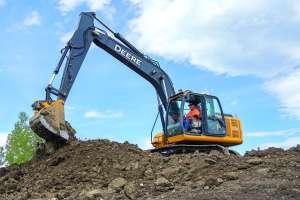
He started with a mini-excavator and a pickup truck and grew the business slowly and steadily: “Now we have four excavators, three skid-steers, a dozer, a couple of gravel trucks and a vacuum truck for pumping septic tanks.” About half of the work is related to onsite systems; the balance is earth-moving, excavating, roadbuilding and small commercial jobs.
The site development package grew out of Foster’s interest in heavy equipment. “Even though we were using equipment for septics, I wanted to head in the direction of more dirt work,” he says. He advertises the offering on the company website and markets it directly to builders: “We have a reputation for it now. Word of mouth is always the best advertising. We get lots of referrals.”
Getting it right
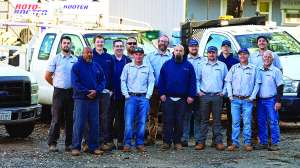
In addition to the owners, the Acreage Development team includes Garry Anderson, Brian Bertram, Kelly Keith, Glen Murray, Eric Teskey and Matreya Slevin. Foster and Luft each have a Certificate of Competency, which is the accreditation for septic system design and installation in Alberta. However, they outsource most system designs because the team is busy in the field and the province’s design process is rigorous.
The soil investigation requires excavation of two test holes, describing the soil layers, classifying the soil structure and having samples analyzed in a laboratory for soil texture. “We get a very clear picture of how much fluid can be applied to the soils,” Foster says.
“Alberta has everything from mountains, to lake country, to prairies. Because of that we want to make sure we understand the soil infiltration and design the system parameters around that. The design also includes getting all the parameters around the building so we know how much wastewater the house is going to produce. Then we marry the two numbers up and determine how big the field has to be.”
Innovative treatment
The company installs relatively few conventional systems. Sand mounds are common and many systems use aerobic treatment units. Foster also relies heavily on and prefers Orenco AdvanTex systems: “We’ve created a good relationship with them. Every four or five years we’ll take some of our team to their headquarters in Sutherlin, Oregon, for training and updating.”
For residential units, the company typically chooses AdvanTex AX20 and AX-RT units. For larger commercial installations, the system of choice is the AX100 with treatment capacity up to 5,000 gpd. Some ATUs become part of innovative at-grade systems on wooded properties.
“In a lot of situations, you would clear the trees to put a field or a mound in,” says Foster. “The at-grade technology was developed in Alberta. It’s designed to be in the trees and utilize the vegetation. It has to be secondary effluent from an ATU or a treatment plant of some type so that it is cleaned up to better than 25 mg/L BOD and TSS.”
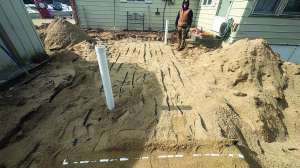
A typical at-grade system has a pressurized line that feeds a series of parallel laterals on the forest floor. The laterals are covered with drainfield chambers, which in turn are covered with filter cloth followed by 12 to 18 inches of bark mulch.
“The first thing everyone always asks is: Won’t they freeze?” says Foster. “But the systems are in the trees. They are pretty well insulated with the bark mulch. And another requirement is that they must be time-dosed, so they get a little bit of warm fluid on a regular basis. Historically, we have better luck with them not freezing than we do with mounds.”
Commercial side
Acreage Development handles maintenance contracts for the ATUs and operates a vacuum truck (2006 Kenworth T800, 2,800-gallon tank with Fruitland 870 pump) for regular septic tank pumping. Altogether the company maintains about 800 systems. On the installation side, the primary equipment includes:
- John Deere 700K dozer
- Four John Deere excavators: two 160G, a 35G and a 60G
- John Deere 333G and 325G compact track loaders
- Ditch Witch SK600 compact track loader
- Two International 9200 gravel trucks with up trailers
- Kubota tractor with rototiller/seeder and other attachments for site cleanup
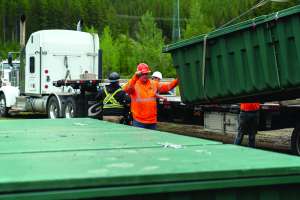
Over the past four years, the company has shifted its focus toward commercial projects, which have included schools, a hospice, veterinary clinics, a truck stop and a bus terminal. Some projects involve maintenance. For example, at a YMCA camp, the company cleared out pressurized laterals, replaced pumps and did general maintenance to restart a treatment system that had been idle during the COVID pandemic.
A major client is Alberta Parks, for which Acreage Development has done work at campgrounds and small subdivisions that house workers. The largest commercial job to date was a $2 million project at an Alberta Parks maintenance facility that included an equipment shop and 16 housing units.
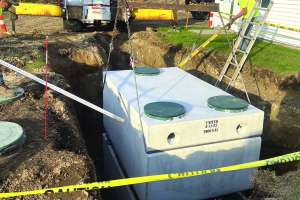
“Their system was outdated — it had timed out,” says Foster. “We decommissioned an older system and installed and commissioned a new system. It included two AdvanTex AX100s with space for a third, 25,000 gallons of tankage, a new control building, supply lines to install and eight separate septic fields.”
People business
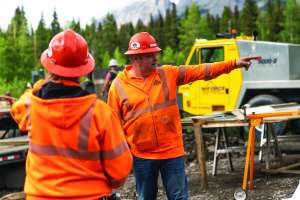
Getting all this work done means finding and retaining high-quality team members. That’s challenging in an area with abundant high-paying jobs in Alberta’s oil industry. “We’re in a negative unemployment situation pretty much all the time,” says Foster. “I don’t remember a time when it has been an employer’s market.”
Foster looks for people who would rather work close to home and family than endure the long hours and remote locations of the oil fields. “We want people who are personable, because our crews interact with customers and we want to make sure they treat them well,” he says. “We need some people who are equipment-centric, and some who are more on the service side, in the manner of residential plumbers.” Some also need commercial licenses to drive trucks.
Foster sees quality as setting the company apart from competitors: “We’ve gone away from any cheap systems. We have alliances with our suppliers so that we have good backing. They support us and we support our customers. I don’t line up with the idea of quality versus quantity. We’re 100% quality.”
Conveying value means customer education. “I spend way more time than everybody likes educating the customers,” says Foster. “The best way to do it is face to face. I sit down and explain their situation, what they’re going to end up with, and the backing they will have with us and the products we install. Some customers just look at the bottom right corner, and we never had those jobs anyway. We can’t have all the customers. We just want the good ones.”
It’s about relationships
For the future, Foster sees the commercial work growing, despite the challenges. “When you’re working on bigger jobs, the problems you run into aren’t necessarily with the ground or the pump. When you get into engineered designs, you’re dealing with soils people, electrical engineers and architects for pumps. There are moving parts that don’t exist in residential work.”
In that sector as in all areas of work, Foster has valued relationships. They include close alliances with vendors like Orenco and Liberty Pumps, which have delivered reliable warranty, design help and technical support whenever called upon. Alberta Wilbert Sales is the primary tank supplier.
It includes relationships with community organizations like sports teams and especially 4-H: “Those are the people who are going to feed the next generation, so we support them through thick and thin.” Acreage Development is also certified aboriginal contractor by way of Foster’s membership in the Métis Nation of Alberta: “We have done some work on their reserves. It’s a point of pride. I like that we’re involved with the Indigenous community.
“It’s important to nurture relationships with team members and with family. My other half’s official role is service coordinator, but she does a lot more than that. She’s an enormous part of the relationships. She’s not just a team member. She’s a leader. Business is tough in the best of times, and without a support network I think it would be impossible.”