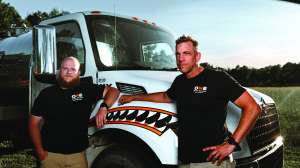
Josh Williams, owner of Lakeland Septic Company in Lakeland, Florida, worked for his father’s septic business for a dozen years before he was bitten by the entrepreneurial bug. With a dedication to building his brand, Williams has grown the company from a one-man shop to one of the busiest septic firms in Central Florida in five short years.
His father, Kenneth, worked in the septic field as long as he remembers. At eight years old, Williams accompanied him on septic runs.
“I was infatuated with the idea of going to work with my dad and pumping tanks,” he says. “It’s something I’ve always been drawn to.”
In 2006 he’d earned enough credits to leave high school early, just as his father launched Atomic Septic Tank in Lakeland. He accepted a job with the company, joined by his younger brother Casey, pumping and installing septic systems.
While he enjoyed the work, Williams wanted to do more to boost the company’s profile.
“I’ve always enjoyed marketing and I suggested things that I thought could help the family business,” he says. “My father is the best installer I’ve ever met, but he’s stubborn and old school and he would tell me, ‘We’re just a septic business.’ He felt that if the big companies weren’t doing something, it doesn’t work. I started to feel like I was going to be on that pump truck forever.”
BRANCHING OUT
In early 2019, Williams’ mother suggested he launch his own septic business and the idea took root. He applied for and received his septic contractor license from the Florida Bureau of Environmental Health in July. That license allows contractors to pump septic tanks, to install, repair and inspect septic systems, and to design septic systems under 1,200 square feet. He launched Lakeland Septic Company that November.
“The area is saturated with small septic contracting companies,” he says. “My mindset going in was that if I wanted to be successful, I had to be different and do the things that nobody else is doing. I wrote down marketing ideas, and I crossed off anything the others were already doing.”
Williams devised a logo featuring a Lakeland swan, famous as the descendants of a pair of swans presented to the city in the 1950s by Queen Elizabeth. The company colors include a standout purple.
“When you see the Nike swoosh, you automatically think about athletic shoes,” he says. “When I rent a billboard, I don’t expect that somebody driving down the road will pull over and call me. But when their toilets start to bubble, the first image in their head should be our swan with the purple logo.”
Williams also invested his energy into learning how to leverage Facebook and Google ads [see online sidebar] and built a social media presence. He created dozens of YouTube videos and flooded social media platforms with blog posts and photographs.
“I word my posts like I’m talking to someone who has no idea what they’re looking at when they see a septic tank,” he says. “That’s my audience. All of these efforts worked very quickly for me, and our business took off like a rocket.”
EQUIPMENT AND PERSONNEL
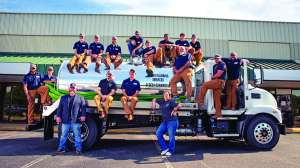
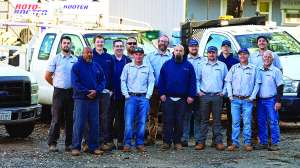
Lakeland Septic hired its first full-time worker in 2021 and currently employs four. One drives the pump truck, two work on installs and the fourth is a floater. Williams performs numerous functions.
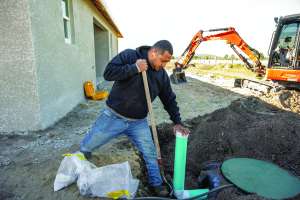
“I might be in the office doing scheduling, estimates or permits,” he says. “I may be on an excavator putting in a system and helping the guys. It depends on where I’m most needed.”
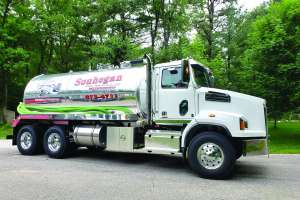
The company’s main pumper truck is a 2023 Mack MD7 with a 2,500-gallon carbon steel tank and Jurop pump built by Iron Vac Trucks. An older 2002 Freightliner with 3,600-gallon carbon steel tank and Masport pump was assembled by Williams and his father and stands by as a backup.
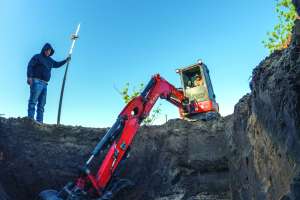
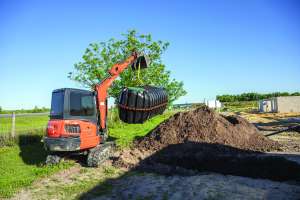
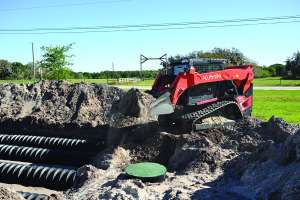
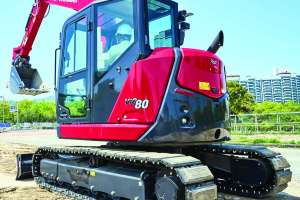
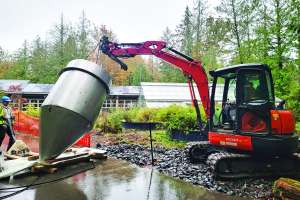
Construction is supported by a 2021 Kubota KX033 mini-excavator outfitted with an iDig TOUCH 2D excavator guidance system, and a 2023 Kubota SVL75-3 track loader. They’re hauled to the site by a pair of Ford F-250s pulling a 24-ft deckover trailer by Bigfoot Trailers.
The company serves Polk and Hillsborough counties, but will travel almost anywhere in the state for large commercial contracts involving drainfields larger than 1,500 square feet.
SYSTEMS AND SOILS
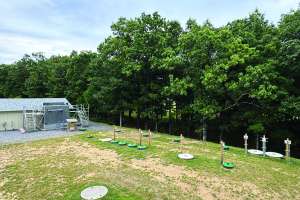
About half the septic systems Williams installs are traditional, and the other half are mound systems.
“The soils have great sand,” he says. “We work in material everyone else has to buy. In Polk County, we have areas where you don’t even hit the water table at six feet down. In other parts of the county, we might hit the water table at three inches and that’s where we need to elevate the drainfield.”
The company is seeing increased demand for nitrogen-reducing ATUs, following the passage of a Florida law in 2021. The Nitrogen-Reducing Systems for Areas Affected by the Florida Springs and Aquifer Protection Act maps out areas requiring these systems on properties of less than an acre covered by Basin Management Action Plans. The affected area was initially small, but continues to expand.
“BMAPs now include most of our area,” Williams says. “I learned how to install ATUs from my father, and got the appropriate education and certification from the manufacturers to install them early on. Now it’s here, and we’re rolling.”
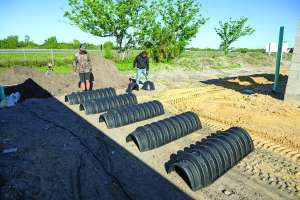
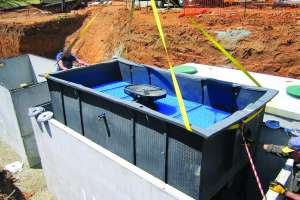
The company favors poly tanks from Infiltrator Water Technologies, using them on 90% of on new installs.
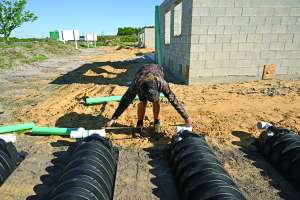
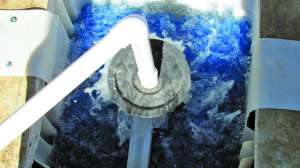
“We’re huge fans of their new Quick5 chambers,” Williams says. “They’re sturdy and give us the most square feet per chamber. We also use Infiltrator Delta series ATUs, because of their simplicity and performance.”
Lakeland primarily uses pumps by Liberty Pumps and Polylok risers. Other material is provided by Lakeland Winsupply.
The company also installs lift stations to support liquid transfer in mound systems and works on large lift stations for commercial clients.
“The big guys may be on a sewer system, but they still need that lift station,” Williams says. “We change a lot of large commercial pumps regularly.”
Commercial work represents about 20% of Lakeland’s work and these larger projects are among Williams’ favorites. Many current projects involve migrant worker housing for agricultural clients, including local strawberry farmers.
“With these engineered projects we get to install different equipment and work on a different scale,” he says. “Last year we did a system for a migrant worker housing development that included seven septic tanks and 7,000 square feet of low-pressure system drainfield.”
Lakeland also continues a small, but steady, grease trap pumping service for clients such as McDonald’s.
ALL ABOUT BRANDING
Williams continues to aggressively build the company brand for the long haul.
In addition to Lakeland’s social media presence, Williams has used radio advertising and sponsors any sports team willing to sport the company logo. He recently purchased a swan costume, including an upsized Lakeland septic T-shirt.
“I wear it at community events and pose for photographs with people,” he says. “Any time they share those photos on social media, it’s free logo exposure.”
Williams represents the company in several professional organizations including the Florida Onsite Wastewater Association, where he joined the board in 2022. As a member of the National Onsite Wastewater Recycling Association, he recently joined a task force to help develop training for challenging site situations.
He attended the Water & Wastewater Equipment, Treatment & Transport show for the first time in 2024.
“The size of the trade show was insanity,” he says. “For three days I walked around and every day I found something I hadn’t seen the day before. It was also a chance to meet and exchange ideas with contractors that I’ve talked to on Instagram for years.”
FUTURE PLANS
The company is still young, so Williams hasn’t considered family succession plans. His wife, Jessica, has a rewarding career in the banking sector. His oldest daughter Karleigh is 15 and likes to work in the office. Her sister Kenslie is 13 and her brother Brody is 10. They’ve all been out to project sites, but any genuine interest shown by the kids will determine their long-term involvement with the company.
Over the next decade, Williams hopes to double or triple the size of the company and expand the pumping side of the business.
“It’s crazy how much we’ve grown,” he says. “In the next 10 years, I want the guys who are working for me now to still be working here, achieving their personal goals, managing aspects of the business and teaching other guys how to do this work. If I leave a legacy in this industry and my community, it would be for people to think of my name any time someone mentions ‘septic.’”