For 20 years, the IslandWood environmental education center has been depending on a living machine to treat its wastewater and has taught children about it. Now its leaders were ready to move into using recycled water for toilet flushing, and they hired A Advanced Septic & Construction Services of Auburn, Washington, to add technology so treated wastewater will be even cleaner.
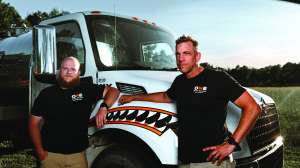
It wasn’t a complicated job because IslandWood’s founders put much thought into setting up the original system, and there was a high level of engineering, says Jeremiah Gunia, head of R&D and quality control for A Advanced.
“What’s really cool about this place, in my opinion,” Gunia says, “Was once we did the final upgrade, all we had to do is turn a couple of fittings and redirect the flow because 20 years ago, before it was approved, before there were any rules or regulations around it, this establishment paid to have plumbing laid with the belief that one day they would get approval to activate it for their reused water. So we didn’t have to replumb any of the buildings for this water to come back in. They had foresight 20 years ago to actually run the lines to the bathrooms for reuse.”
Tidal Water
IslandWood is both a classroom and an event center, Gunia explains. The facility hosts high-end weddings and other events, and uses that income to provide free environmental programs to schoolchildren.
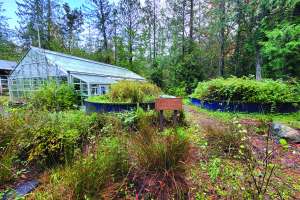
The original living machine consists of five basins. Wastewater from the kitchen and main meeting building flows first into a 10,000-gallon pre-existing concrete trash tank. By gravity water floods the first of two outdoor basins filled with gravel and plants. When this basin is full, water is pumped to the second basin. The basins represent the coastal shoreline, Gunia says, and the high and low water levels mimic the rise and fall of tides. When a basin is empty, oxygen is pulled through roots, he says, and when water is in the basin, plants pull out some of the nutrients.
From the second basin, water flows to a greenhouse where three basins filled with more plants provide additional treatment. A drainfield disperses effluent.
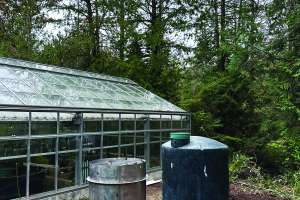
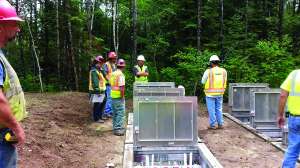
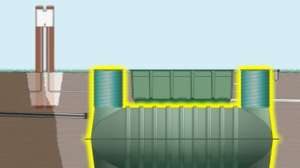
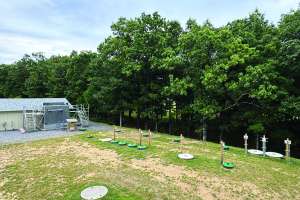
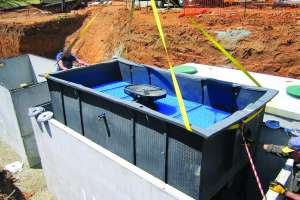
To facilitate wastewater reuse, A Advanced added a bioreactor polishing step after the 10,000-gallon tank, so the pump pushes water to the new series of tanks. All were set above ground so water flows by gravity to the first basin.
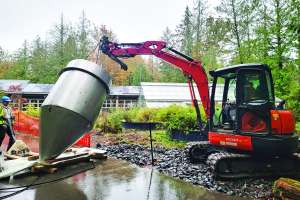
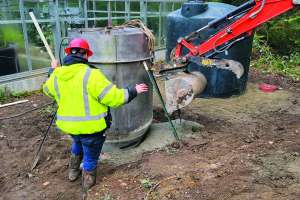
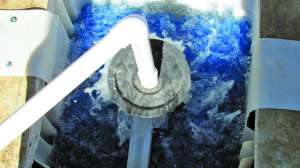
First in the new installation is a 2,100-gallon poly tank from Norwesco. Inside is a Nibbler (Aqua Test) bioreactor with floating media about the size of a Wiffle ball, Gunia says, and this tank is aerated. After this step, water flows into a custom-made, stainless steel, cone-shaped tank that settles and thickens sludge. Liquid flows by gravity to the next basin. Clarified water flows through a 24-inch well with a Polylok filter, then into the first gravel basin of the existing system.
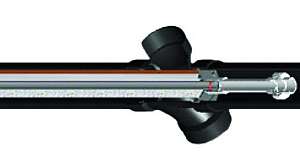
A Advanced also upgraded UV equipment inside the greenhouse, Gunia says. Technicians cut out the old unit and installed one from Aquacare Environment Inc. The lamp is inside a 3-inch-diameter tube so water flows around the lamp on all sides.
Panels were already in place to run the living machine, Gunia says, so engineers sent custom wiring to be fitted into the panels for control of the new components.
Collaboration
IslandWood is 75 miles from the A Advanced shop. That’s a 90-minute one-way drive if there’s no traffic, Gunia says. “We rented some hotel rooms. We did some day trips back and forth.” And it’s all part of the job when you work in an area with islands, he adds. “You may go 5 miles, but when you’re waiting for a ferry to load and unload, it adds time.”
Work was scheduled around events at IslandWood, but some had to happen during events, Gunia says. Technicians needed visitor passes and the IslandWood staff was courteous to the installers and made sure they were fed.
One of the small challenges was working out fittings and parts, Gunia says. Because the engineers for the system are on the East Coast, they specified parts common in their area. A Advanced technicians had to understand what the engineers were trying to accomplish and then find parts that perform the same function and that could be shipped to the island.
Interchanges with the engineering firm were amazing, Gunia says, because they were receptive to suggestions. A Advanced lead technicians, who have been installing for a long time, were honored by being listened to, he adds.
There were some change orders. The 24-inch filter well was added while the job was in process. The stainless steel cone had already been set in its concrete base, so it had to be removed and raised 6 inches to allow gravity flow into the well. Associated pipes had to be raised 6 inches, too.
If the reuse system reaches capacity, there is an overflow to direct treated wastewater to the dispersal field, Gunia says. If IslandWood staff need to, they can also change a couple of valves to send all the treated wastewater to the field.
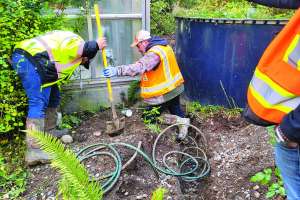
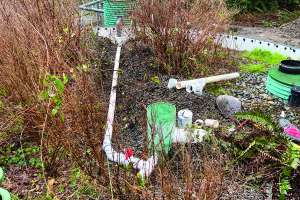
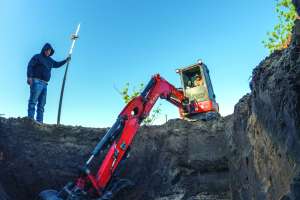
“What made it challenging is we had to dig between the greenhouse and the large rock basins. We had to dig down 3 1/2 feet, identify several of the many pipes so we could intercept and plumb in and out — which sounds really simple until you dig down 3 1/2 feet and you have 17 different PVC pipes,” Gunia says. “When we exposed several feet of the pipes, we found somebody 20 years ago took a Sharpie and wrote on the pipes, and they took a picture of the plumbing. It was still a little bit scary because it’s a working, living, operating machine, and you don’t know if you’re in the right pipe really until you’ve cut it and done the work.”
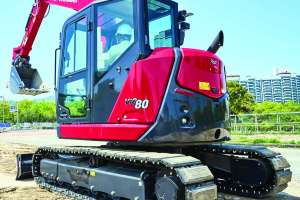
Because of the narrow spaces, about 75% of the job was dug by hand, he says. The rest was done with a Kubota KX040-4 compact excavator. A Kubota SVL95 skid-steer handled materials.
Although not strictly necessary, the polishing equipment installed by A Advanced will improve the system and make maintenance of the gravel basins significantly easier, Gunia says. “You hit a system in four hours with a big event, and sizing and principles go out the window. It all works, but a lot of times we’re sizing these around 24-hour windows, and event centers can hit their daily capacity in three to four hours.”
Some extension of the project occurred because A Advanced recommended changes to make teaching easier, Gunia says. For example, technicians shifted the location of air blowers for the bioreactor so instructors can be more easily heard during tours. Moving some electrical racking created a better walkway.
“They should be putting these at elementary and high schools around the country,” Gunia says. “For the cost of treating your wastewater, and having a reuse opportunity, you can have a botany, a biology, an electrical and basic mechanical class all in one, and have it be a beautification project.
“A Advanced wanted this one to be a win for everybody,” he says. “It certainly was not our most lucrative job, but it’s a 200-plus-acre, high-end educational facility dedicated to children that focuses on wastewater. I don’t know how you find anything more in our passion zone than supporting youth and cultivating a culture where responsible wastewater management is cool.”