A store owner in Goshen, Indiana, wanted to open another discount grocery store with a delicatessen. The Dented Can grocery store would have foods prepared in a fully equipped kitchen, including cooked potatoes, which triggered the state Department of Health to assume high-strength waste and require secondary treatment.
Consequently Stuart Meade, owner of Meade Septic Design in Goshen, included three 2,000-gallon tanks with treatment in his original design featuring Advanced Enviro-Septic treatment-dispersal pipes (Infiltrator Water Technologies). That exceeded the client’s budget, so he deleted potato salads from the menu. This solution satisfied officials provided a contractor tested future effluent to ensure it didn’t exceed 170 mg/L BOD. In case it did, Meade left room for secondary treatment in the design.
Meade said the project was challenging because of the site’s unique characteristics. “The system had to fit in a triangular half-acre with complicated slopes, an overhead power line easement to the east, a drainage easement to the west and a parking lot to the south.”
Meade, who usually lays out systems in the field with a Rugby 620 rotating laser (Leica Geosystems) and Keson steel tape, knew they wouldn’t work here. Instead, he used a BRx6 GPS receiver and Surveyor 2 data collector (Carlson Software) to shoot grades in a tight grid and generate 6-inch contours from the points shot. Using AutoCAD, he drew the absorption mounds over the contour lines, staked the system onsite with his GPS and confirmed the elevations with the rotating laser.
“The only way we could fit the system into the triangle was by splitting the drainfield into a two-third, one-third multiple bed configuration,” says Meade. A complete perimeter drain with a segment drain between the two mounds made the squeeze even tighter. Ben Martin, the owner of B&E Excavating in Nappanee, Indiana, installed the system. It went online in late 2024.
Site conditions
Soils are clay loam with a loading rate of 0.25 gpd per square foot.
System components
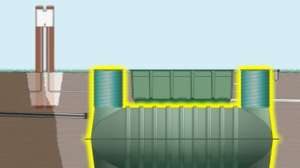
Meade designed the system to handle 1,800 gpd. Major components are:
- 1,000-gallon concrete grease trap. Components supplied by Farmer Tank.
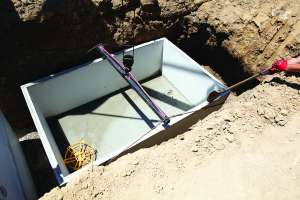
- Two 2,000-gallon dual-compartment septic tanks, each with a PL-525 effluent filter (Polylok) and a 20-inch riser (TUF-TITE)
- 2,000-gallon concrete dose tank with duplex Model 151 1/3 hp effluent pumps (Zoeller Pump Co.) and 36-inch risers six-hole concrete distribution box with flow equalizers
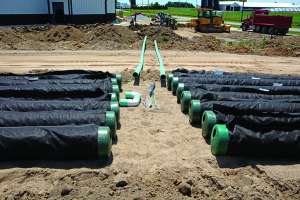
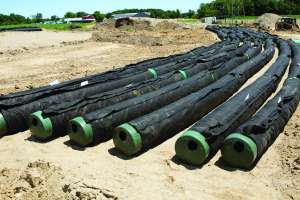
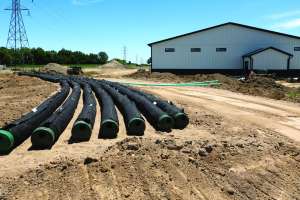
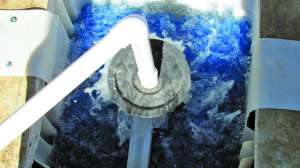
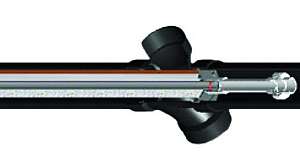
- 840 feet of Advanced Enviro-Septic treatment-dispersal pipe (Infiltrator Water Technologies)
- IFS control panel (SJE Rhombus)
- 600 feet of 4-inch slotted polyethylene ASTM F405-05 corrugated perimeter drain pipe
System operation
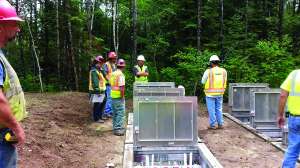
A 4-inch pipe runs 13 feet to the grease trap, then liquid flows to the gravity sewer. Wastewater flows 16 feet to the septic tanks set in series, then effluent runs 34 feet to the dose tank. On-demand alternating pumps send 300 gallons in 10 minutes through a 254-foot-long, 2-inch force main to the distribution box at the head of zone A.
Four-inch header pipes dose the three zones simultaneously. Zone A measures 7 1/2-by-72-feet long and has four rows of 70-foot treatment pipes. Serial zones B and C are 12 feet wide with seven rows of 40-foot pipes.
Installation
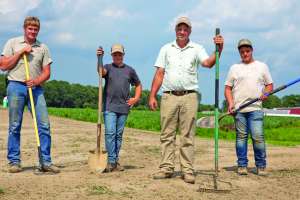
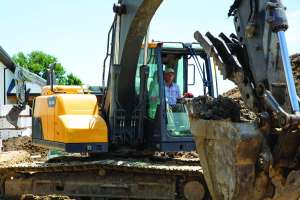
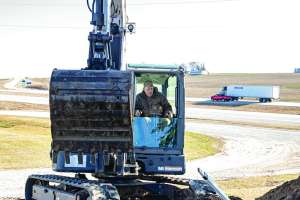
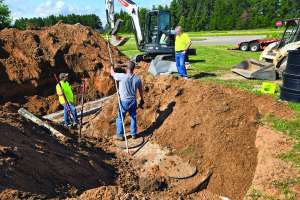
When Martin, his sons Kendrik and Kylan, and laborer and equipment operator Trevor Crist arrived, the grocery store was under construction and Jaguar had graded the tank area. Crist drove the company’s Kenworth T800 tri-axle dump truck to Yellow Creek Gravel 3 miles away for the first load of crushed #53 recycled concrete, while Martin dug tank holes with his Takeuchi TB260 excavator.
“The heavy clay soil held together well, making excavating and bedding routine,”Martin says. Once the grease trap was set, the two boom trucks from Farmer Tank returned twice with the bottom and top halves of the septic tanks.
“The difference in setting these tanks was leaving the gap between the second septic tank and the dose tank for the potential secondary treatment system,” Martin says. They completed the work in a day.
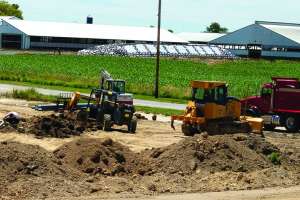
The next morning Martin used his John Deere 650K bulldozer to scrape weeds off the agricultural field, which had been roped off to keep out construction traffic. To prepare the absorption beds, he plowed the soil 18-inches deep using the multishank ripper attachment on the bulldozer.
Martin’s crew installed the sock tile perimeter drain first, then filled the trench with Spec-23 sand. The drain connected to an 8-inch pipe heading toward the detention pond.
While Martin and sons finished the drain installation, Crist stockpiled six loads of specified sand, then quarry drivers delivered the remaining 513 tons. Martin used the dozer and its M18 dual-slope rotary laser (Milwaukee Tool) to build the three 12-inch-deep sand beds.
Rain overnight forced the crew to take a day off while the site dried, then they laid the 10-foot-long sticks of treatment pipe. “It was time-consuming work because the pipes’ total length only fit if we followed Stuart’s flagged contours,” Martin says. He used the laser to confirm they were on target and maintaining the proper amount of sand beneath the pipes.
After the crew positioned the pipes 6 inches apart, Martin used the Takeuchi excavator to dribble sand over the tops and down the sides to stabilize them. They covered the beds with 3 inches of sand and the long sloping toe with 6 inches of sand. Crist mounted the system’s high vent in an unused D-box outlet. “The meticulous installation, which took three days, went smoothly thanks to Stuart’s detailed design,” says Martin.
On July 10, 2024, Hurricane Beryl dumped 5.50 inches of rain on the area in 18 hours. Martin observed the drainfield the following day and saw minimal erosion. “Some native fill was settling around the tanks, which was great, and the field faired very well,” he says.