What an industry we work in.
It hasn’t even been a full year since I was able to add Onsite Installer editor to my resume, but even in that short time I have learned a lot, especially about the type of people that make up the onsite community.
I recently had the chance to visit an installation site, and though the system itself is fairly straightforward in terms of design, the story behind it is anything but average.
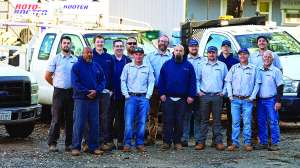
It began with a phone call from Mark Prevost, fluid handling manager for First Supply in Wisconsin. He informed me that First Supply and Eljen were teaming up on an install in Eagle River, only a few miles away from the COLE Publishing office.
It was a replacement for an existing and failing system at the home of Roger Skinner, a U.S. Army veteran who served from 1965-68. It all started when Skinner contacted Greg Simac, owner of Simac’s Plumbing, for a quote on a new system.
“The quote was more than I could afford, so I went to the VA and they donated a few thousand,” Skinner says. “Then Greg reached out to First Supply and Eljen and they said they would donate the materials.”
Within the month, Simac was on site and Skinner was getting a new septic system.
The system
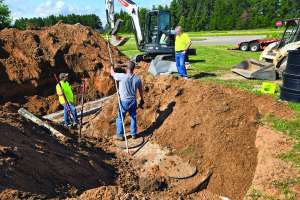
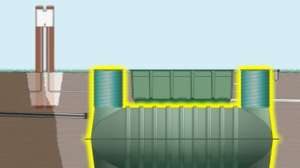
The previous system used a 1,000-gallon holding tank and was sized for three bedrooms. However, the house contains six bedrooms, so upsizing the system was necessary. The existing 1,000-gallon concrete tank was still in good shape, so it was reused. Using a Bobcat E50 mini-excavator, Simac removed enough soil for another 1,000-gallon concrete tank made by Concrete Products of Eagle River.
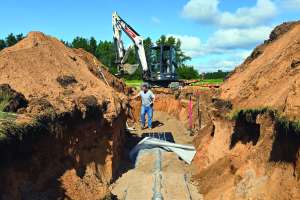
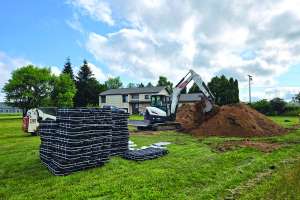
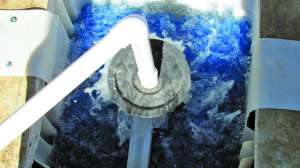
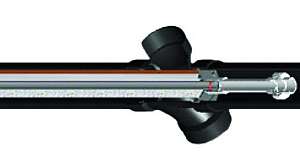
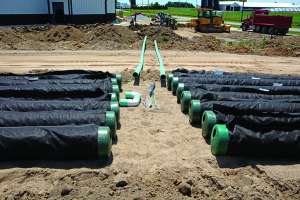
The two concrete tanks were plumbed together making 2,000 total gallons of septic tank. Simac set the second tank just below the first tank with minimal pitch through the tank from the inlet to the outlet. The second tank also had minimal pitch to the header of the drainfield because of soil depth limitations. For the drainfield, Eljen and First Supply donated the 120 total feet of Eljen B43 Geotextile Sand Filters. Due to space limitation and soil composition, the GSF modules were laid out in three, parallel 40-foot trenches.
Scott Moore, technical development lead for Eljen came all the way from Connecticut to assist with the install. “We try to do as many of these donation projects for veterans as we can,” he says. “It’s hard to say no.”
Gratitude
The Vilas County Veterans Service Office also contributed money to Skinner to help cover the costs of the concrete tank and permit. Simac worked with Kevin Eades, the assistant Vilas County Veterans Service officer, to gather those contributions.
“We were able to get the job done and get Mr. Skinner the new septic he needed,” says Simac. “As an Army veteran myself, it was an honor to be able to help out a fellow veteran in a time of need.”
When it was all said and done, only a small portion of the total cost was required from Skinner. For the majority of my visit, I stood back and let the guys work while chatting with him, and he wasn’t shy to express his appreciation.
“I did three years in the Army and during that time I often wondered what I was doing it for,” Skinner says. “But with stuff like this, I know it was worth it.”
One of many
This is just one example of countless selfless acts that occur routinely in the onsite industry, with another instance showing up a few pages ahead in this month’s Contractor Profile. The article features the Resors, a husband and wife that pooled together their skills to create a successful business installing and maintaining septic systems. But when times got tough for the duo due to uncontrollable circumstances, it was friendly competitors that came to their side.
In an era where it often seems more common to see negative news coverage than good, I am happy I was able to visit the Skinner’s home, meet the people and share this positive story. Skinner agrees, “I think this story should go on the front page of the magazine and the paper.”
Thanks for all you do and for reading this month’s issue!