Bay Shore Construction took on a job at a 10-unit mobile home park believing it was just a septic tank replacement.
On investigating, owner Brandon Thompson and his team found that the tank serving two mobile homes wasn’t even discharging to a drainfield. Another tank also serving a pair of units was feeding to a distribution box, but the effluent dead-ended there.
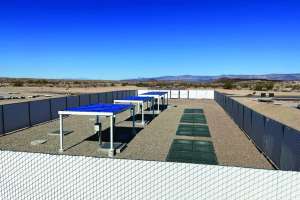
Bay Shore, based in Olympia, Washington, ended up completing a five-week project to create a new onsite system for five of the mobile homes in the 50-year-old park. At its heart are three Oscar sand bed systems fed by an Oscar-X02 aerobic treatment unit, all from Lowridge Onsite Technologies.
Site Conditions
The property, in Tacoma, has a gentle slope. A 2-acre area with five mobile homes on fixed foundations left limited room for the system. Work space was tight, especially because the old septic tanks had to be worked around until they could be abandoned.
The soils were challenging. “We encountered heavy clay,” Thompson says. “We hit restrictive soil pretty quickly. In our first test hole, we found up to 12 inches of black loam, then 18 inches of brown loam and fine sand, and after that 30 inches we found clay. That made us optimistic. But the rest of the perc holes had only 11 to 15 inches of good soil before we hit clay.” Connor Pelzel of Westside Septic Design in Puyallup did the system design.
System Components
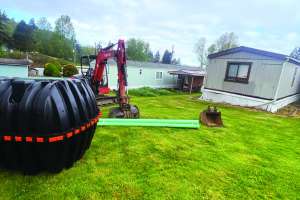
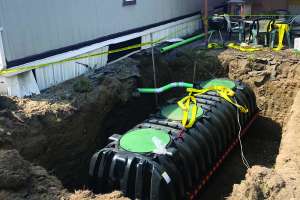
- Two 1,500-gallon single-compartment IM-1530 plastic septic tanks (Infiltrator Water Technologies)
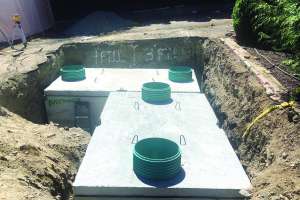
- Two 3,000-gallon, two compartment precast concrete tanks (Evergreen Pre-Cast, Sumner, Washington)
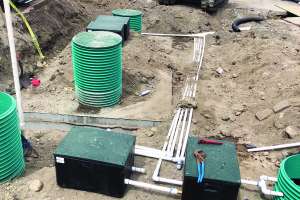
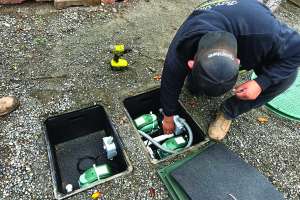
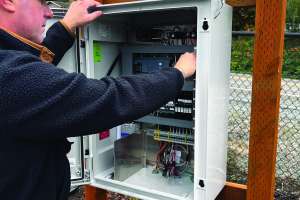
- Oscar-XO2 aerobic treatment unit complete with controls, headworks box, aerators and pump
- Three Oscar sand bed treatment units
- Four tank risers and lids (Orenco)
- 350 feet of 4-inch 3034 PVC pipe
Installation
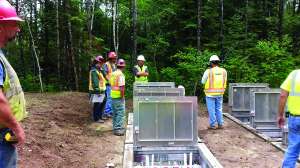
Bay Shore team members first marked out the locations of all components on the site, with the sand beds at the top of the slope and the two 3,000-gallon concrete tanks at the bottom — one functioning as a septic tank, the other holding the ATU and pump chamber. Two crews installed the system, working down the slope because of space constraints.
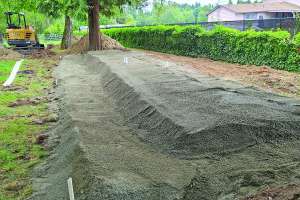
First the crews created the three Oscar sand beds. “We had to build the beds one at a time because we needed to use all of what we called the back area of the site,” Thompson says. “It was very challenging in that space was extremely tight up there.”
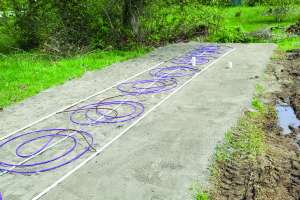
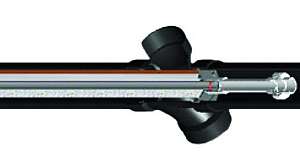
Designed to operate within an extremely compact footprint, the Oscar systems consist of a 6-inch layer of C-33 sand media and a series of pre-assembled Netafim Bioline drip tubing coils. The sand media is placed on a prepared soil surface; the coils are laid on top and covered with an additional 6-inch sand layer.
Next the workers dug a single trench for 4-inch PVC piping carrying effluent from the mobile home septic tanks down to the larger concrete septic tank, and the effluent from the ATU up the slope to the sand beds.
Then they installed and connected the two plastic septic tanks, each serving a pair of mobile homes. The old septic tanks were pumped out and abandoned in place. Then came the installation of the two 3,000-gallon tanks and the testing and commissioning of the ATU.
“One challenge we had was that the park owners wanted the system to have its own independent power source,” Thompson recalls. There was a delay in approval from the local utility before a new line and separate meter could be installed. Until the power was connected, Bay Shore had to keep a vacuum truck at the ready to pump out the mobile homes’ plastic septic tanks as needed.
The owners asked Bay Shore to restore the site to the original grade and then took responsibility for seeding the property with grass.
“When the work was done, we called for inspections,” says Thomson. “The designer came out and said everything looked perfect. We met the county inspectors, and they were very impressed with how it looked. We passed on the first inspection.”
System Operation
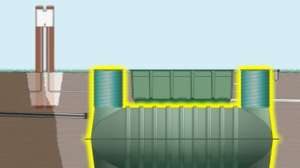
Wastewater from four of the mobile homes flows into the two plastic septic tanks and then by gravity into the 3,000-gallon concrete tank. Wastewater from the fifth mobile home is piped directly to the concrete tank.
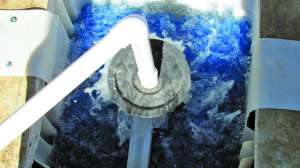
After passing through both compartments of that tank, the clarified water enters the ATU in the first compartment of the second 3,000-gallon tank. There it is infused with air from three pumps to maximize dissolved oxygen and provide mixing. The ATU treats the wastewater to 30 mg/L BOD and 9 mg/L TSS.
From there the water enters the pump chamber from which it is time-dosed at roughly two-hour intervals through an Oscar headworks box and then up to the sand beds. Some of the water is ejected from the coils into the sand; the balance recycles to the ATU and is re-treated. Serving mobile homes with a total of 11 bedrooms, the system is designed to treat up to 1,420 gpd of normal domestic-strength wastewater.
Maintenance
RJ Trends, a company of Bay Shore Construction, performs state-required semiannual maintenance. That includes a complete inspection to ensure that the electrical system and control panel are working properly, the water levels in the tanks are where they should be, and the time dosing is correct. The company will also perform a visual inspection of the site and take effluent samples from the ATU to make sure it is functioning properly. The system will also be recalibrated as needed on each visit.
Solid Result
Thompson and his crews communicated closely with the customer. “We gave them timelines and let them know how far along we would be by the end of each day,” he says. “We were dealing with an older brother and sister who inherited the mobile home park from their father. They didn’t have much knowledge about septic systems. They were extremely happy with our work. They put a lot of faith in us and we’re thankful for that.”