
Last summer a customer hired our company to replace the onsite system for his home. His system was old and failing, and he was ready for a new one. When our crew arrived and unloaded equipment and prepared to start the job, they noticed that the area between the house and septic tank was freshly backfilled.
We asked the homeowner what occurred and he said his septic pumper told him there was a problem with the sanitary sewer between the house and septic tank, so he had recently had the pipe repaired.
Upon exposing that recently repaired pipe, our crew was shocked to see a large smashed hole in the basement concrete block, and the only "seal" method the person who repaired the pipe used was to stuff two pairs of disposable overalls into the hole.
This reminded me of a recurring problem I saw often back in the day. It seemed a lot of people had water coming into the basement around the sanitary sewer line. No matter how we tried and how much hydraulic cement we used both inside and outside around the pipe, water could still get in.
Eventually our company came up with what we feel is our best way to seal the pipe. The calls regarding leaks stopped immediately, and years later we have not had one leak since. Here are our tips and tricks.
Tip #1
For concrete block walls:
We first do "typical" repair of concrete block: Keep the hole as small as possible. Fill where needed using concrete parts, and when tight we fill around the pipe inside and out with hydraulic cement. Once the hydraulic cement is done, on the outside in our excavation we actually use a rubber roof flashing that we seal using butyl to the wall. Calls regarding
leaks stopped.
For poured concrete walls:

For poured concrete walls we drill a 5-inch hole for a 4-inch pipe. We have a gasket for a 4-inch pipe that fits the 5-inch hole so tight, we would not have to use the hydraulic cement nor the roof flashing. Because I never want a call about a leak ever again, we still use the hydraulic cement and roof flashing over the gasket for a
triple-tight seal.
If you look at the picture of the roof flashing we use it looks like the hole is too small for a 4-inch pipe. It is, but it comes with several size holes you cut into it for a perfect fit.
If memory serves, I owe Sam Lindner of Lindner Brothers, a long time onsite installer in our area, credit for the outstanding roof flashing idea (which really works!).
Tip #2
Again this was years ago, but we went through a period where a lot of pumps on brand-new systems we installed were failing. Troubleshooting indicated they were all the same pump — a 1/2 horsepower, 110-volt effluent pump. After several of the same pump kept having problems of course we assumed it was a problem with the pump. But further investigation proved that the outlet in the electrical junction box we were using was not sized appropriately for that size of pump. Credit to the electrical junction box industry who changed the outlets in their boxes accordingly. Problem solved.
But I bring this up because I find to this day issues in electrical junction boxes as the cause of some "pump" issues.
When called regarding possible failed pumps we find the outlet "burned" off or corroded off, requiring merely a replacement of the outlet in the box to get the customer back up and running. The customer is quite happy that they are paying for an outlet and not a pump.
But please be aware that when you replace the outlet, you do so with one that is properly sized for the pump or you could have recurring problems. As plumbers and installers the last thing on our mind is that outlets might be sized differently but they are. A properly sized outlet really helps prolong the life of the pump and reduce callbacks.
Tip #3
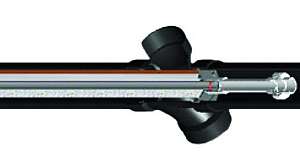
If you do upgrades and retrofits of older systems, the Polylok Extend & Lok is a great fitting that makes it easier to install an effluent filter into an existing tank.
Most existing tanks are difficult to add a filter to because you don’t have pipe to connect to inside the tank. This fitting allows you to twist it into the existing pipe (in most cases) and then hook a piece of pipe and a filter to it. This fitting comes in several sizes.

Tip #4
Sometimes you need to connect clay to PVC or concrete to PVC and need specialty fittings for that. For the sewer industry, Fernco has come out with the HULK, a green coupling that can be used for a variety of connections of the same inside diameter. So, for example, this unique fitting works for both concrete and clay to PVC. This fitting has a lot of potential uses that could really help when needed.
Let us know if you try any of these tricks, or if you have other ideas that solve this problem.
About the author
Todd Stair is vice president of Herr Construction, Inc., with 34 years’ experience designing, installing, repairing, replacing and evaluating septic and mound systems in southeast Wisconsin. He is the author of The Book on Septics and Mounds and a former president of the Wisconsin Onsite Water Recycling Association.
Continue reading for free