
Construction and sitework practices can cause erosion and sediment runoff that pollutes lakes and streams.
Local and state erosion control requirements are typically based on the size of the project and/or how long stockpiles will be in place. Onsite installers in many instances are finished with residential installs before the timeframe for erosion control requirements are reached. And many residential projects also fall beneath the size threshold.
Where project sizes and duration meet the threshold for erosion and sediment control, it is very important that proper protocols are followed to prevent runoff as well as avoid fines from regulatory agencies.
An example of a project requiring both erosion control and site stabilization is one we did a few years back. The site was a large, very steep hill overlooking a very sensitive lake. The lake is a very high-end location that people of means from another state inhabit.

I knew the erosion control permit was going to be crucial to the project; I also knew how sensitive of a site this was. I paid an erosion control company to assist in the erosion control plan because I did not want to miss anything. We applied for the erosion control permit and it was eventually issued.
When you receive an erosion control permit, please note the expiration date. This job went so (painfully) long that our erosion permit literally expired on our last day there.
Inspections
Know the requirements of the permit. Our requirements were not only to install a robust silt fence, double silt fence down near the lake and single, double and triple layer silt sock, but we had to inspect all of it, every inch each week and after each rain.
An inspection report must be kept documenting each inspection, date, time, condition of the erosion control items, and what we did if we found areas that needed repair. But yours are not the only inspections. Erosion control inspectors will inspect upon installation of the erosion control, and then at random times throughout the project. Your erosion control permit and inspection documentation must be on the job, posted in a place the regulator could find the report and review it even if you were not on site. And on this long project, they always inspected when we were not there, and we worked long days. Make sure if any erosion control items are run over or wrecked they get an immediate repair or replacement.
I remember years ago (so many years ago that I do not remember the source) someone showed me a unique idea of using wood chips for new-construction erosion control. Here was the idea. New-construction sites generate scrap wood. The organization or company would take scrap wood, trees, etc., and turn it into mulch. They would then be hired by builders to come and cover the entire site in 8 inches or more of wood chips.

If it rained, no erosion would occur because the rain would be hitting the wood and not any exposed soil. I have no idea if this idea took off or not, but it seemed to have some merit. The other reason it seemed like a good idea is that wood is biodegradable. So in theory, the wood (over time all mashed into the soil ) would not even have to necessarily be removed; at least that was the idea.
Site stabilization
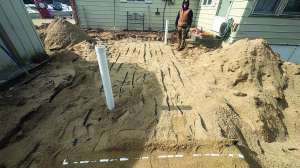
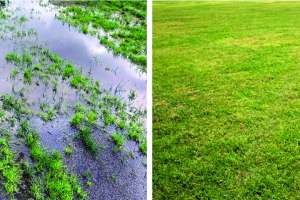
Site stabilization is important for several reasons, runoff being one. Site stabilization is important to protect onsite systems until a healthy sod layer has been achieved to protect the onsite system from any damage. Every mound system has (or should have) site stabilization measures before you leave the site.
Site stabilization is typically seed and mulch. I really like the straw mat rolls; they do a good job of soil stabilization while waiting for the grass to grow. There are also plenty of different geo cells and other rolls of grid that physically hold the soil. This type is typically for steeper slopes. There are chemical plasticizers/polymers that are also used. The most immediate and best stabilizer is sod. Install the sod — stabilized, done.
Proper erosion control saves both the environment and your bottom line.

About the author
Todd Stair is vice president of Herr Construction, Inc., with 34 years’ experience designing, installing, repairing, replacing and evaluating septic and mound systems in southeast Wisconsin. He is the author of The Book on Septics and Mounds and a former president of the Wisconsin Onsite Water Recycling Association.
Continue reading for free