
Decades ago I watched as inspectors charged customers to drop pebbles into their vent pipes to “inspect” existing onsite systems for home sale inspections. If there was a splash, the letter said (paraphrasing here) that the system did not pass — the system had failed. I asked why they didn’t look in the septic tank at all and the response was that their employer did not want them to lift something so heavy.
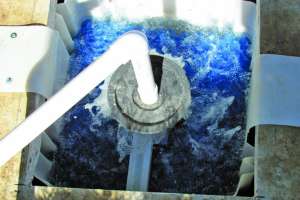
In replacing several of these systems, it became very obvious to me that several of the systems were replaced prematurely and were nowhere near failing. I also began to realize that many of the systems being "failed for a splash" because of vents on top of distribution boxes. You are going to get a splash in a distribution box because a distribution box will always have water in it. This experience resulted in five years on a committee to develop a peer-reviewed curriculum to teach a class in best practices of evaluating existing systems for property transfers — a class I still teach today.
As discussed in a previous article, not only is basing evaluation results on water in a vent pipe very wrong, in my state it does not even meet the statutory definition of a failed system. The concerning thing about this ongoing method of determining pass or fail is that those who continue to use this method (still common in my area) don’t even know when the vent is on a distribution box, nor the construction techniques included in installing the onsite systems they are evaluating.
In discussing the importance of knowing if you are looking in a vent that is on a distribution box or not, I have found that most people I am training assume the distribution box is only on the inlet end of the soil absorption component. In our area, if a distribution box was used as the method of "feeding" a bed size distribution cell or bed, there is typically one at the far end of the distribution cell also.
Installing onsite systems in my area (Wisconsin) does not require a distribution box be used if the soil absorption cell is flat, only if multiple cells are stepped down a slope and each has a different system elevation. In flat cases headers or PVC manifolds are used. But in older systems, if they didn’t have a header on one end and used a distribution box, in most cases, they didn’t have a header on the other end either and used a distribution box on both ends.
Improving on the D-box
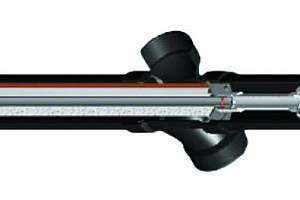
Because distribution boxes were intended for equal distribution but have been shown not to successfully provide equal distribution1, new add-ons were developed. Dial-a-flows or "speed dialers" were developed to allow each individual pipe exiting a distribution box to be adjusted to get closer to equal distribution.

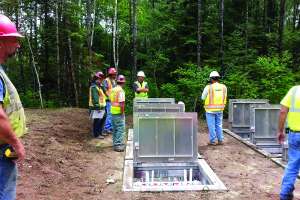
In making system repairs, many distribution boxes have been found to no longer be level in the ground on older systems, possibly since the date of backfilling during installation. Some companies, after flattening off the location for the distribution box (and in some cases compacting), then place a paver-type flat concrete base beneath the distribution box to prevent settling or offsetting of the distribution box in hopes that it helps with the equal distribution by keeping it flat after backfilling.
Some install a PVC Tee fitting on the end of the inlet pipe inside the distribution box to act as a "velocity reducer" and minimize any solids that might get pushed out of the distribution box.
Some people modify distribution boxes to be used as dropboxes in serial distribution systems. In serial distribution systems, the highest trench has to be ponded and operating at an advanced stage of saturation before the next trench lower even starts to get any of the effluent. Former University of Wisconsin professor and onsite legend Jim Converse has said many times that the use of dropboxes, as in serial distribution, is to him a great idea because it allows you access into the drop box at the end of each cell/trench, so you can easily adjust and maintain what cells/trenches are getting how much effluent, if any. He mentioned many times how this type of access is such a great management tool.
Like any other component of onsite systems, distribution boxes serve an important purpose, but must be installed as carefully as possible to achieve their purpose.
About the author
Todd Stair is vice president of Herr Construction, Inc., with 34 years’ experience designing, installing, repairing, replacing and evaluating septic and mound systems in southeast Wisconsin. He is the author of The Book on Septics and Mounds and a former president of the Wisconsin Onsite Water Recycling Association.
1 Coulter, J.B. and T.W. Bendixen. 1958. Effectiveness of the Distribution Box. Final Report to the Federal Housing Administration U.S. Public Health Services Robert A. Taft Sanitary Engineer Ctr. Cincinnati, Ohio
Continue reading for free