Proper training costs money — lots of money.
Recently my company purchased a piece of equipment for $14,000. Three employees had proper training on the piece of equipment. We did three jobs with it. On the fourth job none of the three trained employees were available; but we had several days to train the employees who would be on the job. The morning that job began, I asked my trainers if the crew going to the job was properly trained. The response “We think so” should have been a red flag. Two hours later the piece of equipment was broken and required $ 1,700 to fix what the repair person called “obvious user error."
So for a job we charged $1,200 for, it cost me all the labor plus $1,700 in repairs. That was not a good day.
To train five employees at the factory (nearby) is $1,000. If I had spent $1,000 and had five people trained, it would have saved me the $1,700 repair. Put another way, for $1,000 I could be ahead $700 right now; but instead on one job I’m out $1,700.
I do realize I should have quadruple-checked that the crew knew what they were doing because it is a touchy piece of equipment, and it’s not cheap. I should not have put the piece of equipment nor the employees in a situation they weren’t ready for.
I pride myself in how much training we do. Recently we had six employees at a three-day continuing education conference, and soon I’ll have four more employees at another three-day comprehensive onsite class that covers everything from code and soil testing to design and install.
We stress every day that we want to improve and be the best, and only the best training will help us do that. The first two certifications we have each employee get is trench safety (OSHA Competent Person) training and confined-space entry certification. Both are six-hour courses and the employee then receives a certification for each. Although OSHA requires that people know this important information, those two are chosen for safety reasons.
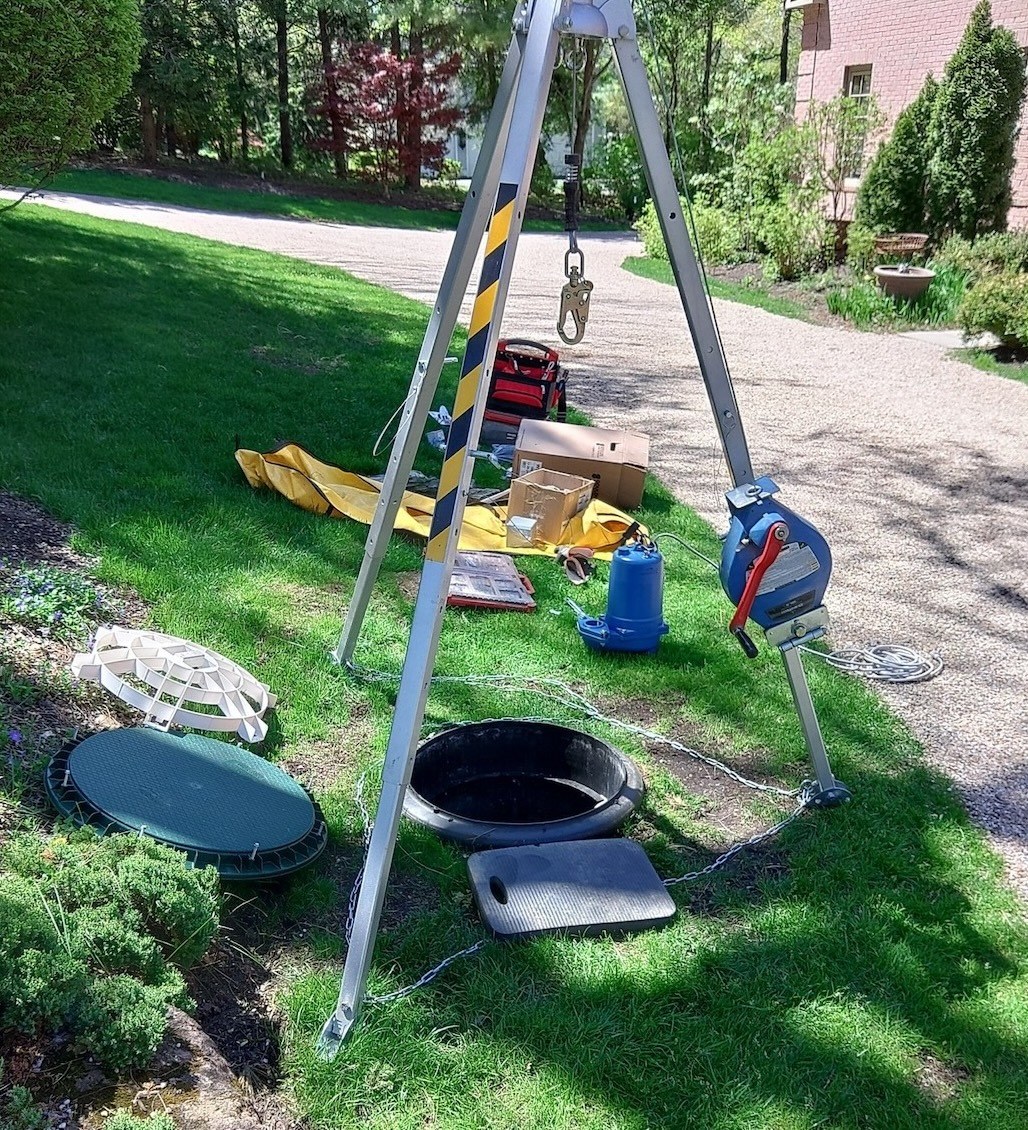
When a job requires work in a tank, I want my employees to be smart (and comfortable) enough to say, “We’re not using a ladder and just climbing in. I’m getting our confined-space crew with all the necessary equipment to keep the entry person safe.” I know companies in our area who use the ladder method, and that makes me really mad and concerned for their employees, who probably just don’t know any better. That is unfair and dangerous for the employee and borderline criminal for the employer. I know many would say, “I’ve been in a tank a thousand times and nothing ever happened to me.” I used to hear people say that all the time. The fact is that’s wrong, that’s dangerous and that is how people die. It may have worked a thousand times, but it only takes one time to be fatal.
Competent person/trench safety training is the second of our two initial certification training sessions. It’s required if you are digging deeper than 4 feet; but more important, it makes your employees safer by putting the danger of trench cave-ins foremost in their mind. It lets them know there are safe ways to do our inherently unsafe work. Competent person training instructs employees that they are required to look at each site each day (even if it’s the same site they were on the day before) and evaluate it for potential hazards and determine how they are going to mitigate those potential hazards so the project can proceed as safely as possible.
Speaking of trench safety, a great safety instructor in our area shows up and begins his presentation walking around the room snapping a rat trap. For anyone uninitiated, a rat trap is the same as a standard mouse trap but much bigger. He asks if anybody is willing to put their hand in it and pull it out fast enough before it snaps. He gets no takers, as we can all see the speed and force at which it is snapping closed. He says this rat trap takes three-quarters of a second to snap shut. That’s how fast a trench collapses. Less than a second. Nobody has time to react in any way. It’s immediate and it’s deadly.
A smart company has the competent person fill out a checklist each day that documents that morning’s site evaluation, lists the potential hazards and how the crew will mitigate those potential hazards. That checklist should be logged in at the office every day. If you remember anything in this article, please remember the previous two sentences. It is very important to have those daily competent person checklists completed and filed should OSHA ever audit your records.
Did you know if a person smashes their thumb with a hammer and goes to the hospital, you better be able to prove you trained that employee with proper use of a hammer? Sounds outrageous, right? But that is the rule. If an employee is using any piece of equipment, you need to be able to show that they were properly and competently trained on that piece of equipment. From a hammer to an excavator and everything in between, you better be able to document that proper training was provided.
I bring in as many third-party trainers in the winter as I can. The typical winter will be a general safety presenter, first aid, chainsaw training (if you use chainsaws you should absolutely have proof of professional training), load securement training, etc.
Training actually does save you time and money in the long run. I was driving to meet a customer and I passed a police officer pulling over a small truck towing a trailer with a mini-excavator on it. I met with my customer and ended up meeting a second customer in the same neighborhood. Two hours later, I’m driving back to our office and I see down a short side road that the police officer is still there with the truck and trailer, and on the street they have all of the person’s chains and binders laid out on the ground. That person was clearly pulled over for improper load securement, so what did that cost the guy? I don’t know what a ticket for that would cost him. What I do know is if he had a crew waiting for him, or a customer waiting for him, it cost him at least a few hours while he’s having a discussion with law enforcement on the side of the road.
Do you know that everything on the trailer must be properly secured? If you don’t sweep off your trailer and there are big dirt chunks, those are unsecured. You can get pulled over for unsecured dirt chunks. If you have a pipe that you slide shovels and brooms into, those are not secured. If it’s on a trailer it better be properly secured.
I don’t want my team to ever be unsafe. I don’t want my team delayed three hours for being pulled over. I do want my team to know we take safety very seriously. I want my team to know the codes, know what we are doing, how and why. I want them aware of the latest equipment, tools and best practices. All of this takes time, effort and training. But that’s how you build the strongest and safest team.
About the author
Todd Stair is owner and president of Herr Septic and Sewer, Inc., with over 35 years’ experience designing, installing, repairing, replacing and evaluating septic and mound systems in southeast Wisconsin. He is the author of The Book on Septics and Mounds and a former president of the Wisconsin Onsite Water Recycling Association.
Continue reading for free