After a year and a half working in the oil fields of North Dakota right out of college, Miles Holden came to a realization. “I knew I could not work for somebody,” he says.
During his college days, he had worked with some septic installers, and that’s the industry he turned to when thinking about self-employment. He wasted no time getting his installer’s license and in 2016 got his first job — a repair on a hand-dug pipe system — from a referral.
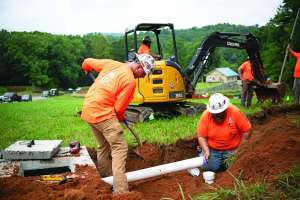
Today Holden’s company, MHI Contractor & Septic Services in Mills River, North Carolina, has a staff of 20 who work under five crew leaders — septic foreman Tyler Creech, level IV installer and inspector; Miles’ brother Micaiah Holden, grading and conventional septic systems; Thomas Carter, pumping and air-blasting; Hunter Wade, plumbing and electrical work for advanced systems; and Cody Brown, clearing and dump truck work. Holden’s wife Ashley along with Skyler Duling handle office work.
The company currently works predominantly in Western North Carolina and northwestern South Carolina, but Holden is also licensed in Virginia and Tennessee. About 75% of their work is septic-related installations, repairs and inspections, but they also do grading, excavation and hauling.
A YOUNG ENTREPRENEUR
Holden was just 12 when he first ventured into entrepreneurship. “My parents owned a nursery and I saw that some people needed their flower beds weeded, or the plants they just bought needed planting,” he says.
While working on his construction management degree from Western Carolina University he was exposed to the septic industry. “I would help installers,” he says. “And my mom owns a lot of rental property and I saw there was a need for septic repairs because she had so many issues. That’s what piqued my interest in the industry.”
When Holden made the decision to commit to septic work, he took an 18-hour introductory course at North Carolina State University. And he didn’t stop there. “Immediately after that, I took continuing education classes so I could get my level IV certification,” he says. “And then I also did my inspector certification classes.”
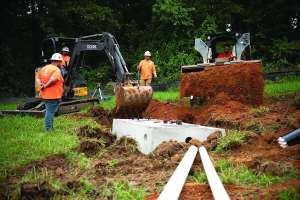
He started with installations. In the beginning he had other contractors do the digging due to not owning his own equipment, but in 2018 he bought a John Deere 50G track hoe and a John Deere 323 skid-steer. That’s also about the time he hired his first employee.
Ashley was on board from the beginning. She started out knowing nothing other than “you just flush the toilet,” and now she has a level IV installer license, Holden says. “She’s learned a lot which is why she excels in the office. She can answer the questions people would call me about.”
EXTENSIVE LICENSING
Holden is licensed in North Carolina as a level IV installer, subsurface operator, pumper and inspector; in South Carolina as a tier III installer and pumper; in Virginia as a master alternative contractor; and in Tennessee for conventional, drip and low-pressure pipe.
“I’m thankful I got licensed in North Carolina first because it’s the most stringent with all the different classes and the number of hours of continuing education,” he says. “It set me up to become more knowledgeable. My goal is to be licensed in the southeast within the next couple years.”
Marketing is predominantly through word of mouth, and referrals come from engineers, soil scientists and builders. “We do have a Facebook page and a website because people look for that,” Holden says. “But I like word of mouth better than somebody just randomly calling me off of Google.”
Holden doesn’t fear competition. “A grader a long time ago told me there’s a large pie out there and everybody should get a piece of it. That’s really stuck with me. I try not to be combative with other people’s jobs. I don’t want to do a job if I know somebody has already bid it.”
WIDE VARIETY OF SYSTEMS
In 2024, the company installed about 180 systems, including 70 for one homebuilder. About half were conventional systems and half aerobic and anaerobic pretreatment systems — Quick4 chambers (standard, low-profile and high-capacity) from Infiltrator Water Technologies, EZflow (also by Infiltrator), large-diameter pipe, panel blocks, drip, low-pressure, pipe, bed and gravel.
“We use Orenco, Infiltrator, E-Z Treat, T&J, Crumpler Plastic Pipe,” Holden says. “We have talked with reps on doing FujiClean USA who just got their certification in North Carolina. They’re a pretreatment system. We’ve also done American Manufacturing Co. systems.”
It’s all dependent on soils and steepness, he says. “We’ve got a lot of steep slopes, sandy and clay soils. Predominantly we’re installing systems in a 0.3-0.4 long-term acceptance rate. We do have some in the 0.5-0.6.”
Although much of their work is residential, they also do a lot of commercial work — state parks, subdivisions, fire departments, big construction companies. They recently put in a system for Greer Middle College in South Carolina.
Equipment is from John Deere — excavators in sizes ranging from the model 30 compact unit to the 135, two skid-steers and one dozer. They also have four dump trucks (Peterbilt, International and Ford) — one quad-axle, two tandems and one single-axle.
Holden didn’t initially plan on doing other types of excavation work, but people started asking for it since he had the equipment. So he got his unlimited heavy highway grading license. He has found it works best if the same company does both septic and grading work on a site. “Otherwise communication gets lost,” he says. “The grader might disturb the septic area, or the septic system might get put in and then the grading gets shifted.”
Although not required in North Carolina, the company does a lot of point-of-sale inspections. “What I do versus a lot of other people is I flag the drainfield, uncover the distribution box and both sides of the tank so the homeowners can take a picture,” Holden says. “We also provide them with a drawing of where the system is, so if they decide to put in a pool or a shed or whatever, they can refer to the drawing.”
TAKING CARE OF THE STAFF
Holden does not advertise job openings. “It’s all word of mouth,” he says. “If my employees will vouch for others, I feel like that’s good enough.” Not everyone finds that the job suits them, but those who stay enjoy the camaraderie, working environment and good pay. The guys average 50 to 60 hours a week.
“My employees take care of me, so I try to take care of them,” Holden says. “I make myself available to answer questions. When they request time off, I try to be flexible. Ashley and I run a family-oriented business. When they have family things going on, we’re there as support for them. We understand that things happen and we want to give them the time off they need.”
The company also pays for training — CDL or anything someone wants to do that benefits the business. “I will pay for the class and their time in the class, and then typically they will get a raise,” Holden says. In exchange, he asks them to sign a noncompete agreement.
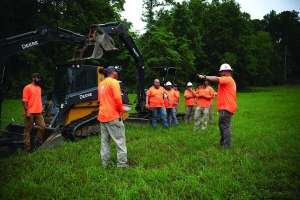
Crew leader meetings are held every Monday morning. And once a month the whole team gathers for a business meeting. “We go over things that need to be addressed, or where we want to improve, or find out what they’re enjoying, what they’re not enjoying,” Holden says. “We want to find out what makes our employees excel, and then hone in on that and help them out.”
The Holdens invite everyone over for a dinner at Christmas time, handing out bonuses and plaques. “We used to buy Christmas gifts for everyone,” Holden says. “But last year we did a ‘stingy Santa’ where everybody bought for each other. We’re just trying to figure out what works best for us.”
On the fun side, the Holdens have cookouts at their house (with pool). And they have taken the guys deep-sea fishing, skeet shooting, hunting and, in 2025, a trip to Gatlinburg.
“You spend so much time at work that you’ve got to have a break,” Holden says. “And I like the camaraderie. We have a phenomenal crew.”
SEPTIC WHISPERER
Holden has always felt that, if he was going to do something, he wanted to know everything about it. “Sometimes my wife calls me the ‘septic whisperer,’” he says. “I can look at the ground and just tell where the septic system is and what’s wrong with it without doing a lot of investigative work.”
Holden loves solving problems. “The more advanced, the more critical, the more difficult it is, the more I love it. Our niche is we get the systems nobody else wants, whether it’s a steep system, a hand-dug system, something that’s out of someone’s wheelhouse.”
His knowledge has been beneficial not only for his staff and customers but he has taught classes at North Carolina State University. And he often gets calls from new installers asking for advice.
While there are frustrations and challenges — delegating, learning to say no, getting materials on time, coordinating with inspectors — Holden loves being self-employed. One of the most rewarding aspects is the instant gratification of helping people in their time of need, he says. “The phone call I love the most is, ‘My system’s backing up into my house and I’ve got 14 people coming tomorrow.’”
Holden says Ashley has been his biggest support. “She really pushes me to be the best I can be. We’ve got two little girls, 5 and 3, and they’re the reason I continue to do what I do. I want to make the best life I could possibly give them, and this has been it.”