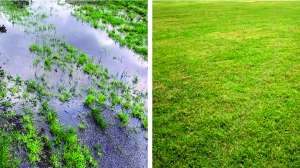
The unincorporated hamlet of Shenandoah, in northern Richland County, Ohio, has 35 homes, a church, general store and community center. A citizen’s complaint about wastewater discharging to an open ditch led the local health department to 36 failed onsite systems. Most had small lots, preventing their replacement. In 2003, the Richland County Health Department told the county commissioners to acquire a decentralized sewer system as soon as possible.
The commissioners contracted Wayne Bishop, P.E., of K.E. McCartney and Associates Inc. in Mansfield, Ohio. “We considered every possible treatment alternative,” he says. “The solution had to be cost-effective for the residents, involve innovative technology to help acquire funding, satisfy Ohio EPA requirements, and meet criteria for grants being pursued. It was a difficult balancing act that finally came together in 2007.”
Bishop’s design combined low-pressure sanitary sewers (LPSS), conventional gravity sewers, settling tanks and peat biofilters discharging to elevated sand mounds. It became the first residential community decentralized household sewage treatment system in Ohio. Officials see the system as a possible answer for hundreds of small communities far from municipalities.
Site conditions
Glacial till soils are Bedington and Cardington silt loam with an 18- to 30-inch seasonal high water table. The area has poor to severe drainage for effluent disposal. The agricultural land is flat to rolling (6 percent slope).
System components
Bishop designed the system to handle 10,000 gpd. Its major components are:
• 15 E/One 2000 grinder pumps from Environment One Corp., Niskayuna, N.Y.
• 6,400-gallon settling tank. All tanks are single-compartment and made by United Precast Inc., Mount Vernon, Ohio.
• 6,300-gallon settling tank
• 6,100-gallon settling tank
• Three A300 effluent filters from Polylok of Wallingford, Conn. (one per tank)
• 7,000-gallon dosing tank with three 3-hp Model 6123 pumps from Zoeller Pump Co., Louisville, Ky.
• Three STF-100A3 effluent filters from Sim/Tech Filters Inc., Boyne City, Mich., one per pump
• 54 Puraflo peat biofilters from Bord na Mona Environmental Products, Greensboro, N.C.
• 7,000-gallon sand mound dosing tank with five 3-hp Model 6123 pumps
• Five 463-foot elevated sand mounds
• Six 1,500-gallon septic tanks with effluent filters
• Six AX20 AdvanTex units, Orenco Systems Inc., Sutherlin, Ore.
• Six 150- to 200-foot off-site elevated sand mounds.
System operation
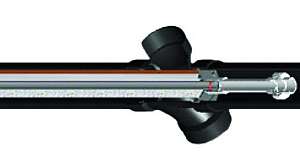
North-south Route 13 intersects Route 603 in the middle of town, dividing Shenandoah in half. Waste-water from 15 homes on the west side flows through 4-inch laterals to individual grinder pump stations that discharge to 1.25-inch pipe connected to a 2-inch SDR 21 PVC low-pressure sewer collector. Pump stations on the opposite side of the road discharge to a 1.5-inch LPSS that ties into the larger line at a manhole.
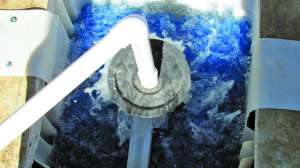
“It was cost-effective to put an 8-inch SDR 35 PVC gravity sewer on both sides of Route 603 on the east side of town,” says Bishop. “The LPSS ties in just after itcrosses Route 13.” The 8-inch pipe discharges to three septic tanks in series. Effluent flows through a 6-inch SDR 21 PVC pipe to the dosing tank, where three alternating pumps cycle every 42 minutes, sending 216 gallons per dose to a bank of biofilters 34 times per day. A separate valve box determines which group is dosed.
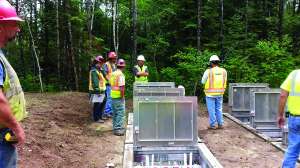
The biofilters are arranged in three banks of 18 modules served by a common header. Every unit has a spray manifold that evenly doses the peat. Purification occurs as the liquid percolates through the media. Peat also suppresses odor. Treatment performance averages less than 5 mg/l TSS and BOD, and 99 percent reduction for fecal coliforms with no pathogens.
Two weep holes topped with clean stone on one side of each module drain effluent into 4-inch pipes. Drainage pipes, with sampling port and cleanout, flow to two 6-inch SDR 21 PVC pipes that discharge to the sand mound dosing tank. An external valve box alternates the five pumps in the tank. An 8-minute dosing cycle sends 98 gpm every 12 hours to the pump’s dedicated sand mound.
Each mound has two 1.25-inch PVC drip laterals 430 feet long on 1-foot 9-inch centers, with 1/4-inch emitters every 5 feet. Weeps in the pipes enable liquid to drain back to the dosing tanks when the pumps shut off.
Installation
Don Stillion of Stillion Bros. Excavating Inc. in Perrysville, Ohio, was the general contractor. His crew staked out the contoured drainfields, then scarified the soil using a small tractor with chisel plow. “We trucked in a lot of concrete fines sand, which is coarser than silty fines sand,” he says. “The mounds run parallel to the contour and rise 3 to 6 feet above grade depending on the slope.”
The drip laterals were installed with emitters down on 6 inches of prewashed gravel over 3.25 feet of sand. Stillion covered the distribution system with 2 inches of aggregate, then a synthetic fabric topped with 18 inches of topsoil to insulate the biological growth.
“The highway department wouldn’t allow us to open cut along a state route, so we directional drilled the low-pressure and gravity sewers,” says Stillion. “We used open cut and directional drilling 50/50. The system’s installation was straightforward.”
The second half of the project involved the eight properties not discharging to the sand mounds. Stillion pumped the two good septic tanks. The six failed systems were on large parcels. These households received 1,500-gallon septic tanks with effluent filters.
An AdvanTex secondary treatment unit sits atop the septic tank. As effluent trickles down through and between sheets of textile media, microorganisms provide treatment. When the effluent reaches a preset level, the recirculating splitter valve sends half the volume back to the septic tank, and half to the 150- to 200-foot sand mound.
“Our original design called for three sand mounds and three leachfields, but poor soil permeability and a seasonal high water table pushed us to substitute elevated sand mounds at all six sites,” says Bishop. “The big challenge was limiting disturbance to the terrain and not compacting the mound basal area.”
Maintenance
Richland County Sewer District (RCSD) operates and maintains the cluster system and eight onsite systems. The county health department monitors everything. The project was 64 percent grant-funded.
The remaining $295,000 was covered by a no-interest loan, which divided into $7,763 per property. To collect the money, the county added a $25 per month user fee adjustment to the 38 homeowners’ sewer bills. The fee also connected them to the system. Shenandoah residents pay the same rates as other RCSD customers.
Continue reading for free