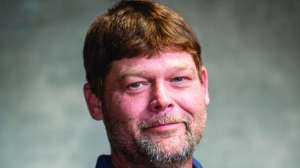
Art Megeath declares he will do “whatever it takes to be on the leading edge of the onsite industry.” Owner of Arthur Megeath Contracting Inc. in Front Royal, Va., Megeath embraces change as an opportunity to grow his skills and his business. It also keeps him on that cutting edge.
To Megeath, change is not a catchy word. It’s an integral part of his business plan and he sees it as his friend.
Megeath came to the onsite business after working for an international chemical company, where he was on the plant maintenance crew and was the crew’s trainer. When faced with a new technology, “I put aside any feelings of insecurity or self-doubt and set out to learn all I could about the new equipment or process,” he says.
After graduating from Nashville Auto and Diesel College in 1978, he started a heavy equipment repair business on the side. Soon he had a backhoe and was digging perc holes and doing other excavation. When asked to install a septic system, he dug right into studying the state regulations and system design, installation and operation. Only when he was comfortable with his knowledge did he go to work. In his business, change and growth are ever present. “I choose to work in the public marketplace bidding on government projects,” Megeath says. “These jobs bring us into contact with new products and techniques and nurture our growth.” Public projects are larger and more complex, but Megeath likes it that way. “I want my name associated with large or innovative public projects,” he says. That approach positions him as the principal introducer of emerging onsite technologies in his market.
Family adventure
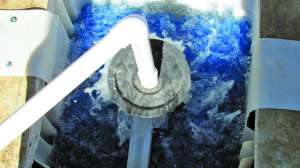
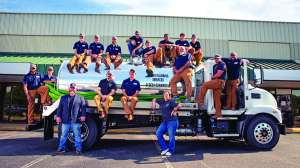
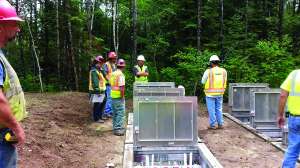
Potential customers may not appreciate the fine points of the inno-vative system Megeath is installing for a visitor center at the Andy Guest Shenandoah River State Park. Still, he sees value in those customers knowing they can hire the state’s contractor to install their residential system. “Connection to government contracts elevates our company in clients’ eyes,” he says. Megeath and his two employees, son Evan and brother Monty, are well known around Front Royal, where they install 25 to 30 new systems per year. Father, son and brother grew up in the family homestead. Now Art and his wife, Lorraine, the company bookkeeper, live there.
“Working with my dad and uncle has been an adventure,” says Evan, who left a job at a local engineering company to work in the business. “Dad and I don’t always see eye to eye, but we get through it.” Father and son share a vision of the company’s future that includes new technologies, new directions and growth.
Monty, a former excavating contractor, is there when his brother needs extra hands, and the business has been there for Monty when other opportunities were limited. All three enjoy outdoor work that brings them into contact with a variety of systems and people. “The smell of the soil and the freedom of the work get into your blood,” Evan says.
The company’s complete service package includes working with homeowners, site evaluators, designers and equipment manufacturers to match the system to the site. Virginia regulations require registered engineers to design advanced systems, but that does not keep Megeath from taking an active and vocal role in the design process. After installation, he blends systems into the terrain. “I do my best to use existing vegetation and topography to help in the concealment process,” he says.
Role as educator
Art Megeath believes installing a system is a small part of his customer relationship. Education is critical. “We are a quality-conscious company that has a commitment to the customer and to environmental protection,” he says. “We educate each customer about their system, how it works and how as partners the customer and the system protect the environment.”
Education usually starts before site evaluation and continues long past system startup. “Once a system is buried, if it becomes a problem there is no chance for a do-over,” Art says. Five years out, if there is a problem with a system he installed, he will be there to satisfy the customer. “I will not bill for my service time to diagnose the problem,” he says. “Being prompt, prudent and honest in all our customer interactions is the only way I operate.”
Art Megeath seeks out training for himself and his employees. He and Evan are regular attendees at NOWRA and VOWRA training events. “Installers need to understand the theory of onsite systems. To know too little is to shortchange your customer,” Art says. “Self-doubt is a businessman’s enemy. It often causes people in this industry to have an animosity toward their competitors, and it holds back growth and change.”
Megeath says his occasional insecurity with the unfamiliar causes him to dig deeper and learn about the issue. He has no animosity toward competitors, many of whom call him asking questions about sites and systems.
The firm is recognized by the manufacturers to install treatment systems from Orenco Systems Inc. (AdvanTex), Ecoflo, Bord na Mona, Puraflow and Bio-Microbics Inc. It uses drip-system products from Netafim USA and Geoflow. Art Megeath has completed the Con-sortium of Institutes for Decentralized Wastewater Treatment installer training course, and he has earned the Certified Installer of Onsite Wastewater Treatment Systems credential from the National Environmental Health Association.
These credentials lend confidence when he speaks and add credibility for those who hear his message or seek out his services. He has also trained employees of the Virginia Department of Health in advanced treatment technologies.
Controlling costs
Megeath Contracting is a general excavating contractor focused on the onsite market. Reliance on subcontractors for specialized equipment and skills helps reduce equipment costs. “I see no sense in buying equipment when I can get next-day service from reliable contractors,” Megeath says. He regularly subcontracts blasting, hoe-ram work and treatment tank pumping. Drawing on his early training, Megeath maintains his own equipment fleet and occasionally services other contractors’ equipment. He believes clean, serviceable equipment engenders operator pride. Well-maintained equipment seldom breaks down, and that keeps morale up and work moving along. Megeath’s equipment includes a 2000 Case 1840 Uniloader, a 1996 Cat D4 dozer, a 1998 Cat 953 loader, a 2005 John Deere excavator, a 2006 Case Super M backhoe, a 1997 John Deere farm tractor, and a 2002 Kenworth single-axle dump truck. Support or utility equipment includes a 2002 Eager Beaver lowboy trailer, a 2006 Vermeer chipper, and a 2006 Ford F350 service truck.
From surplus topsoil acquired on jobsites, and using a Leroy Screen Machine to separate clumps of vegetation and rocks, Megeath has created a stockpile of prepared soil that he keeps on his property. Many of his drip systems are placed on the prevailing grade. After the tubing is placed, it is covered with topsoil and seeded with suitable ground cover. Sites like this usually are short on topsoil and when there is no nearby source, he relies on his own stockpile, saving money for himself and clients.
Business slowdown
By June 2008, the housing slump was affecting Art Megeath and his competitors. In the past, he could be selective about which jobs he took. As the slowdown continued, his phone still rang, although less often. With the work on the books and calls coming in, he kept his crew working full-time. While he likes to keep his single-family system service area within about a 10-mile radius, he was willing to travel a bit farther as the economy changed.
To get the large public sector jobs he likes, he has always traveled farther, and still does. Megeath reports that there were more than 600 brand new, unsold houses in Warren County at midyear. With that inventory unsold, he saw repairs becoming a bigger part of his business.
“I believe in what we are doing. We are right where we want to be,” says Art Megeath. In five years, however, he sees the industry’s emphasis shifting toward management, operations and maintenance, and expects a corresponding reduction in his equipment inventory. In spite of this, Megeath Contracting will always do new system installations, always be learning about new technologies and always moving forward.
“If you fear change,” Megeath says, “you just won’t get any better.”
Continue reading for free