Question:
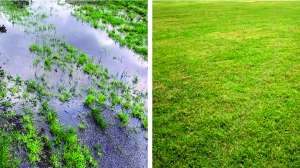
I have a septic system with lateral lines on a slight slope. In addition to the 1,000- gallon trash tank, I have a 1,000-gallon pump tank. I’m in Oklahoma, where we’ve had record rainfall over the last year. I now see water surfacing when the pump activates.
The septic guys I talked to say the field is saturated and I need to convert to an aerobic system. The three companies I talked to use all-in-one tanks but would use my existing trash tank and cave in my existing pump tank. In my research, it seems I might be able to drop in an aeration tank between the existing trash and pump tanks and add lines and sprinkler heads for distribution of the effluent. Does anyone have experience with this they can share?
Answers:
Converting to aerobic bacteria is a fairly simple process. Aerobic bacteria are claimed to be faster-
acting and more aggressive than typical anaerobic bacteria. It is also claimed that when the aerobic bacteria get to the field, they will devour the biomat, which is a common cause of field failure.
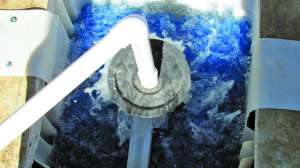
Supporting aerobic bacteria requires an air infuser, also called an oxygenator. An air pump that sits outside of the tank pumps air to the infuser (an air bubbler) inside the clarifying chamber of a tank. The already-somewhat-clean effluent is “bubbled,” and the fine particles fall to the bottom, super-cleaning the effluent.
Aerobic bacteria are manually added periodically, above the bubbler, and are mixed in by the bubbling action. Filters are optionally added at the tank’s outlet. A riser above the bubbler is necessary for scheduled maintenance and for adding the aerobic bacteria packets.
It sounds like you have a “forced” system: In other words, it drains under pressure (with a pump) rather than by gravity. Although what you suggest may be helpful, I would also consider installing a chamber system to add drainfield capacity. And protect the chambers from rain infiltration with the appropriate products.
If you’re going to dig a hole, you may want to install the chambers and get it over with at the same time. And give the rainwater someplace to go instead of sitting on top of your field.
If you have been experiencing record rainfall, your condition might be temporary, and you may need nothing more than time or a curtain drain around your drainfield to divert the groundwater. I’d get another opinion or two before I went to the expense of going aerobic.
Curtain drains are just shallow French drains designed to drain off soggy backyards. It sounds as if this onsite system is pressurized (there is a pump.) The surface water may not be just rainwater. It could be mixed with effluent being pushed up to the surface. In addition, three companies have looked at it and say the field is saturated.
Aerating the system gives you options on how to dispose of the effluent because it’s much cleaner. I think sprinklers are problematic. Are you going to spray around remnants of household bleach and your latest medical prescriptions? Is it really safe for children and pets?
You’re fighting nature: high water table and poor soil conditions. The effluent has nowhere to go. There may be two more alternatives to sprinklers. Ask about a backup mounded field. A separate pipe is brought from the existing pump to a remote corner of the property. Favorable, good-draining soil is brought in and mounded.
Within the mound, chambers are installed. The idea is to get a second field above ground level. Sizing is up to you because the
primary field has met local requirements (that would be my argument). On the pump outlet is a three-way valve where a homeowner can swing the handle to redirect the effluent to the original field, the mound or both.
All this talk of adding things to the system, but nothing about how much it will cost. Mound systems are very expensive, tending to be $3,000 to $6,000 more than a typical tank and leachfield system. I like the aeration system solution the best, since it is a minor change to your existing system. Some companies advertise an aerator motor for an existing septic tank — then you wouldn’t have any tank costs.
The problem you have is you’re trying to put water into water. Septic systems don’t work underwater. One of the best things you can do is conserve water. Turn off the water when you’re brushing your teeth or shaving. In the shower, get wet, turn off the water, soap up, then turn the water back on to rinse off.
Replace an older top-load washing machine with a front loader, which uses nearly half the water of a regular machine. Replace all faucet aerators and showerheads with water-conserving devices. If you really want to get radical, replace your toilets with new water-conserving toilets. Bottom line: Less water will help your system.
Continue reading for free