The onsite system serving the former Cliffdale Park restaurant in Port Murray, N.J., failed its real estate transfer inspection. The 750-gallon metal septic tank discharged under the gravel parking lot onto 6- to 12-inch river stones covered with sheet metal.
Heritage Conservancy, a conservation organization, purchased the property to provide 1,100 feet of public access to the Musconetcong River. Plans called for keeping the restaurant but converting the upstairs one-bedroom apartment to office space.
The organization did not want to pay the yearly inspection fee for systems larger than 2,000 gpd. Such systems also require a special permit from the state Department of Environmental Protection, and the town of Port Murray would need to sign as co-applicant. Local officials wanted no part of that.
To reduce flows below 2,000 gpd, designer Paul Ferriero, P.E., of Ferriero Engineering Inc. in Chester, recommended downsizing the restaurant from 66 to 44 seats. The site, surrounded by the river, a wetland, and flood hazard zone, had no room for a secondary drainfield. Ferriero’s solution used grease and septic tanks with low-pressure dosing lines, enabling the conservancy to meet its conservation goals and state code.
Site conditions
Soils are sandy with percolation rates of 3 to 15 minutes per inch. The water table is 7 feet below grade. The site is 225 feet from the Musconetcong River, designated as a Wild and Scenic River. It also lies 26 feet from wetlands draining into the Musconetcong River watershed.
System components
Ferriero sized the system to handle 1,980 gpd. Its major components are:
• Two 1,500-gallon grease traps. All tanks, made by Granville Concrete Products, Randolph, N.J., are single compartment and have traffic-rated lids, and cast-iron risers.
• Two 1,500-gallon septic tanks.
• 1,000-gallon lift station with duplex alternating 1/2 hp pumps from Goulds Pumps – ITT.
• 2,646-square-foot drainfield with two zones, each 23.5 by 28 by 8.5 feet deep.
• Model D10020N1 EZ Series duplex with attenuator indoor control panel from S.J. Electro Systems Inc., Detroit Lakes, Minn. (SJE-Rhombus)
System operation
Kitchen graywater flows through a 4-inch Schedule 40 PVC line, through the grease tanks, and into the primary septic tank. Flow from the restaurant and office restrooms flows through a 4-inch PVC line to the primary and secondary septic tanks.
Effluent flowing into the lift station is dosed on demand to manifold A or B through 3-inch Schedule 40 PVC force mains. The alternating pumps run for 110 seconds, sending 260 gallons of effluent to the drainfield. Each zone has six 1.5-inch laterals 50 feet long on 3.75-foot centers. The laterals have 16 offset 1/4-inch orifices on 3-foot centers. The emitters face down, and the zones have an individual inspection port.
Installation
Ferriero, also a licensed surveyor, staked out the tanks and drainfield area. A plumber separated the kitchen waste line and plumbed it out the back of the building to maintain the proper elevation.
Installer Bob Jewell of Jewell Excavating in Port Murray added two 45-degree elbows, bringing the line around the side of the building and into the primary grease trap. “The elevated kitchen line ran above the existing sewer line, enabling us to keep it and ensure proper pitch to the first septic tank,” he says.
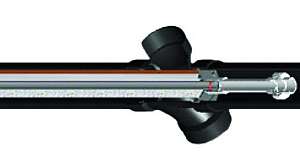
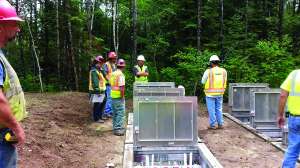
His crew excavated the holes for the tanks after removing the existing septic tank. The men dug and set one tank per day using an EX 200LC Hitachi excavator with 1.75-cubic-yard bucket. Instead of an effluent filter, the septic tank outlets received a PVC gas deflector to prevent rising bubbles from carrying solid particles to the drainfield. Workers attached them to the bottom of the tee with a strap and plastic wing nut.
The parking lot had no curb, only a guardrail along the highway. Two cherry trees grew on the east side between the lot and the drainfield’s leading edge. Some trees also grew on the opposite side where the bank dropped off sharply to the wetlands.
Jewell trimmed the trees so the 46,000-pound excavator could park at the far end of the drainfield and backfill the laterals after installation. “I thought a lot about where to position the equipment, because if I got it wrong, we’d be stuck,” he says. “Once the sand and gravel went in, we’d have to work from the ends of the field. Neither side would have any room.”
Jewell’s 160 John Deere excavator and 550 bulldozer excavated the 47.25- by 56- by 8.5-foot-deep hole in 1.5 days, while dump trucks hauled away the material. The onsite code required Ferriero to inspect the excavation and sample three loads of K3 sand stockpiled for the system. “The sand is screened to 3/4 inch and can’t have any variances because of the area’s environmental issues,” say Jewell. “We weren’t allowed any field changes either.”
After workers installed a 3-foot lift of sand and lightly compacted it, Ferriero took another sample. They repeated the process the next day before the workers covered the sand with 18 inches of 1.5-inch stone. The drainfield required 950 tons of sand and 220 tons of gravel.
Jewell used an excavator to pull back 6 inches of gravel before installing the drip lines, which are not backflushed. The men bored the holes in the pipe by hand and deburred them. Because the laterals had staggered orifices, Jewell marked the pipes 1 through 12 with matching numbers on the manifolds.
Once the piping was installed, the excavators backfilled, but left a 3-foot-wide swath in the middle of the field for inspection. “All 12 lines had to be exposed to prove we had drilled the holes in alternating patterns,” says Jewell. “We marked the tops of the pipes so they couldn’t miss it.”
To prevent people from driving on the drainfield, Jewell used the excavator to reposition a telephone pole. It functions as a deadman to stop vehicles from going over the bank in front of the absorption bed. Ferriero then sent a survey crew to do an as-built drawing and shoot the final grades.
Maintenance
The system is unregulated because it is less than 2,000 gpd. Maintenance is solely the owner’s responsibility.
Continue reading for free