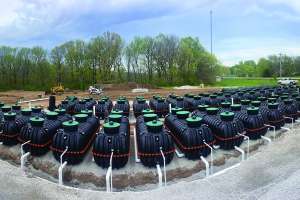
Like many companies in the 2020s, SludgeHammer Group grappled with rising materials costs, as well as oncoming pricing uncertainties of imported products. Not wanting to pass price hikes for its advanced treatment technology onto their customer base, the company in January moved most manufacturing operations stateside, and made improvements to its Aerobic Bacterial Generator units along the way.
“This is our chance to finally say, ‘Let’s get complete control of our supply chain,’” says Dan Wickham, founder and chairman of the board. “If you’re dealing with older homes and failed septic systems, you’re often dealing with people who are retired or on fixed income. This has to be a product that’s affordable.”
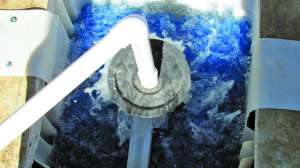
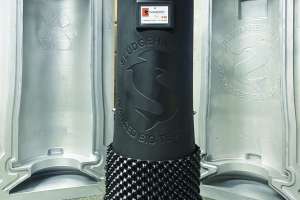
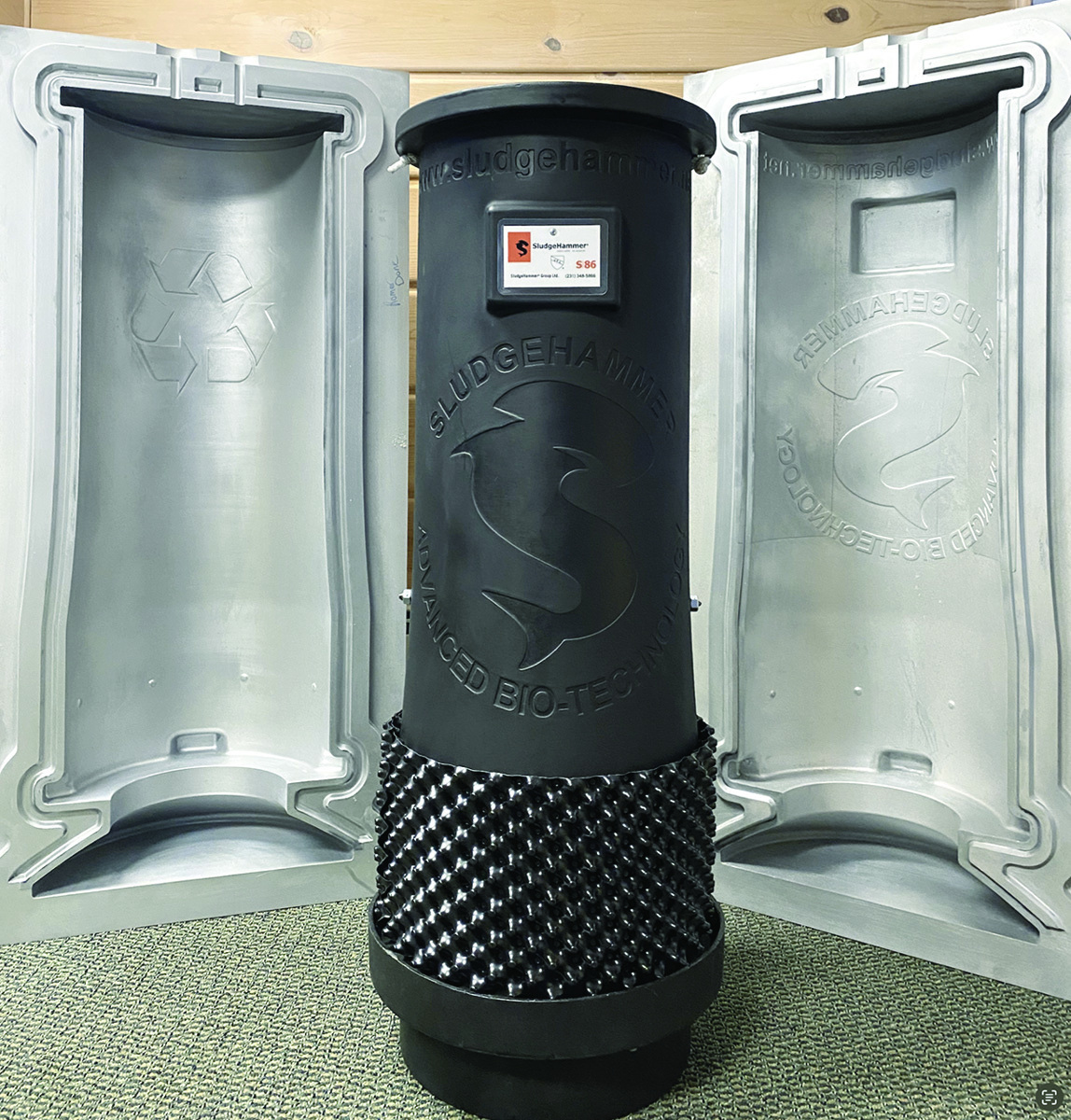
The residential and commercial lines of ABG units, whose columns originally used virgin PVC, now use a Wisconsin-manufactured rotational-molded, 100% recycled-material ABS plastic with a new tapered center. SludgeHammer also added a cast iron weight, fabricated in Michigan, situated at the bottom for stability when lowering the column into the tank.
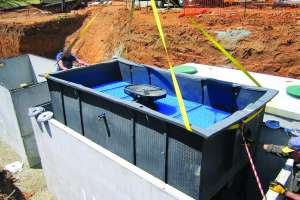
One in five households use onsite systems, and Wickham says millions of aging systems fail each year. SludgeHammer technology retrofits inside septic tanks, converting conventional systems to aerobic treatment units and saving property owners, in some cases, tens of thousands of dollars. Oxygen transfer and mixing are central to this treatment process that prevents leachfield biomat, and Wickham says the new tapered design makes the process more efficient.
“What we’re doing is the portion at the bottom has a larger diameter, and that liquid is being pulled in through the unit. What’s happening is the air is forcing liquid through the tube,” Wickham says. “And of course, water comes into it at the bottom; by having that tension there, it projects it and makes it leave the unit at a much faster speed.”
SludgeHammer’s improvements also include a new fine-bubble diffuser hub, which further improves aeration.
“We get more air delivery from our blowers, better oxygen transfer and it extends the life of the blower by years,” Wickham says.
The new-and-improved ABG units also pave the way for nitrogen removal. SludgeHammer has collected data on installations in northwest Michigan to comply with state regulations and discovered, inadvertently, that its treatment bacteria was denitrifying waste in the lower anoxic zone, averaging 15 mg/L TN. However, in some cases, TN was discovered as low as 2-3 mg/L, and SludgeHammer is currently conducting research to meet NSF/ANSI 245 standards consistently.
“[The updates] help us get the process of oxidizing the ammonia going better, and that way we can then go through the denitrification process more efficiently,” Wickham says.
The S-400 through 1000 units are currently certified under NSF/ANSI Standard 40, and their remedial models are UPC-listed under IAPMO Standard IGC180-2003.
SludgeHammer revamped its website and is updating its marketing campaign to promote the upgraded ABG unit’s launch.
321-348-5866; www.sludgehammer.net
Continue reading for free