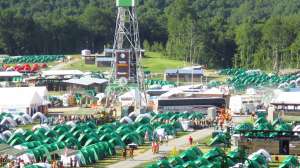


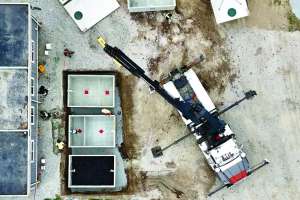
A commercial greenhouse was expanding its vegetable production on the 92-acre site in Delta, British Columbia. The new greenhouse would cover 24 acres.
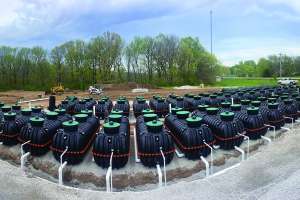
The facility relies on contracted temporary foreign workers living in company housing on the north and south ends of the property. To accommodate the new laborers, management added a two-story modular bunkhouse alongside two existing dwellings to the north. Two separate septic systems totaling six concrete tanks and five sand mounds serviced this area. The south complex also gained a third bunkhouse and was serviced by six concrete tanks and two sand mounds.
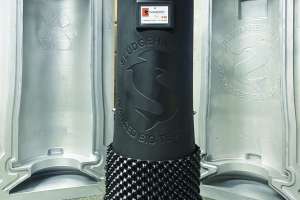
While the additions required two new onsite systems, management also wanted to prepare for future expansions by laying the pipe now. Canadian Septic in Langley won the bid to install the low pressure systems with Bionest extended aeration fixed film reactors. James Stiksma, the company’s owner, and employees Arien Brouwer and Tom Daniels began work in late July and finished at the end of October 2024. Although mostly routine, the project still held some surprises.
Soils are silty clay with a percolation rate greater than 60 minutes per inch.
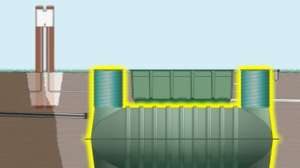
Craig Regier, P.E., designed two systems to handle a total of 6,000 gpd. Tank volumes are Imperial gallons (1.2 U.S. gallons). Major components include:
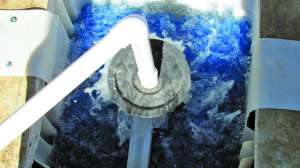
Wastewater from the north bunkhouses gravity flows through the two septic tanks, then through the two reactors aerated by linear air pumps and fine-bubble diffusers. After treated effluent gravity flows from the reactors to the equalization tank, alternating pumps send it 3,000 feet through a 2-inch HDPE force main to the dose tank. The south treatment train is identical.
Alternating pumps in the dose tanks send 141 gallons 24 times per day to two center-fed manifolds feeding two zones per mound. Each zone has eight 75-foot-long by 1.25-inch-diameter laterals with 1/8-inch orifices spaced 24 inches apart. Every lateral has 30 orifice shields (Polylok) for a total of 960.
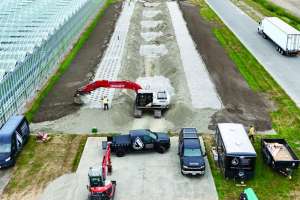
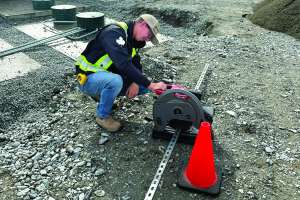
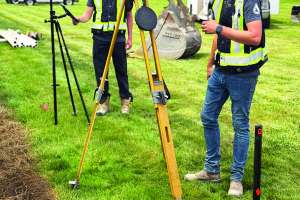
In late July, Colten Van Dyk, Stiksma’s 16-year-old nephew from Alberta, joined the crew just before Joe Bradley, regional service manager from Brandt Tractor, arrived to acquaint them with the updated features on the MC-Mobile and Pocket3D software (Topcon Positioning Systems). While FJM Utility Locating swept the area for two days and set flags, Van Dyk quickly mastered the software and began drawing the sand mounds into the data collector. “The technology enables us to keep them in line with the greenhouses and not wander off course with the excavator,” says Stiksma.
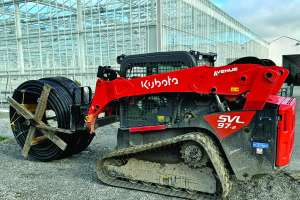
The following day, rain prevented work on the mounds, so the crew dug force main trenches with Stiksma’s Kubota KX057-5 crawler excavator and moved spoil with his Kubota SVL 97-2 track loader. The engines were barely hot before the excavator snagged an unidentified 2-inch Schedule 40 pipe. “We blew the whole day tracing the line back to the other side of the main driveway, only to discover it was an old abandoned line,” he says. They capped and buried it.
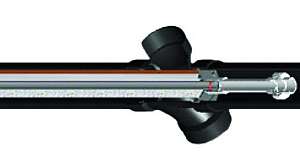
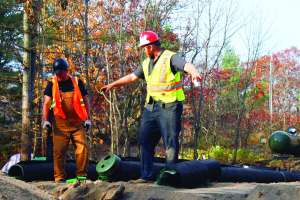
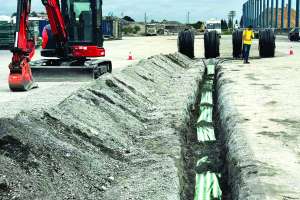
When dry weather returned, Heidelberg Contracting stripped the sod and prepared the base for the mounds as Stiksma’s team lay 1,200 feet of force main. To expedite unrolling hundreds of feet of 2-inch-diameter HDPE line, he had RAW Fabricating make a rotating axle that fit inside the HDPE shipping reel. “The track loader forks slip into sleeves to hold the reel, then I back up the machine to unwind the spool. It works essentially like a giant toilet paper holder,” he says.
With a little help, trenching the remaining 1,800 feet took two weeks. “When we were building mounds, the Heidelberg crew would hop into our machines and dig trenches if things were slow for them,” says Stiksma. He covered the top of all pump lines with underground detectable marking tape (T Christy Enterprises).
Stiksma also purchased attachments for the job, a SVP5 18-inch hydraulic plate compactor (ShearForce Equipment) and an 84-inch Hydra Bucket (CMP Attachments). The bucket mounts in the heel of the track loader’s bucket and scarifies or power rakes the soil. “As long as it was dry, the attachment cleaned up well as we dug through areas, and later it cleaned and smoothed the mounds for seeding,” he says.
The beginning of August was marked by a parade of dump trucks from Marno Trucking. For seven days they delivered more than 250 tons of washed 1-inch round drain rock, 3,000 tons of C33 sand, 200 tons of river sand, 300 tons of 3/4-inch clear crushed aggregate, and 900 yards of turf mix.
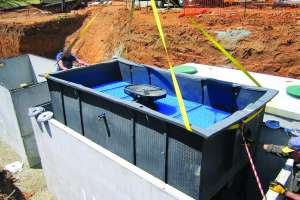
The city of Delta is along the Pacific Ocean and tides have caused existing concrete tanks less than 50 feet from the new tank locations to float and become off plumb. Consequently, Regier specified the tanks to be cast two feet shallower than originally designed, but reducing their volume increased the number of required tanks from three to five.
The new north bunkhouse and tanks were on a “farm plate” and could not extend beyond this building envelope. That made for some tight quarters as Heidelberg employees dug tank holes with a Volvo ECR235EL crawler excavator and a Link-Belt 210 excavator.
To avoid interrupting traffic on the property, Stiksma hired CB Horizontal Directional Drilling to bore four pump lines under sections of the driveway. Trident Environmental was called to pothole for the numerous utilities in the area, including a new pipe carrying underground high-voltage cables.
Although digging occurred at the height of summer, Stiksma still found some water in the north tank holes and at the dose tanks where the soil was softer. Concerned about the groundwater, he looked at tidal charts to see what days and times were best for installing the tanks. Stiksma also added groundwater monitoring ports. “I’ve popped the caps several times after installing the tanks and have seen water sitting at the top of the pipes,” he says.
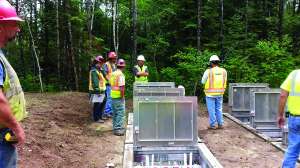
Galcon Precast delivered three shipments of tanks from Vancouver Island while Mainland Crane Services unloaded and placed them. “Only two of the four east-west force mains are connected now,” says Stiksma. “The other two are earmarked for future expansion.”
Trenching on the south side was unnecessary because the two existing 2-inch force mains already ran to two established mounds. “By installing an indexing valve, we freed up a force main and that freed up a pump line for our new system,” says Stiksma.
Other work included pouring a concrete slab by the mounds for a utility shed housing the control panels, and another at the South System for the aerator pumps and alarm panels. The North System already had a shed, but the pumps were in vaults.
Stiksma and the customer are happy with the results and Colten is already planning on how to return next year.
Continue reading for free