The growing student body at a K-12 school had overwhelmed the capacity of the 1970s single-pass intermittent sand filter. The superintendent recognized the problem when wastewater surfaced near the playground in Scott, Arkansas.
David Meints, the system’s new maintenance provider and owner of Meinco Wastewater Services in Bryant, Arkansas, offered administrators several treatment options. They selected BioMicrobics’ BioBarrier Membrane Bioreactor for its affordability and quality permeate. The latter was crucial as water would surface discharge to a bayou at the edge of the property.
“Surface discharge was our only alternative because of the school’s future development plans,” says Meints. Enviro-Tech Solutions in Fayetteville, Arkansas, designed the system, the first of its kind in the state and the largest commercial wastewater treatment plant Meinco had undertaken to date.
The intense installation required multiple subcontractors and the Meinco team learning some engineering on the fly. “Nevertheless, the install was uneventful, which is what we want, and the plant runs flawless,” says Meints. Begun in August 2022, the project concluded in June 2023.
Site conditions
Sandy, alluvial soil without structure; seasonal water table at 10 feet.
System components
David Meints II, P.E., designed the system to handle 8,000 gpd. Major components are:
- Lift station (Jack Tyler Engineering) with Myers duplex 2 hp VS-20-21 grinder pumps (Pentair)
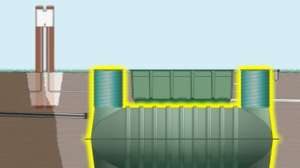
- 9,000-gallon settling tank with triplex 818-8 SaniTEE effluent filters (BioMicrobics) and risers (Orenco Systems)
- 10,800-gallon mixed anoxic tank with duplex 1 hp WS1034B pumps (ITT Goulds Pumps)
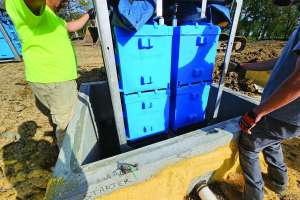
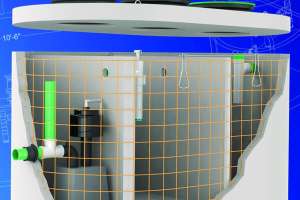
- 12 high-strength BioBarrier Membrane Bioreactors 9.0 (BioMicrobics) in 12,000-gallon aeration tank with duplex recirculating 0.5 hp pumps (Goulds)
- 7.5 hp K07-MS regenerative blower (FPZ)
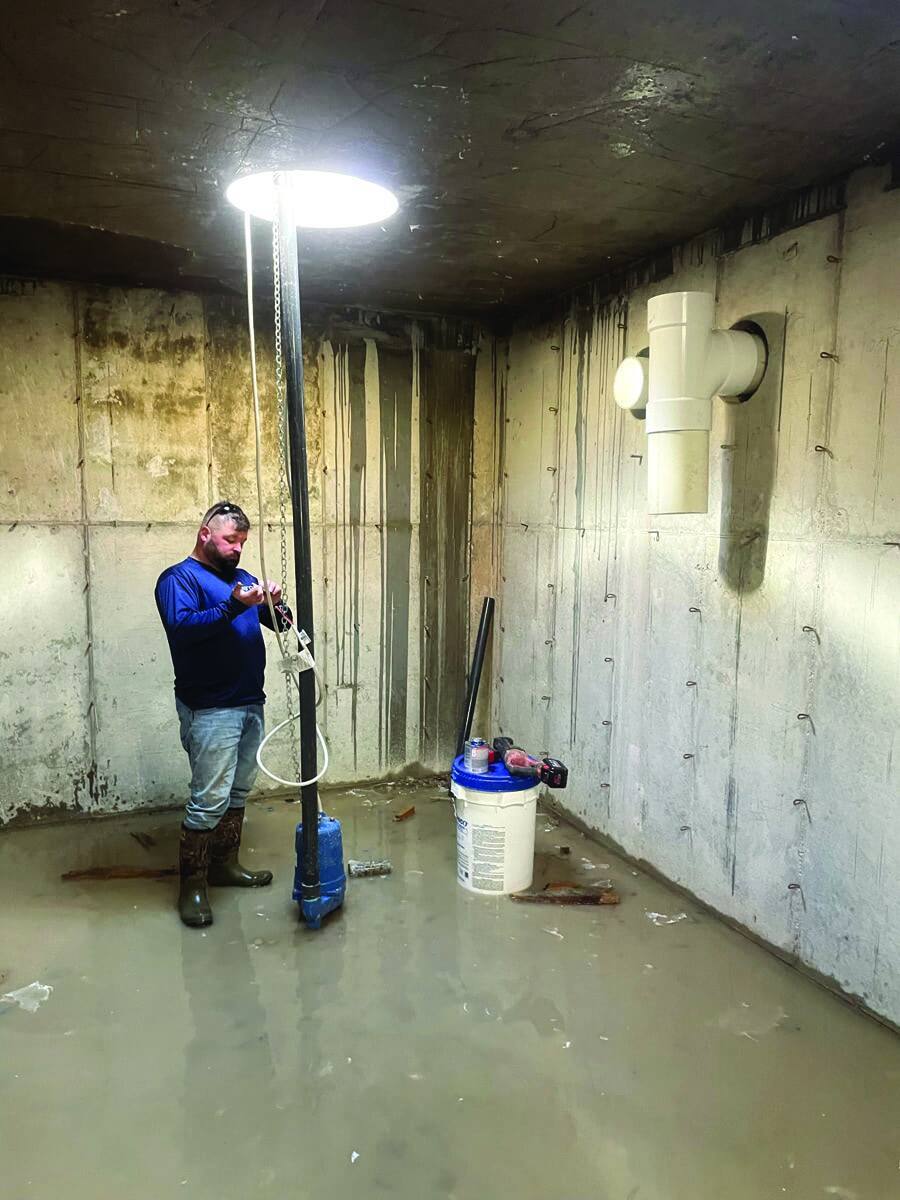
- 36-by-48-inch dry basin with 1 hp P63FZY-4417 permeate pump (Goulds)
- 36-by-84-inch basin with duplex 0.5 hp PF300511 discharge pumps (Orenco)
- MS2500 electromagnetic flowmeter and MV110 converter transmitter (Flomotion Systems)
- Two ultraviolet 80/2 LCD chambers (Lutz-JESCO American Corp.)
- Product-specific control panels
System operation
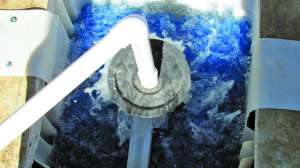
Wastewater flows from the school to the lift station, then alternating on-demand pumps send 30 gpm 800 feet through a 2-inch HDPE force main to the settling tank. From there, effluent gravity flows to the mixed anoxic tank and on-demand pumps send 18 gpm to the aerobic tank. Coarse bubble diffusers in the tank oxygenate the mixed liquor suspended solids and scour the surfaces of the submerged membranes. A pump draws water through the membranes, producing 99% contaminant-free permeate. The biomass remains in the tank.
Between 4,000 to 16,000 gpd of mixed liquor recirculates to the mixing tank, while 8,000 gallons of permeate flows to the pump station. Water is pumped through the flow meter, disinfected and flows 150 feet through a 1.5-inch PVC pipe to surface discharge under a NPDES permit.
Installation
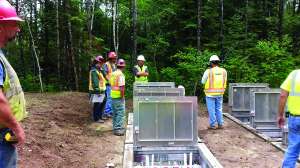
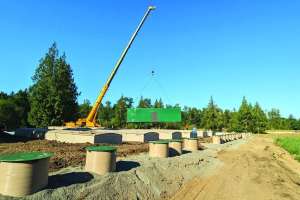
BioMicrobics specified that the settling, mixed anoxic and aeration tank compartments be part of a 32-by-22-foot-wide cast-in-place tank. Meints hired PMI to build it, with Richard Davis, field service manager, overseeing the work. When the excavator bucket hit the water table, the soil liquified, forcing the operator to grade back to the maximum slope. “We decided to raise the tank 12 inches so it sat on solid ground,” says Meints. “The elevation didn’t matter because we were pumping up to it.”
The site was far enough from the school not to attract children, but bus drivers noticed the activity and were worried. “They came over to check that we weren’t disrupting their bayou fishing hole,” says Meints.
It took a month to build the tank frames in sections, pour the walls and wait for the concrete to cure. Meanwhile, Randy Carter Construction and the Meinco team installed the force main. Philip Johnson, Meinco’s commercial installer and field operations manager, supervised installers Preston Johnson (no relation), Tommy Douthit, Tyler Cossey, Jimmy Lowery and his son, Triston Lowery.
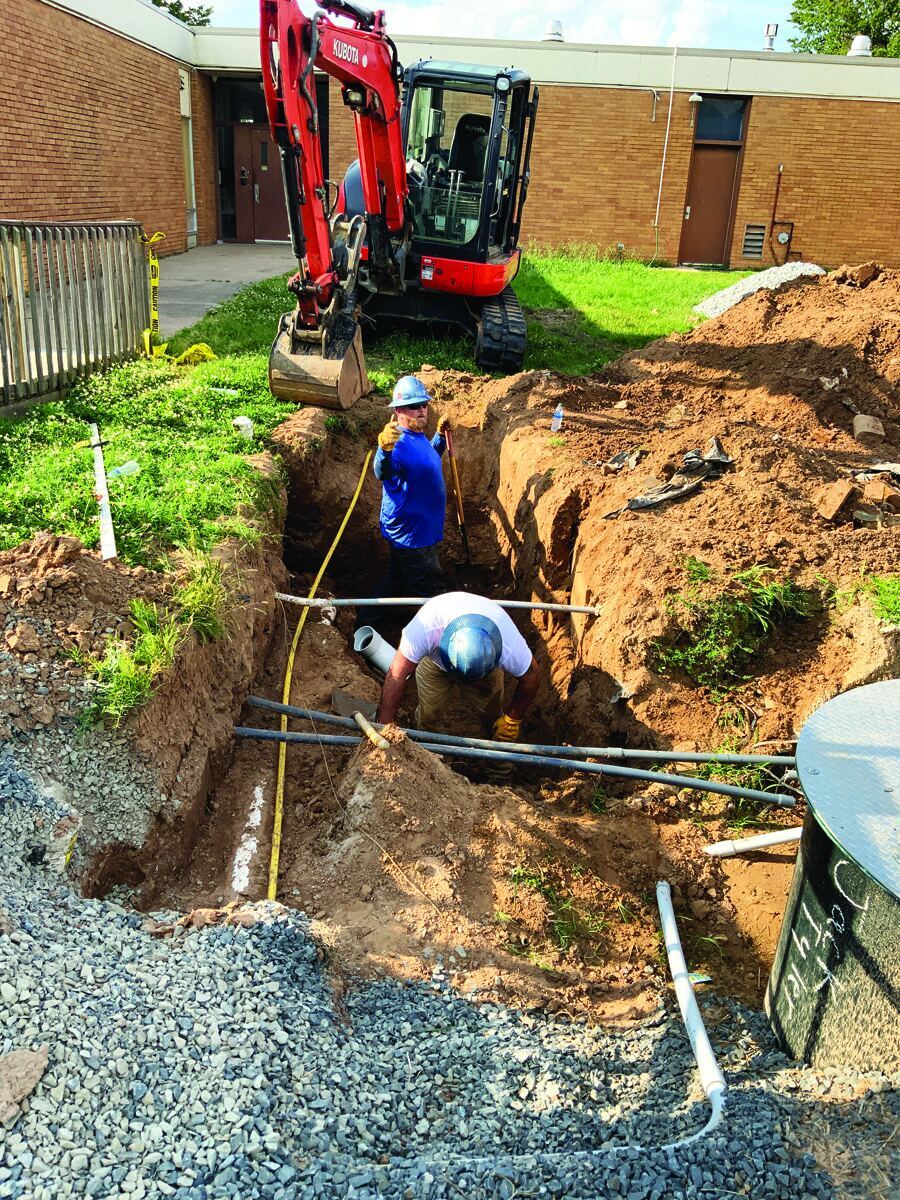
The area between the buildings was a maze of fiber optic, electric and gas lines. Preston Johnson used a Kubota KX057-4 compact excavator to pothole and locate the utilities before excavating the entrance pit and exit pit, one on either side of the driveway. Carter’s crew then pulled the force main through the campus, beneath the road, and to the treatment plant on the opposite side.
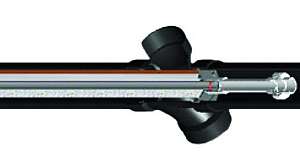
“The last 40 feet transitions to 4-inch Schedule 40 as it passes under the driveway to the settling tank,” says Meints. “We used the larger diameter to slow the flow a little and reduce turbulence in the tank. We also sleeved the section under the drive.” Including excavating the trench for the discharge line, the work took a week.
More to follow
Once PMI poured the tank lid, Meinco bedded around the tank with a 3-to-1 gravel slope. From then on, all their efforts went into plumbing the plant, but the lack of instructions made the installation intense. “This was a sensitive install because it was the first in the state and we were relying on our previous plumbing experience to figure it out,” says Meints.
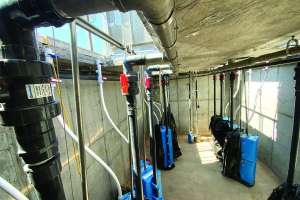
The crew took it one day at a time and met before and after work to ensure everyone was confident in what they were doing. They also focused on a user-friendly design, enabling service providers to open the hatches and easily reach the unions to remove the membrane subassemblies.
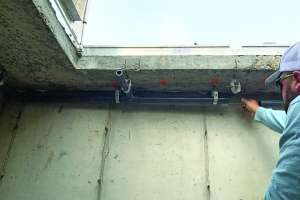
The men built scaffolding to reach the ceiling and insert hangers for the stainless steel piping. The custom aeration manifolds were field cut. “Philip took measurements, called them in to PVF Industrial Supply, and the next day we’d pick them up,” says Meints. The team spent weeks standing on platforms to install the piping. Underwater piping was PVC.
Days were spent cutting stainless steel pipes to length, cleaning and buffing the ends, then grinding the outside diameter for a press-fit into the tops of the modules. Next, they marked the pipes with the location of the predrilled hole in the units and scored the marks in both directions with a cutoff wheel to remove stock and prevent the drill bit from wandering. Finally, they cleaned the holes and fastened the parts with a bolt —24 times, two per module.
And still more
Because the blower pushed out 294 cubic feet per minute, Meints was concerned the exhaust might be malodorous. Mimicking the biofilter Fayetteville Wastewater Treatment Plant built from a grain silo, he filled two 30-inch risers with bags of double-hammered, finely ground oak mulch to trap the odor-laden moisture and purify the air.
The “stink stacks” were a first for Meinco. When Joe Rebori, BioMicrobics’ manager of inquiries and engineering, and Mahmoud Abourkis, vice president of operations, arrived from Kansas City and saw the biofilters, they told Meints to patent them. “Normally Joe and Mahmoud dedicate a week to assembling and starting up plants, but they left the day they came because my guys had done it correctly,” says Meints.
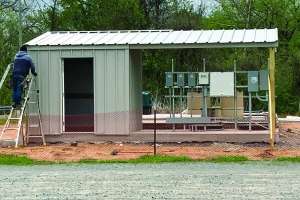
Meanwhile, Menzies poured the 10-by-9-foot-wide slab for the equipment shed. Davenport Construction built the room for the flowmeter and vertical UV chambers, and the overhanging roof above the control panels. Upton Electric brought in the power. “A chemical feed system to address pH and alkalinity is a future option, so we plumbed for it while we were there,” says Meints.
Because school was in session in late August 2023, Meinco installed the lift station on a weekend. Using a Caterpillar 320 excavator, Philip Johnson dug the hole for the 60-by-96-inch fiberglass-reinforced plastic basin with a 48-inch-square valve vault. The soil turned to soup again and the hole became so large that only the 320’s arm was long enough to set the basin.
“The system was designed for a second plant to treat the school’s expansion,” says Meints. “However, the average flow so far is 2,500 gpd, so the addition probably won’t be necessary.”
Maintenance
Meinco holds the maintenance contract and a technician visits the site twice a month. He samples the permeate and mixed liquor monthly and cleans the UV bulbs. Although the plant requires a Class II wastewater operator, maintenance is straightforward.