
Many people who launch businesses start with technical skills and figure out the human side of things as they go along.
Allied Waterproofing & Septic had both sides covered right from the beginning. Christopher Friedsam brought about 15 years’ experience in the sewer and drainage industries. Jennifer Mrdalj came with a strong background in human resources: recruiting, hiring, mentoring and training, only partly in a water-related business.
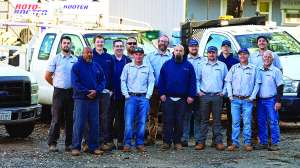
They came together in 2019 and today operate a company with 10 team members, doing about three dozen new and replacement residential and commercial onsite treatment systems per year. They work within a 50-mile radius from Manteno, Illinois, about 45 minutes south of Chicago.
Mrdalj is the sole owner, and the company is completing certification as a Women’s Business Enterprise, able to bid on federal, state and other projects that require participation from companies owned by women and minorities.
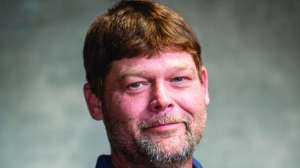
Friedsam serves as the chief operating officer and is a licensed private sewage installer in the state. He oversees field operations, leads system design and manages permit acquisition. Jennifer Mrdalj oversees office operations, focusing on marketing, accounting and, most critically, the recruitment, training and retention of team members.

Making the connection
Friedsam, a Plainfield, Illinois native, graduated from high school in 2006 and began his career waterproofing basements and installing drain tile. He entered the sewer field in 2008 and worked for a couple of companies doing line cleaning, jetting, repair and maintenance, gaining invaluable experience. Building on his expertise, he founded American Underground Specialist in 2019.
Mrdalj, a native of Chicago Heights, attended community college but before finishing took a corporate job in human resources. She worked for a few businesses over about 15 years, the last being a water and waste recycling company, where she developed training programs for multiple positions including vehicle drivers and utility operators.
The two met because Mrdalj’s brother owned a plumbing company and shared shop space with Friedsam. Mrdalj bought the waterproofing business in 2019, and Friedsam rebranded it to include onsite treatment.
It was a natural extension because Friedsam had dealt with septic systems, drain tile and stormwater drainage as part of his sewer service background. “Waterproofing is basically similar to septic systems, he observes. “Stone, pipes, pumps; they all correlate. The background was definitely there. We were looking to expand the business, solve more problems for customers, and generate more revenue.”
Today, onsite treatment represents about 75% of the business. “We still have the waterproofing side,” says Mrdalj, “but our septic side really took off after Christopher got his license in 2022.” The bulk of the onsite work is replacing systems that have aged out.

Building a team
Mrdalj’s background has been essential to the company’s growth. She takes a strategic approach to recruiting people and providing incentives for them to stay: “It’s having experience in how to recruit and interview, build systems and programs and get employees the right benefits, health insurance and paid time off.
“We try to find people who have a background working for other companies and doing septic installs. We use Indeed, ZipRecruiter, Facebook and LinkedIn. A lot of it is word of mouth.
“We try to be competitive with pay. We’ve done a market analysis of pay in our area. And if our people sell jobs in addition to the project they were assigned, we pay them a commission on top of what their hourly rate is.”
During interviews she stresses the advantages of working for a smaller company: “We have a family type of environment where their needs get heard. We have meetings regularly where they can discuss what their expectations are from us.
“They can see that we’re expanding and growing. A lot of times, with the company they work for, there’s nowhere on the ladder for them to move up. Their opportunities are capped. Here, we can separate into different divisions. Our goal is to open another office, maybe farther north, so there will be opportunities for advancement.” Team members are:
- Joseph Munoz-Macha, waterproofing foreman
- Jonathan Themer, septic foreman
- Michael Gue, waterproofing technician
- Dakota Knight and Issac Servin, septic technicians
- Gerardo Servin and Issac Noe, field technicians
- Lalo Ramirez, equipment operator
- David Valadez Torres, laborer
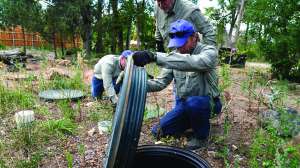
Resources are available for team members who want to learn new skills. Friedsam coaches them individually, walking them through the process of designing systems, creating drawings and securing permits. Septic foreman Themer accompanied Friedsam and Mrdalj to Norweco headquarters in Norwalk, Ohio, for daylong certification training.
The company’s vision and goals are posted around the office along with the core values of humility, commitment, respect, integrity, safety and communication. Team members are recognized for accomplishments, like completing a difficult installation or recognizing an issue in the field or office and taking appropriate action.
Milestones like birthdays and work anniversaries are celebrated with gifts. “We maintain open communication channels and foster a culture where feedback is important and all ideas are valued and welcome,” Mrdalj says.

Tough conditions
Work in the field has its own challenges. “The water tables here are really high, and on top of that the soils are very hard,” says Friedsam. “In some areas we’re lucky if we get a percolation rate of 0.25 gpd per square foot. Then there is a drastic change next to the river where the rates are over 0.75, so now we have to make very sure we keep adequate separation from the water table and bedrock.”
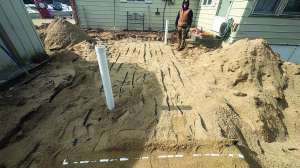
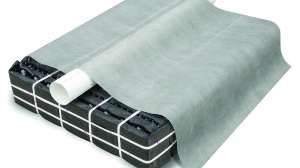
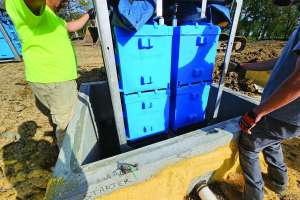
Some soils are rated Category E, the most difficult, and for conventional systems would require 740 square feet of drainfield per bedroom. Because of conditions like those, rock-and-pipe septic systems make up no more than 5% of the workload. Most installations involve a lift station and either an Advanced Enviro-Septic system from Infiltrator Water Technologies, or an aerobic treatment unit.
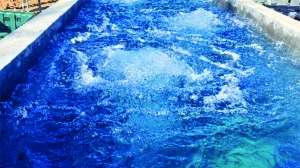
Allied Waterproofing is a distributor for Norweco and installs and maintains the company’s Singulair R3 and other residential units. Some ATUs discharge to surface water after UV disinfection (also Norweco) and therefore require NPDES permits.
“Sometimes there are tight spaces we have to fit into,” Friedsam says. “We did one system in Kankakee County where the front yard had only about 30 by 60 feet of working room. Luckily, the loading rate was 0.75, so the field didn’t have to be extremely large, but we still had to work with a good separation. So we added an ATU to be able to reduce the field size.”
The company chooses mostly IM Series plastic septic tanks (Infiltrator Water Technologies). Concrete tanks, when required, are supplied by Norwalk Tank Company. For lift stations, the company relies on Champion pumps. The control system of choice is the Norweco WASP (weatherproof advanced surge protection) panel.
For drainfields, most applications use low-profile chambers (Infiltrator). “Because we are so close to the surface, the low profile gives us those extra 4 inches of clearance,” Friedsam says. “Chambers are also nice because they give us 5 square feet per linear foot of trench as opposed to the standard 3, which is really helpful. The more capacity we can get into a small area, the better. We also use EZflow (Infiltrator) in sandy applications.”
For low-pressure pipe systems, such as mounds, Friedsam chooses SDR35 PVC pipe and NIBCO deep socket fittings. “We install risers to grade or within 6 inches for tanks, and above grade for ease of access to lift stations and ATUs,” Friedsam notes. Laser levels (Leica and Spectra) help ensure that system elevations are correct.

Well equipped
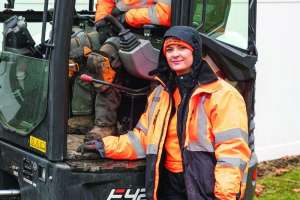
For machinery, the company relies mostly on a 2023 Bobcat MT100 mini track loader and a 2023 Bobcat E42 T4 mini-excavator. The crew will rent others, especially larger equipment, when needed for specific jobs.
Competition can be tough. Although there are only two other licensed installers in Kankakee County, Allied’s home base, neighboring Will County has several more. Fortunately, the good name Friedsam had acquired carried over to the rebranded business: “We had a strong reputation for doing quality work and going above and beyond for customers, and we built off of that.”
One solid source of business leads is strategic partnerships with septic tank pumping companies that do not install systems. Mrdalj observes, “We get many calls for pumping. There’s a large pumping company in our area that services pretty far out, and we’ve given many of our calls to them.”
In return, when the pumper’s people encounter issues like a broken septic tank or an inlet or outlet that needs replacing, they refer the repairs to Allied. Sometimes those referrals lead to full drainfield replacements.

Office efficiency
To keep the business on an even keel, Allied uses Housecall Pro customer relationship management software. “We have our phones linked through it,” says Mrdalj. “It’s how we take payments; it’s how we send out all our reviews when a job is done. It’s for everything related to a job.” Friedsam uses NewSeptic land planning software to design systems and create drawings to submit with permit applications.
Mrdalj observes, “There is always something new coming out, and we need to stay current with industry trends. We’re researching different products to use that could be easier to install, better price-wise and better in general for our customers. That research includes watching videos, reading magazines, and attending industry events such as the WWETT Show.”
The synergy of technical knowledge, continuous learning and effective management bodes well for future success and growth.
Continue reading for free