Across the country, septage haulers are facing increasing pressure from municipalities that are tightening or outright denying acceptance of septage at publicly owned treatment works. What was once a routine disposal option has become a regulatory, operational and financial challenge. In response, more haulers are exploring the development of their own septage pretreatment facilities — not merely as a technical solution, but as a long-term business strategy.
Developing a pretreatment facility allows haulers to regain control over disposal, stabilize costs and ensure regulatory compliance in an increasingly restrictive environment.
Why Septage Pretreatment Is Necessary
Septage is one of the most concentrated waste streams encountered in the wastewater industry. Levels of organic strength (biochemical oxygen demand), total suspended solids, nutrients and oil and grease often exceed municipal sewer limits by orders of magnitude. Most sewer ordinances are written to protect downstream treatment infrastructure, meaning untreated septage is either heavily surcharged or prohibited entirely.
Pretreatment bridges this gap. By reducing pollutant concentrations before discharge, a hauler can meet sewer limits, lower surcharges and avoid the uncertainty that comes with changing municipal policies. For many operators, owning a pretreatment facility represents long-term cost stability and operational independence.
The Core Challenge: Mixed Waste
At its most basic level, septage pretreatment exists to solve one fundamental problem: Septage is a mixed waste. It arrives as a combination of liquids and solids, and landfills are not permitted to accept that mixture. Separation is mandatory.
Effective pretreatment focuses on separating, conditioning and managing each waste stream independently. Liquids are treated to meet sewer discharge requirements, while solids are processed into a form suitable for landfill disposal, land application or some beneficial reuse.
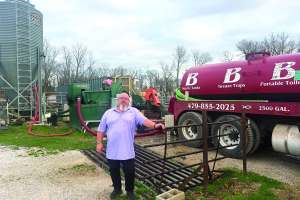
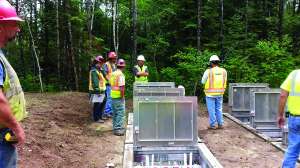
What a Typical Pretreatment Facility Looks Like
While every facility is site-specific, most septage pretreatment systems follow a similar process flow:
- Receiving and Input: Trucks unload into a controlled receiving area equipped with screening, grit removal and flow measurement.
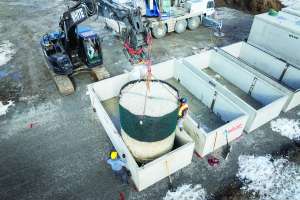
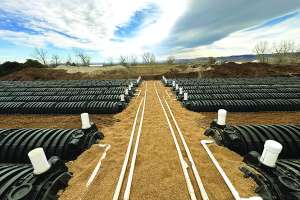
- Storage and Equalization: Tanks or lagoons buffer variable flows and pollutant loads, creating more stable downstream operation.
- Conditioning: Polymers are added to improve solids separation.
- Dewatering: Mechanical processes concentrate solids and reduce volume.
- Outputs:
- Liquid effluent discharged to a POTW under permit, some facilities discharge effluent to spray irrigation fields or in-ground soil treatment areas.
- Dewatered solids sent to landfill, land application or other stabilization process
This process transforms an unmanageable mixed waste into two regulated, predictable streams.
Operational Realities: Grit, Storage and Records
Operational experience has shown that grit is one of the most damaging and underestimated components of septage. Removing grit early reduces wear on pumps, pipes and dewatering equipment. A common rule of thumb is that every 50,000 gallons of septage contains roughly 1 cubic yard of grit and 1 cubic yard of screenings. A cubic yard of either weighs slightly less than one ton.
Storage/equalization is equally important. Larger tank volumes smooth out peaks in flow and pollutant loading, improving performance and reducing operator stress. At the end of the day, the blend is very homogenous allowing for consistent processing.
Modern facilities also rely heavily on electronic waste acceptance and recordkeeping systems, which support regulatory compliance and simplify reporting to state and local regulatory authorities.
Conditioning and Dewatering
Polymers play a central role in pretreatment. They allow small particles to bind into larger flocs with a characteristic “cottage cheese” appearance. Proper polymer selection, activation and gentle mixing are critical; poor handling can destroy floc structure and reduce dewatering efficiency.
With effective conditioning and dewatering, most facilities achieve solids concentrations of 25%-30%. The final disposal method for the solids dictates the type of dewatering equipment a facility may choose to install.
Treatment Levels and Disposal Options
The amount of further treatment the solids need depends on regulations, resources and end use:
- Septage: No beneficial reuse without further treatment (which may be as simple as the addition of lime)
- Class B biosolids: Land application allowed, pathogens detectable
- Class A biosolids: Public use allowed, no detectable pathogens
Higher treatment levels such as composting or gasification require additional investment, but may open more reuse and revenue producing options.
Understanding the Regulatory Reality
It is important to recognize that a septage pretreatment facility is not a full wastewater treatment plant. Its purpose is to treat septage so it can be economically and legally further treated using a POTW. Municipalities have economies of scale that make final treatment cheaper on a per-gallon basis than the pretreatment facility can do on its own.
Discharge fees, surcharges for pollutant exceedances and capital reimbursement fees (essentially the facilities share of the wastewater treatment facility, collection system and pump stations) must be factored into any feasibility analysis. The municipality will have a sewer use ordinance that defines these costs. You must get to know the sewer use ordinance before you get too deep into a feasibility study.
Odor Control: A Nonnegotiable Requirement
Odor is often the most visible risk to community acceptance. Hydrogen sulfide, ammonia and organics are things that can quickly create complaints if not managed properly. Successful facilities incorporate odor control from day one, using solutions such as activated carbon, wet scrubbers or biofilters which range from simple to highly engineered systems.
A Strategic Business Decision
Ultimately, owning a septage pretreatment facility is a strategic decision that balances regulatory compliance, operational complexity, odor management and economics. Facilities that succeed are those designed with early solids separation, adequate storage, reliable odor control and a clear understanding of local permitting and sewer requirements.
For septage haulers navigating tightening disposal options, pretreatment is no longer just an alternative — it is increasingly a competitive necessity.
Continue reading for free